


In March 2024, Ben White signed a new Arsenal contract, taking his estimated wage from roughly £120,000 a week to about £150,000.
A raise of around 25%.
It turns out White had hired the same data consultancy that famously helped Kevin De Bruyne prepare his Manchester City contract negotiation.
But White presented them with a very different problem.
De Bruyne could walk into a negotiation as one of the best players in world football.
White could not.
His performance numbers were good. Sometimes very good. But they did not scream best defender in Europe. So his analysts could not simply produce fifty pages of rankings showing that Arsenal were underpaying a superstar.
They needed to find something else.
And according to the Harvard Business School case study and ESPN’s account of the negotiation, they found it in something most football analysis treats almost as an afterthought:
Ben White was always available.
The challenge was turning that from a nice characteristic into something Arsenal should actually pay for.
So I tried to reconstruct the main analyses.
Everything below uses information available around the time of the negotiation. It goes without saying that I do not have the actual report, so this is a reconstruction of the logic rather than their exact numbers.
The result comes down to four analytical tools.
Before getting into the tools, it is worth understanding what made White’s negotiation interesting.
Why Ben White needed a different kind of argument
Most football statistics are measured per 90 minutes.
That makes sense if you want to answer:
How good is this player when he is on the pitch?
But Arsenal were not buying ninety minutes. They were committing tens of millions of pounds to a player over several years.
And for that decision there is another question:
How often is he actually available to produce those ninety minutes?
That distinction matters.
An exceptional player who is available for half the season does not necessarily deliver more value than a very good player who plays virtually every week.
White’s advisers appear to have built much of their case around that gap.
So the first tool was to measure it.
Tool #1: Measure the thing per-90 stats miss
How valuable is being there every week?
Start with the simplest evidence. Before signing his new contract, White had been extraordinarily available.
At Brighton in 2020/21, he played 91% of the club’s Premier League minutes.
At Arsenal: 84% in 2021/22, 91% in 2022/23 and roughly 86% of the available league minutes by the February 2024 cut-off used here.
Across his first 100 Premier League matches available to Arsenal, he appeared in 93. Transfermarkt records only 31 injury days across the preceding three and a half seasons.
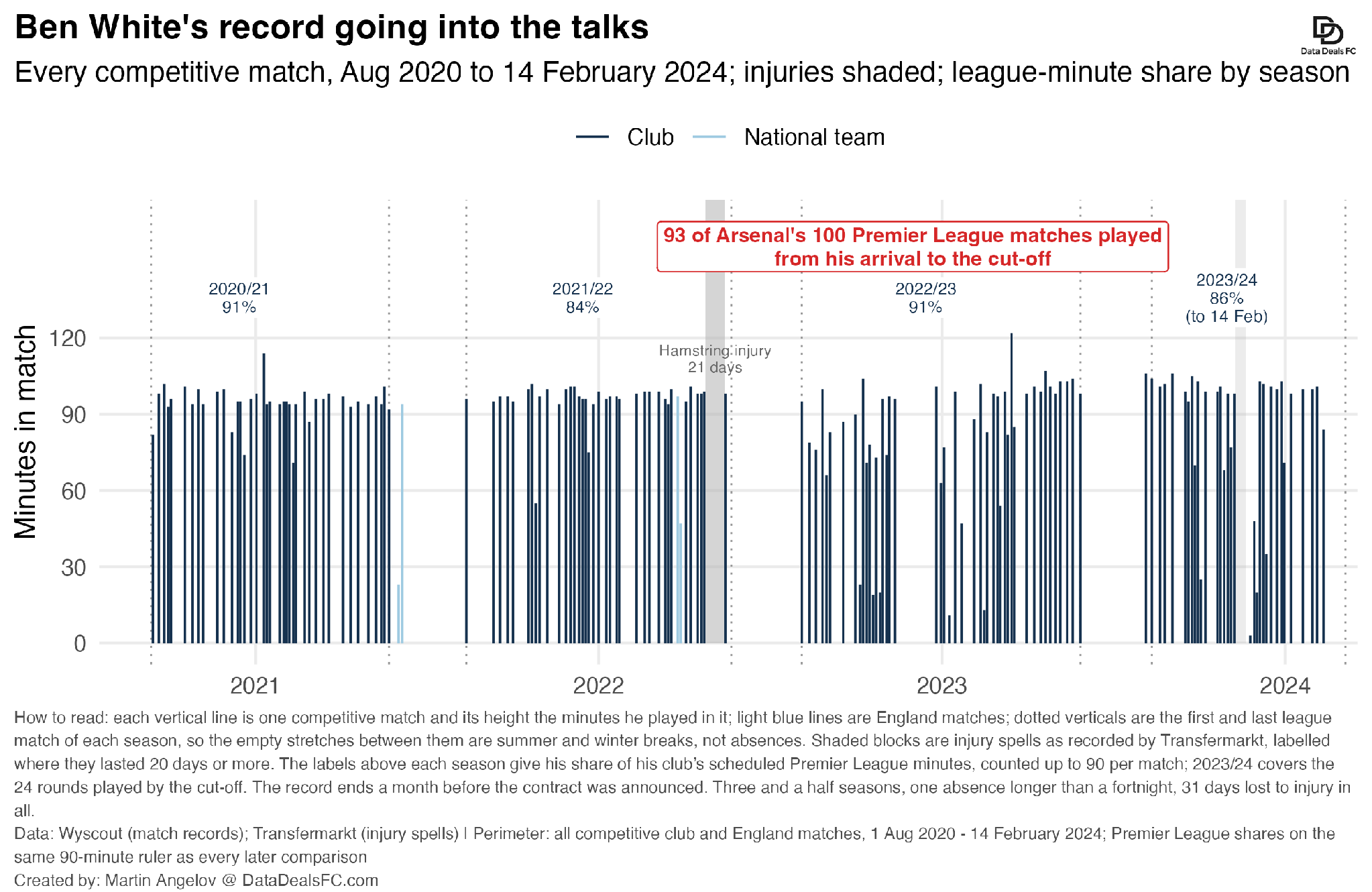
That is a nice record. But Arsenal already knew Ben White rarely missed games.
The useful analytical question is:
How unusual was it?
So I compared him with every outfield player who spent all three complete seasons from 2020/21 through 2022/23 in the Premier League. That leaves 228 players.
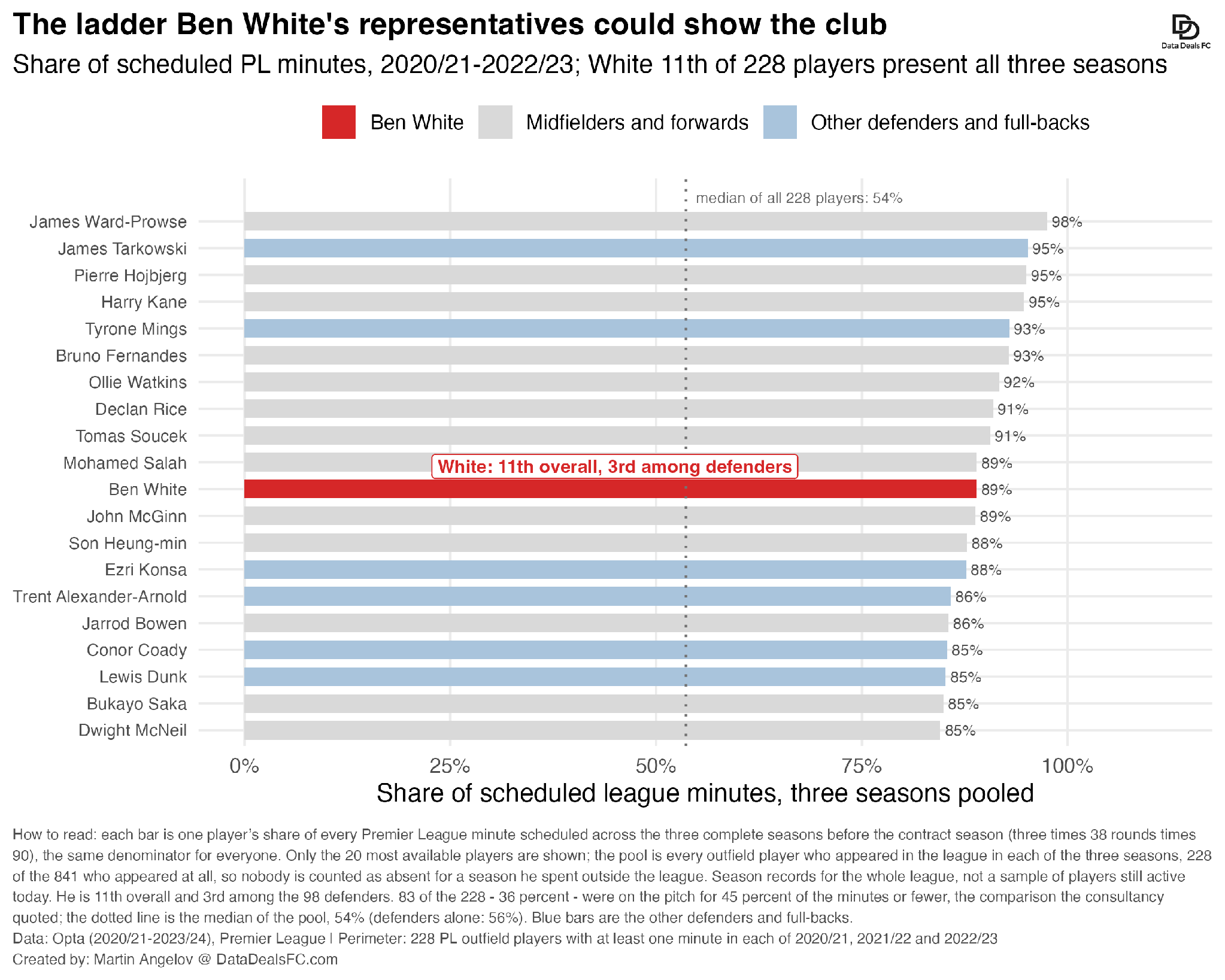
White ranks 11th of 228. Among defenders, he ranks 3rd of 98. Only James Tarkowski and Tyrone Mings spent more of those three seasons on the pitch.
Suddenly ‘Ben White is reliable’ becomes something more useful:
Very few Premier League defenders were as consistently available as Ben White.
But the interesting part comes when we combine that with performance.
Good every week can beat great half the time
The HBS case describes White’s individual match statistics as solid rather than exceptional. My reconstruction reaches roughly the same conclusion.
Across ten role-adjusted full-back metrics, White sits around the 67th percentile during his Arsenal right-back seasons. Good. Not elite.
And that is important because the exercise should not manufacture an elite player where there isn’t one.
Instead, put two things on the same chart: quality per match and percentage of minutes played.
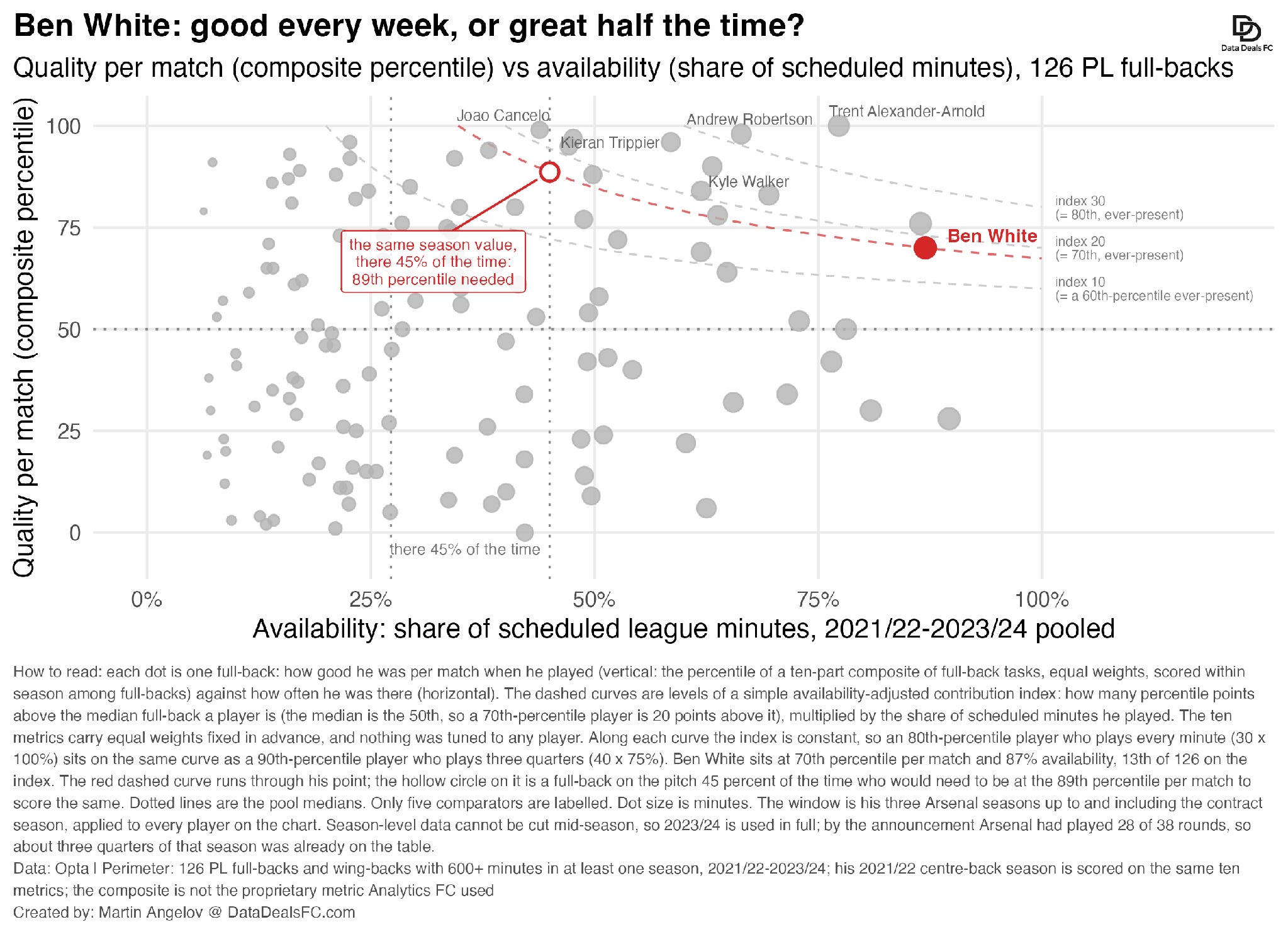
White is not at the very top vertically. He is almost all the way to the right.
Once I multiply his performance advantage over the median full-back by the share of minutes he actually played, White moves from roughly the 70th percentile per match to 13th of 126 full-backs in season-long contribution on this measure.
Put differently:
About seven in ten full-backs were worse per match. But roughly nine in ten delivered less total contribution over the season.
The comparison becomes even clearer if you turn the question around.
A full-back available for only 45% of the minutes would need to perform around the 89th percentile per match to deliver approximately the same season-long score.
That is the negotiation argument. White did not need to be one of the best full-backs in Europe every time he stepped onto the pitch.
He was very good. And he stepped onto the pitch almost every week.
What this gave White: a way to turn reliability from a compliment into measurable season-long value.
Tool #2: De-risk the long contract
What happens when a 26-year-old full-back gets older?
Arsenal were not negotiating for the Ben White of March 2024. They were also negotiating for the Ben White of 2025, 2026, 2027 and potentially beyond.
That creates another problem.
Full-back is a physically demanding position. Pace, repeated carries and attacking involvement can become harder to sustain as players move into their thirties.
White’s report apparently addressed that directly.
According to ESPN, Analytics FC modelled the ageing curve of full-backs and considered what might happen if White eventually moved inside to centre-back. That mattered because White had already played there.
The argument was not:
Ben White will become an elite centre-back at 30.
It was more subtle.
Are the skills Arsenal are paying for the ones most likely to survive ageing?
I tried to test that.
For full-backs and centre-backs, I followed players from season to season and measured how different skill groups changed after age 26.
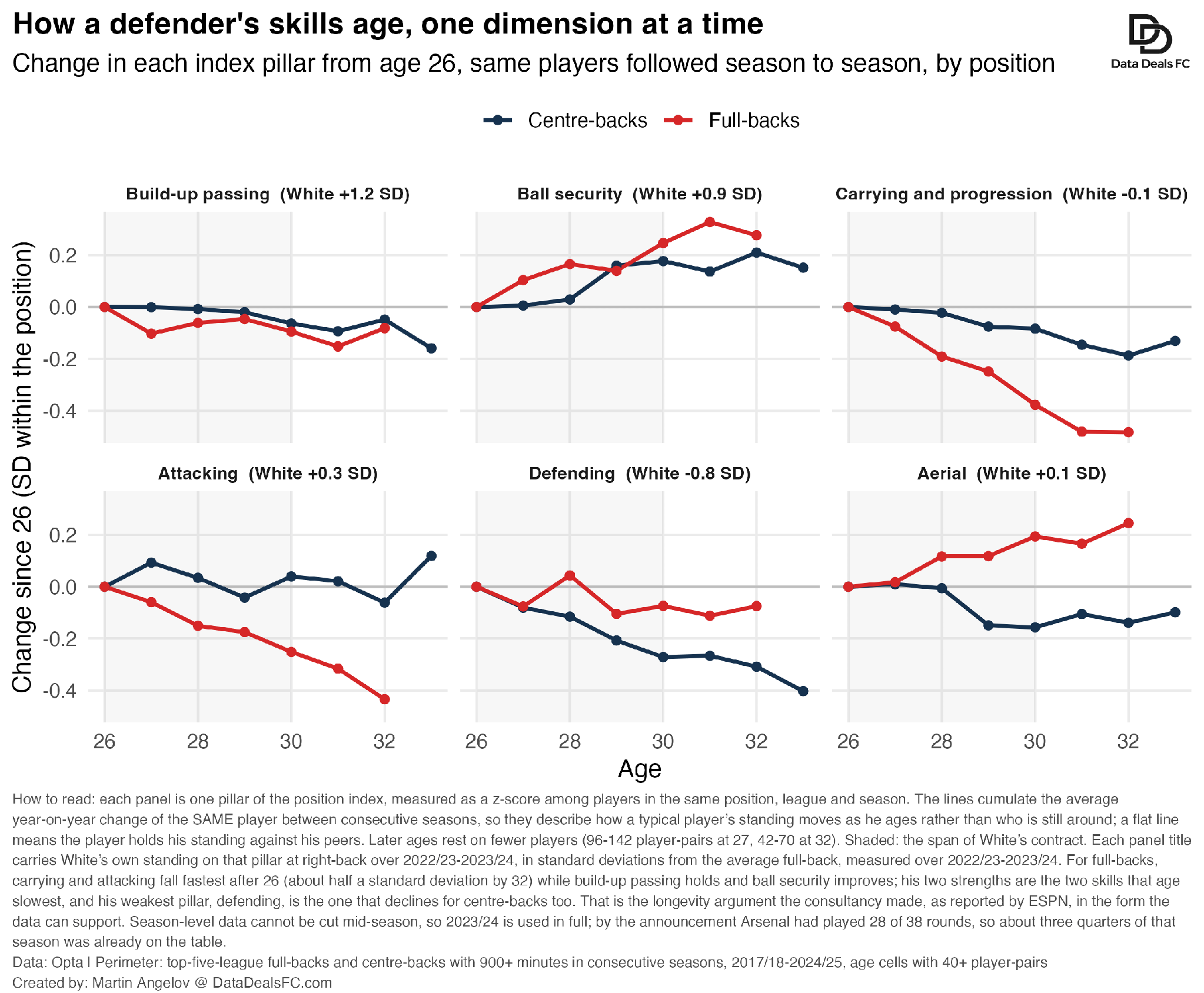
The pattern is useful.
Carrying, progression and attacking contribution tend to decline more sharply.
Build-up passing is much flatter.
Ball security actually improves in this sample.
Now compare that with White.
Across his Arsenal right-back seasons, his build-up passing was about 1.2 standard deviations above the average Premier League full-back.
His ball security was roughly 0.9 above average.
Those were two of his strongest attributes. And they were also two of the skills that held up best with age in the sample.
His defending score was weaker, and moving inside would not magically fix that. So the argument should not be pushed further than the evidence allows.
But the basic point survives:
White’s value was concentrated in skills that looked relatively durable, while his ability to play centre-back created another possible use for him later in the contract.
That changes the risk of a long deal.
Arsenal were not simply buying four more years of the exact same right-back. They were buying a player whose strongest skills had plausible routes to remain useful as his physical profile changed.
What this gave White: evidence that the contract did not necessarily expire when his peak full-back years did.
Tool #3: Make the outside options credible
Who else could actually use Ben White?
A player negotiating with his current club needs another thing:
Alternatives.
Not necessarily a transfer offer sitting on the table. But enough evidence that walking away is plausible.
According to ESPN, Analytics FC simulated White in the starting elevens of five clubs: Manchester City, Barcelona, Milan, Bayern Munich and Marseille. The real analysis used Analytics FC’s proprietary Goal Difference Added model, which I cannot reproduce.
But one part of the exercise can be tested:
Would White actually fit how those teams played?
For every club in Europe’s five big leagues, I built a fifteen-metric profile of what its full-backs were asked to do: passing, progression, crossing, box involvement and defending.
Then I compared each club’s profile with White’s Arsenal right-back profile. The closer the profiles, the smaller the distance.
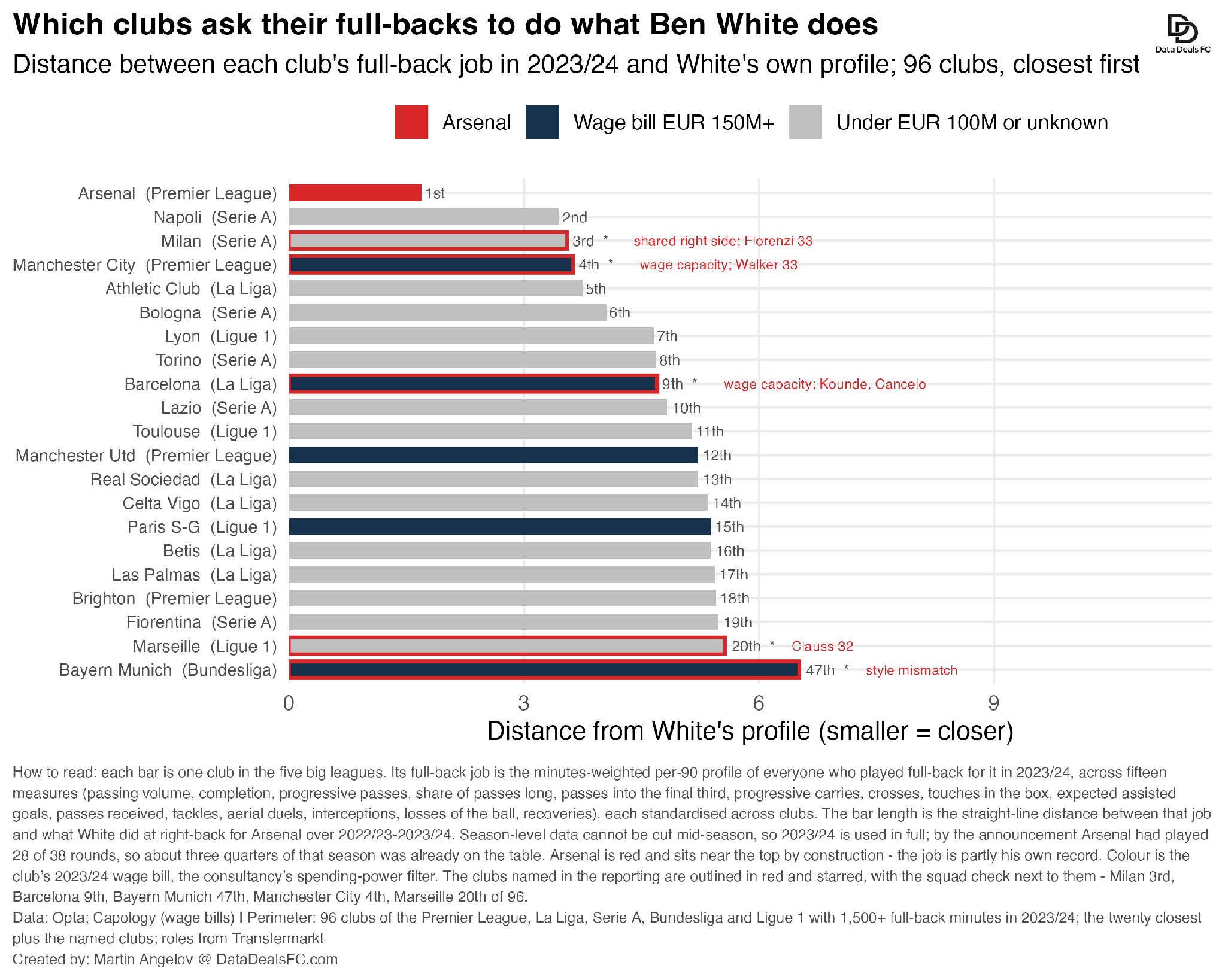
Arsenal come first — unsurprisingly, because White helped create Arsenal’s own profile.
But after that:
Milan rank 3rd;
Manchester City 4th;
Barcelona 9th;
Marseille 20th.
Among the clubs with wage bills above €150M, City and Barcelona are the two closest stylistic matches to White in Europe.
Then add squad composition.
At City, Kyle Walker was 33.
At Milan, the right side was shared between Davide Calabria and Alessandro Florenzi, who was also 33.
At Bayern, nobody completely owned the position.
At Marseille, Jonathan Clauss was 32.
None of this proves those clubs were preparing bids. That is not the point. The negotiation does not require White’s agent to say:
Manchester City are signing him tomorrow.
It allows him to say something more credible:
There are rich Champions League-level clubs whose playing style suits him and whose squad structure gives the move some logic.
That is very different from the generic agent line: ‘we have other options.’
What this gave White: evidence that Arsenal were not the only plausible high-level buyer for his particular skill set.
Tool #4: Put a price on reliability
Does football actually pay more for players who stay fit?
This is where the analysis becomes especially interesting.
So far we have shown that White was unusually available. But reliability only matters in a wage negotiation if clubs actually pay for it.
The real report benchmarked White’s salary against elite defenders across Europe. On public estimates, his new £150,000-a-week salary put him among the highest-paid full-backs in the Premier League.
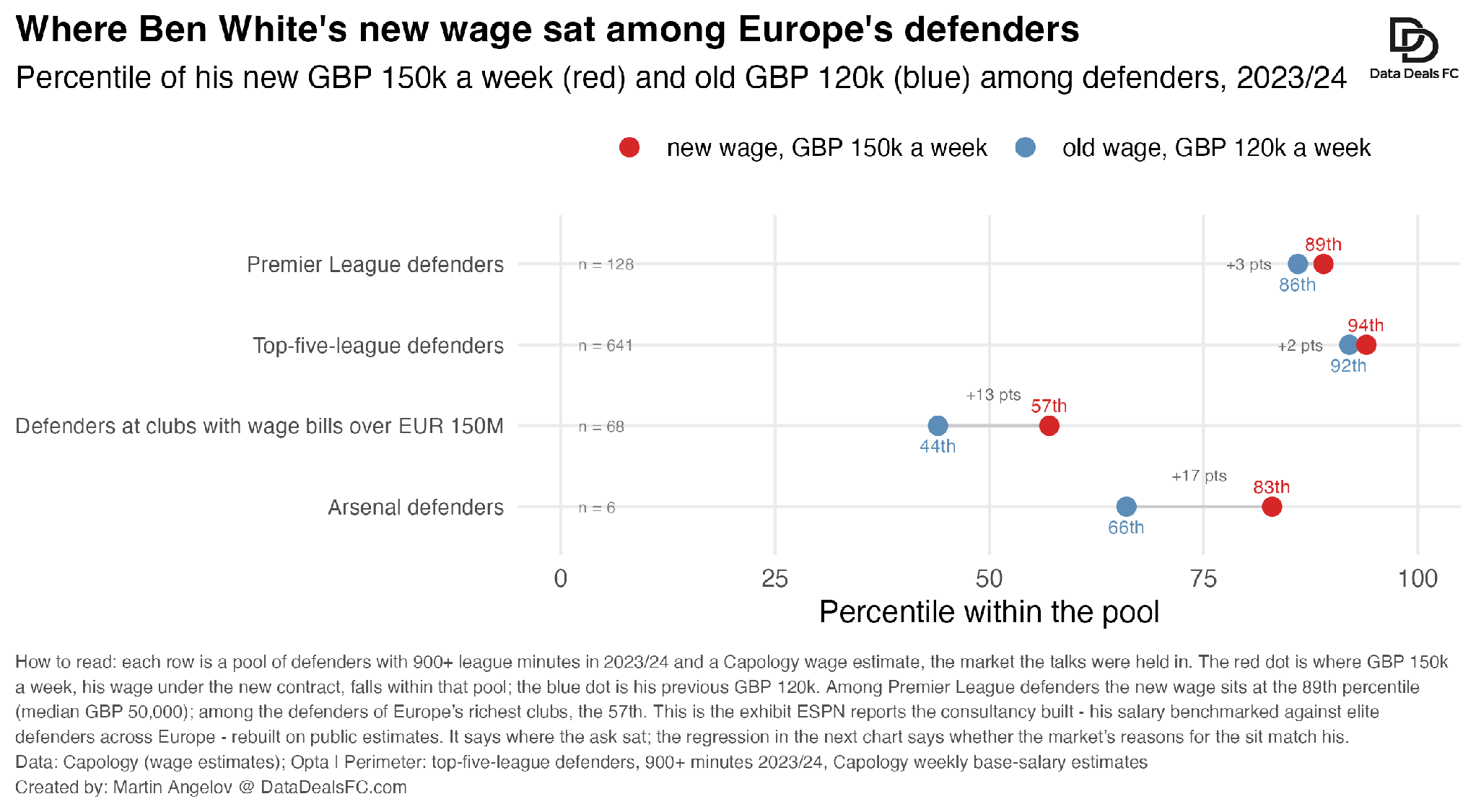
The problem is that his per-match performance does not obviously explain that wage. My pooled performance index places White 25th of 63 Premier League full-backs. At approximately his performance level, the typical wage is closer to £80,000 per week.
So why £150,000?
One possibility is exactly what his advisers were selling:
Availability.
To test that, I used 5,815 player-seasons from Europe’s five major leagues.
First I estimated wages using the things we already know matter: performance, age, position, league, club spending power and season.
But I deliberately left availability out.
The model therefore tells us approximately what each player should earn before knowing how consistently they play.
Then I ask a simple question:
Do players with better availability systematically earn more than that benchmark?
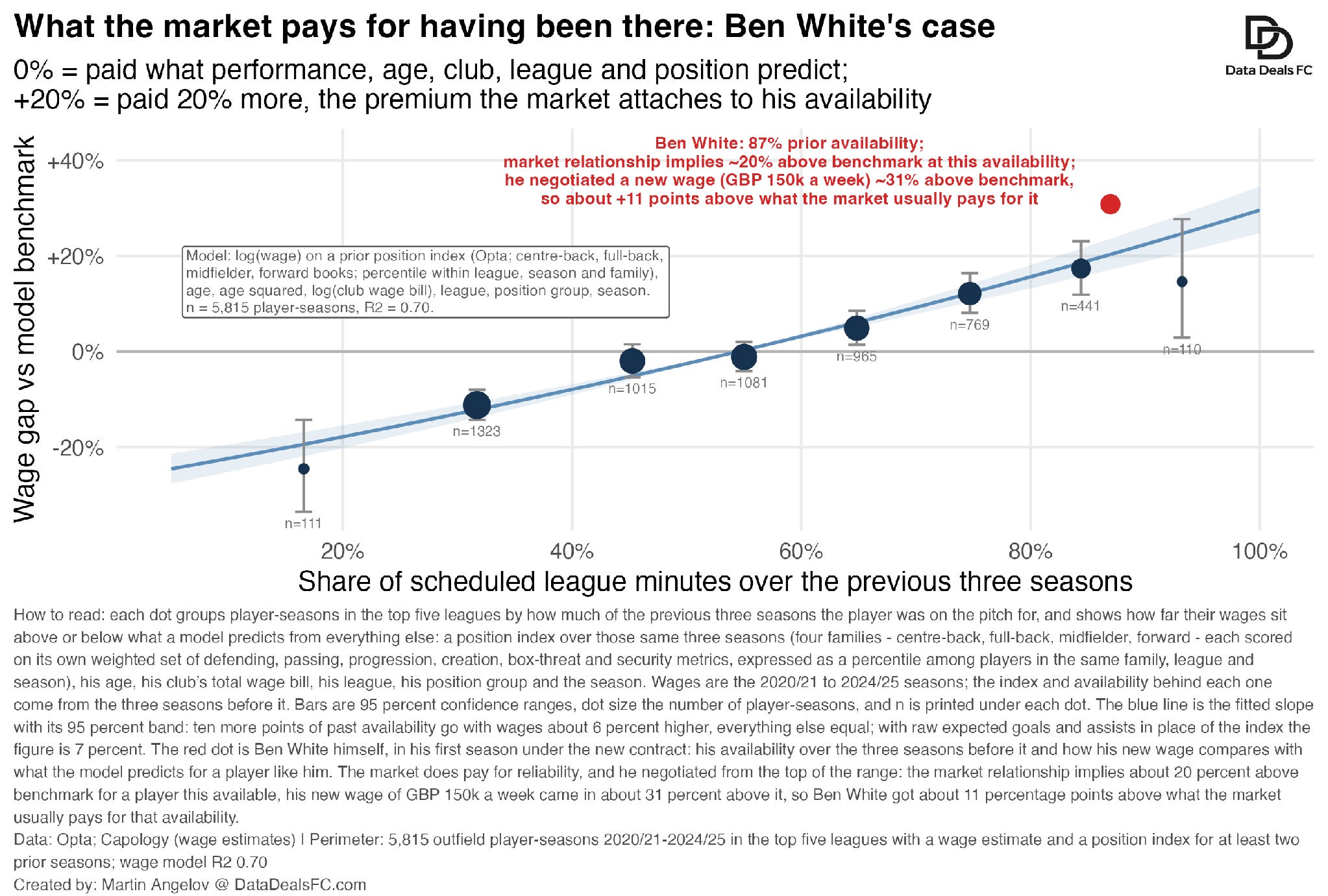
They do.
Players available for less than 20% of league minutes over the preceding three seasons earned roughly 25% less than the model otherwise predicted.
Players in the 80–90% range earned around 17% more.
Across the full model, another 10 percentage points of past availability — approximately four league matches per season sustained over three years — is associated with about a 6% increase in wages, all else equal.
For comparison, another ten percentile points of performance are worth roughly the same.
That is a striking result.
In this sample, moving from 70% to 80% availability is associated with roughly as much pay as becoming ten percentile points better at football.
Now place White into the model.
Based on his age, performance, league, Arsenal’s wage bill and the other controls — but not his availability — the model predicts roughly £6M per year.
His new estimated contract pays around £7.8M.
About 30% more.
Players with White’s availability profile typically carry a premium of around 20% in the same analysis.
So approximately two-thirds of the premium the model cannot explain before availability is added is consistent with something the wider football labour market already pays for: being there.
This is not proof that availability caused Arsenal to give White his raise. Contract negotiations do not work like laboratory experiments.
But it tells us something useful.
His advisers were not trying to persuade Arsenal to pay for an imaginary asset. Across thousands of player-seasons, the market already appeared to value it.
What this gave White: a financial benchmark showing that reliability was not just useful on the pitch — football clubs already attached money to it.
The negotiation pack, assembled
Put the four tools together and White’s case becomes much simpler.
Availability: White was among the most consistently available defenders in the Premier League.
Season-long value: his per-match performance was good rather than elite, but combining quality with playing time pushed his contribution toward the top of the market.
Long-term risk: some of his strongest skills were relatively durable with age, while his centre-back experience created another possible pathway later in the contract.
Outside options and price: several wealthy European clubs were credible stylistic destinations, and the wider labour market appeared to pay a meaningful premium for exactly the reliability White offered.
That is much more persuasive than trying to prove Ben White was secretly the best right-back in Europe.
Because he wasn’t.
And that is what makes the case interesting.
The data scientists did not change the facts. They changed which facts the negotiation was organised around.
Instead of: ‘Ben White’s per-90 numbers are better than Player X,’ the case becomes:
Ben White is very good, almost always available, difficult to replace over an entire season, useful in multiple roles, compatible with other elite clubs and possesses an attribute the market demonstrably pays for.
That is a much stronger argument.
In March 2024, Arsenal agreed a new long-term deal reportedly taking his estimated salary from around £120,000 to £150,000 a week.
Roughly a 25% increase.
Then the asset Arsenal paid for disappeared
And this is where the story gets an unfortunate twist.
Six months after the extension, White developed a knee problem.
Two months later came surgery.
He played only 36% of Arsenal’s league minutes in 2024/25. The following season: 21%.
Since the contract was announced, his recorded injury absence reached 154 days — roughly five times the total from the preceding three and a half seasons.
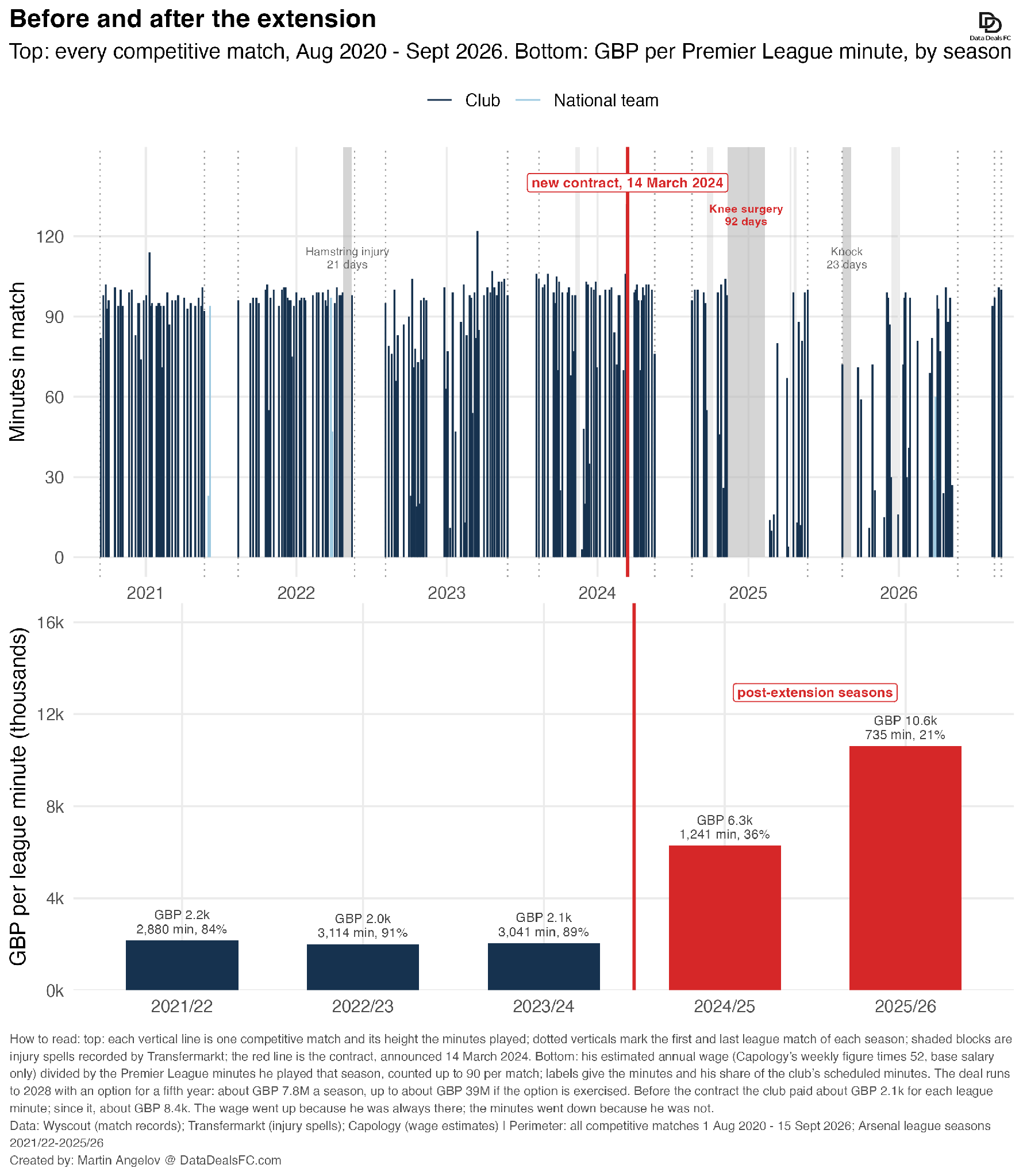
At an estimated £150,000 a week, Arsenal were now paying far more for every Premier League minute White actually played.
Before the extension, roughly £2,100 per league minute.
2024/25: approximately £6,300.
2025/26: approximately £10,600.
The economics flipped.
But that does not automatically mean Arsenal made a bad decision. That would be hindsight.
So I looked at players aged 26–28 who had played at least 85% of their club’s minutes in two consecutive seasons and asked what happened next.
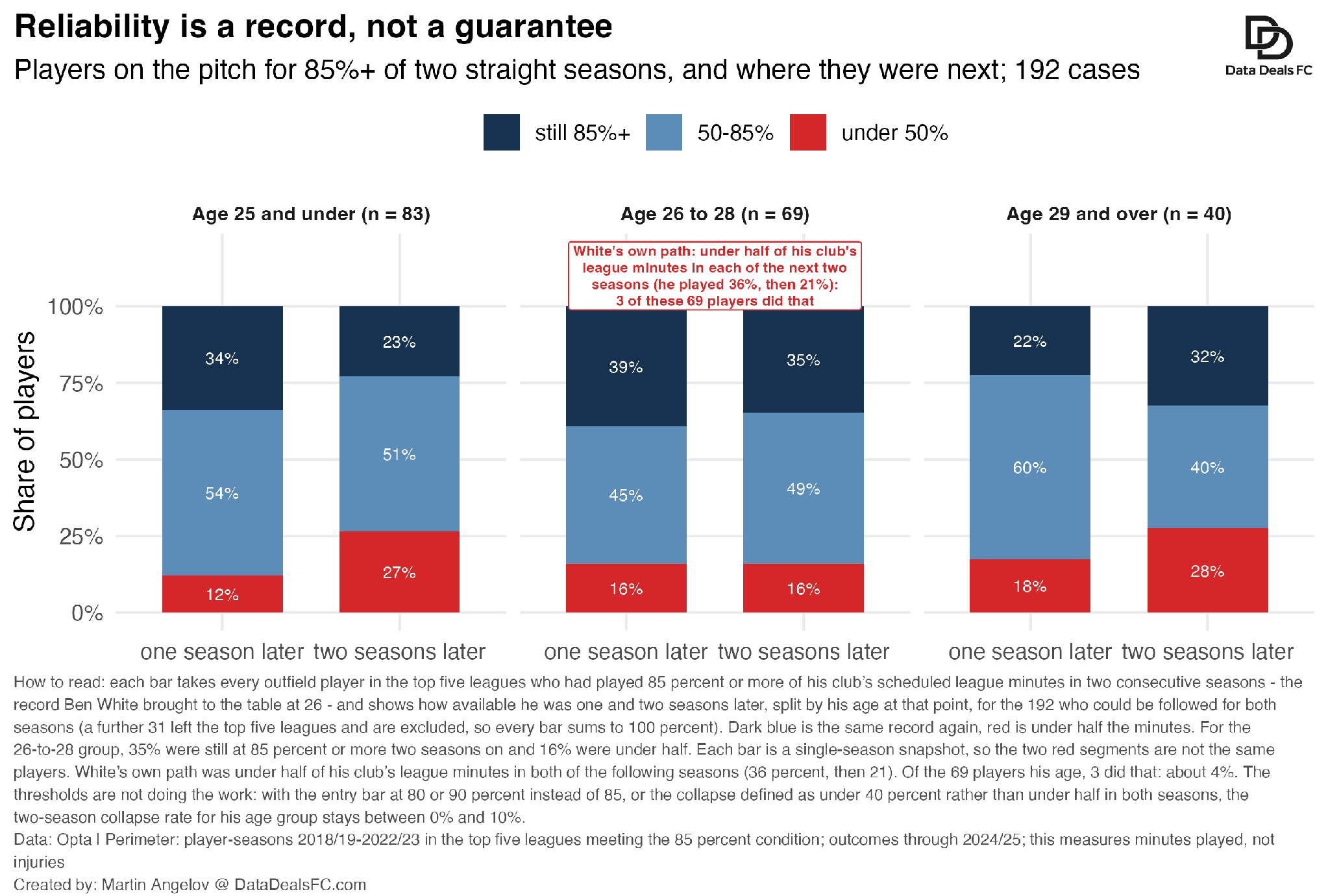
Two seasons later:
35% remained above 85%;
49% landed between 50% and 85%;
16% fell below 50%.
Only about 4% followed White’s particular path of falling below half the available minutes in both subsequent seasons.
That is a better way to frame the outcome.
Arsenal bought an unusually strong availability record. They then received an unusually poor availability outcome.
Analytics could quantify that risk. It could not make it disappear.
The part I would steal from this case
De Bruyne’s negotiation was about proving just how expensive an elite player was to replace.
Ben White’s was subtler.
His advisers took something that usually sits in the background of football analysis — availability — and made it the centre of the commercial argument.
First they showed it was unusual.
Then they showed how it changed season-long contribution.
Then they connected it to longevity, alternatives and ultimately wages.
That is the useful lesson. You do not necessarily win a negotiation by finding a metric on which you rank first. Sometimes you win by identifying the thing the standard comparison leaves out.
And there is one final implication I find interesting. If availability is part of what both sides are pricing, the obvious contract-design response is to make some compensation contingent on it.
A strong guaranteed wage plus minutes-linked bonuses would allow the player to monetise his unusually good historical record while protecting the club against precisely the tail outcome Arsenal eventually experienced.
The data does not eliminate risk.
The contract decides who carries it.
Boom — that was my reconstruction of how Ben White used data scientists during his Arsenal contract negotiation.
Unlike Kevin De Bruyne, White did not need an argument that he was one of the best players in world football.
He needed an argument for why good almost every week could be worth more than great some of the time.
And that is what makes this case so useful.
Thank you for reading until the end ❤️
I hope you enjoyed this one as much as I enjoyed putting it together.
See you next week,
Martin
PS. If you liked this piece chances are you’ll also enjoy how Kevin De Bruyne himself used data scientists to secure a 30% increase at 29, or how Man City used a magical data science technique to find his replacement or what Bruno Fernandes’ data science team likely argued in his ongoing negotiations with United.