


Kevin De Bruyne famously used a team of data scientists to help him negotiate a new Manchester City contract in 2021.
The result was a roughly 30% pay rise and a deal worth around €80M.
Bruno Fernandes now finds himself in a surprisingly similar position.
He is 32. He has around 10 months left on his Manchester United contract. He reportedly wants to stay.
And United face an uncomfortable question:
How much should they pay to retain a player approaching his mid-thirties — even if that player remains the Premier League’s most productive creator?
So I tried to recreate the exercise.
If Bruno Fernandes hired his own data team tomorrow, what would they put in front of Manchester United?
Here are the five exhibits I think they would lead with.
1. Man United depend on Bruno more than any Premier League club depends on one creator
Everyone knows Bruno Fernandes creates chances. The more interesting question is:
How much of Manchester United’s creativity actually runs through him?
Last season, Bruno broke the Premier League assists in a single season record with 21. But the more revealing number is his share of the team total.
He accounted for 46% of Manchester United’s league assists. The season before: 36%.
For context, the typical leading creator at a Premier League club accounts for roughly 16%.
Bruno is therefore operating at almost three times the normal level of creative dependence.
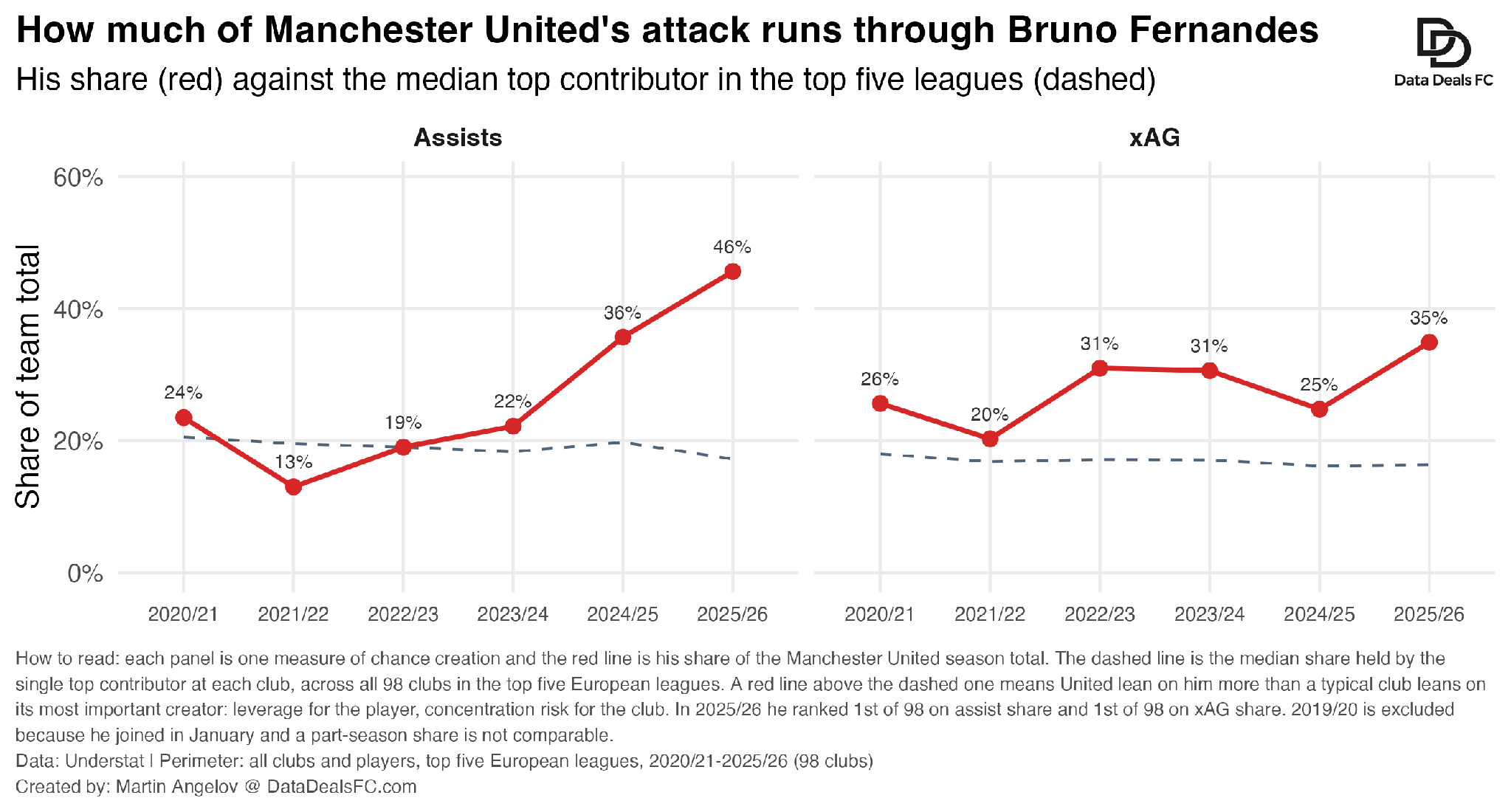
And this is not just a denominator trick. You could argue that his share is high simply because Manchester United create so little without him.
In 2024/25, that argument had something to it. United managed just 28 league assists, one of the five lowest totals in the division; the typical club managed 43. A big share of a small number is not hard to reach.
In 2025/26, it falls apart. United’s total rose to 46, the third-highest in the league. Bruno’s own assists more than doubled, from 10 to 21.
So his share went up while the team itself created far more. That gives his representatives a very simple negotiating line:
You are not paying for another creative midfielder. You are paying for the player through whom almost half of the team’s assists currently run.
And that immediately creates the next question.
What happens if he leaves? We’ll come back to that.
2. At 32, Bruno’s availability looks more like an asset than a risk
Age will almost certainly be Manchester United’s opening counterargument.
Bruno is 32.
Any new contract would pay him through ages 33 and 34. Normally, that would immediately raise questions about availability.
Except Bruno’s record is absurd.
Since joining Manchester United, he has played between 97% and 100% of available Premier League minutes in every season.
Not once has he fallen below 97%.
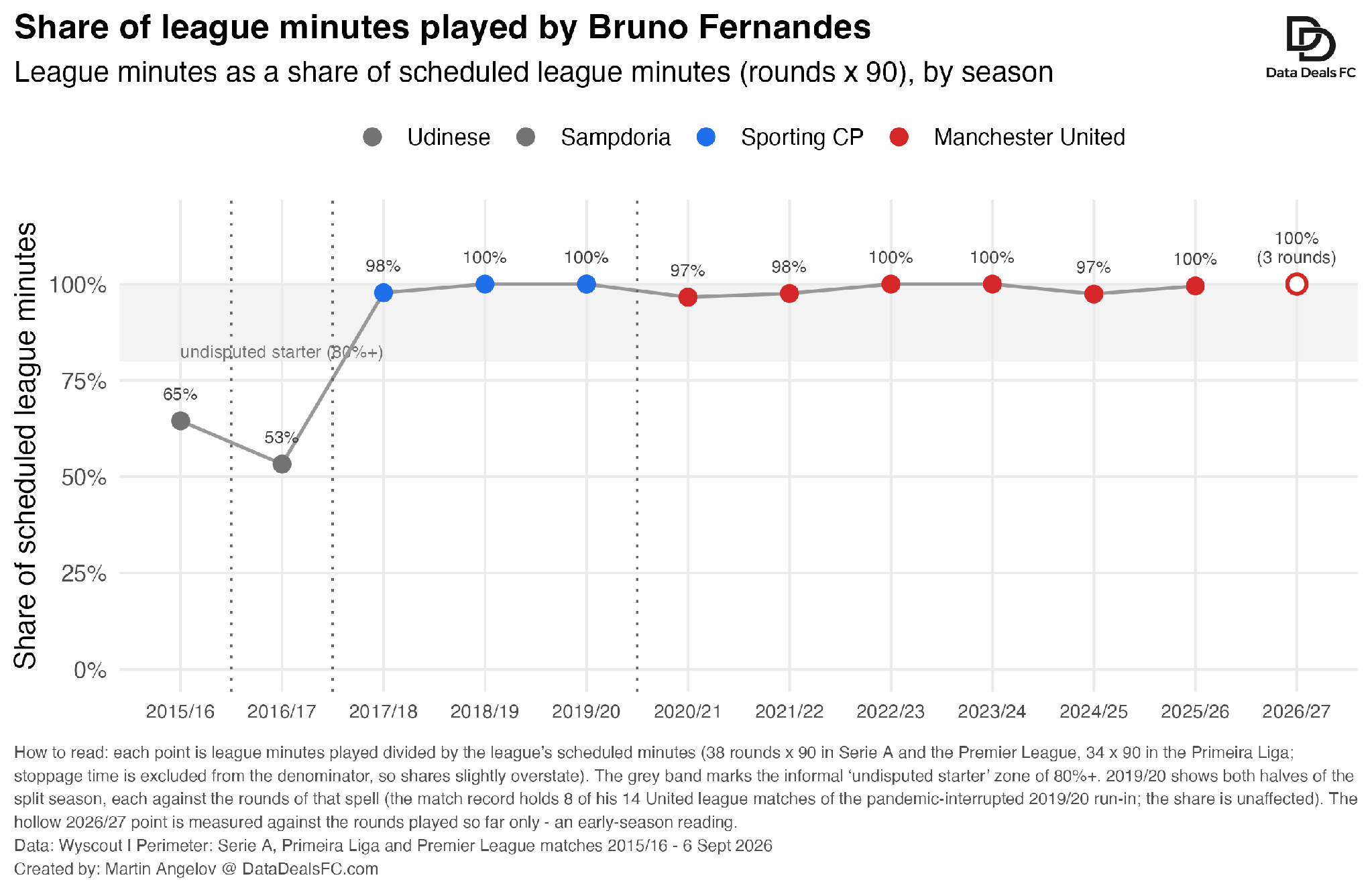
And the injury record is even more striking.
Take his entire Manchester United career — from his debut in February 2020 to today, six and a half seasons.
He has lost just 27 days to injury. Over that same window, the median Premier League regular lost 184 days.
He has appeared in 233 of United’s 245 league matches. Ninety-five percent.
And he has played the third most Premier League minutes of any player in the division over the period. The two ahead of him, Jordan Pickford and James Tarkowski, lost 53 and 97 days to injury.
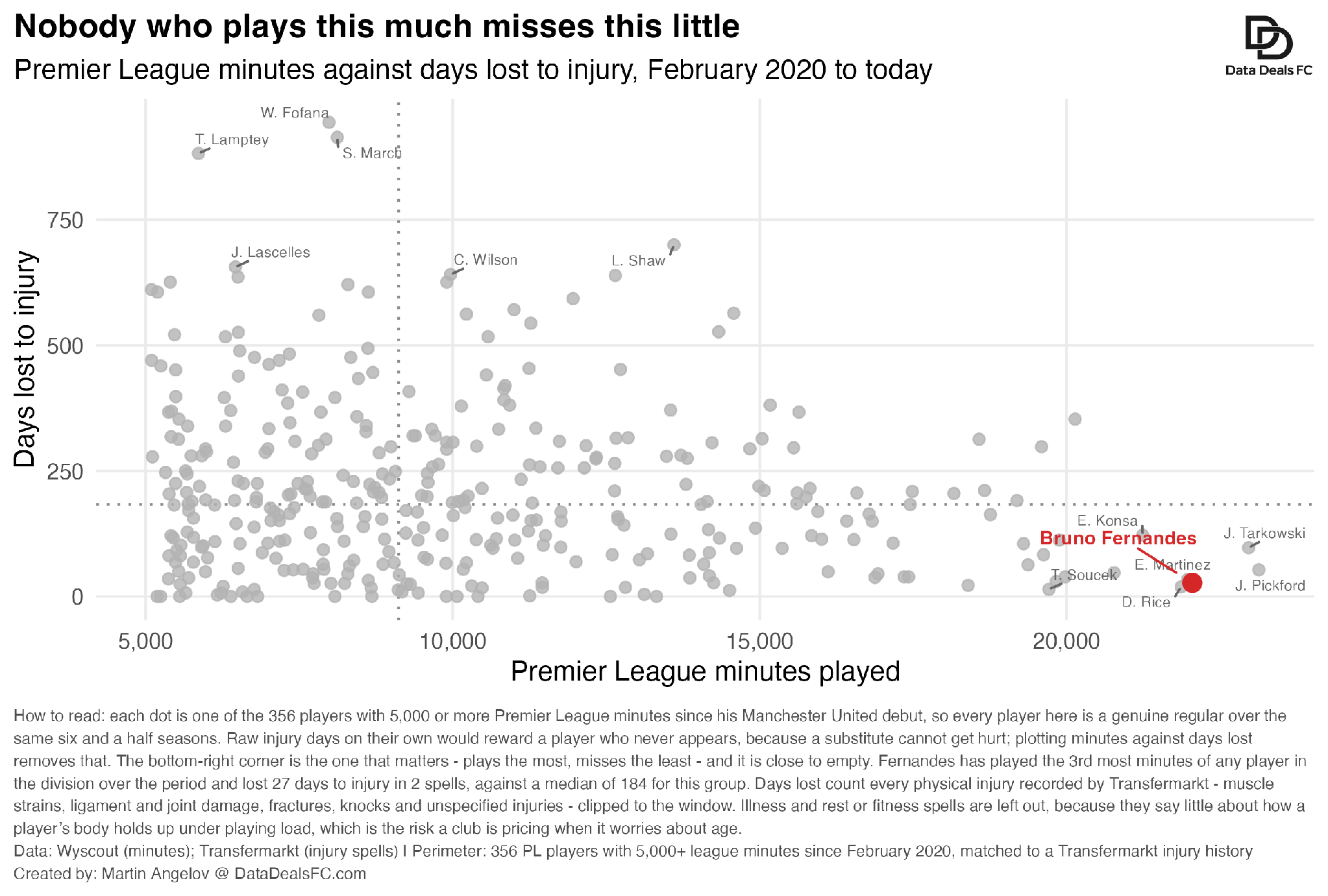
Among the fifty most-used players in the league since he signed, only three missed fewer days than he did: Declan Rice, Tomáš Souček and James Ward-Prowse. All three played fewer minutes. Nobody who has played more than him has missed less.
This matters because clubs normally use age to price future availability risk.
Bruno’s representatives can respond with the strongest observable evidence available:
Fine. If you think age creates an availability risk, then price the availability, because nobody in this league has more of it.
But there is another reason his minute share matters.
Manchester United are not merely paying him a large salary. They are using him like a player worth a large salary.
Across the last three seasons, he has played more Premier League minutes than any Manchester United outfield player.
Different managers. Different systems. Same result. He plays.
3. The performance data says Bruno’s decline hasn’t started
This is the most important distinction.
A 32-year-old playing every week isn’t necessarily valuable if his performance has already started falling.
Bruno’s hasn’t.
On the contrary, 2025/26 was the best creative season of his Manchester United career by several underlying measures. Across his entire United spell among Premier League attacking midfielders, he ranks around the:
98th percentile for expected assists
98th percentile for chances created
98th percentile for passes into the box
98th percentile for through balls
100th percentile for passes into the final third.
Any good creator will clear one or two of those. Almost nobody clears all five.
Take the 81 attacking midfielders who have played 2,700 or more Premier League minutes since 2019/20, and ask how many sit in the top 5% of the league on every one of those measures at once.
Sixty-eight of them manage none. Two manage all five.
Bruno Fernandes, and Kevin De Bruyne.
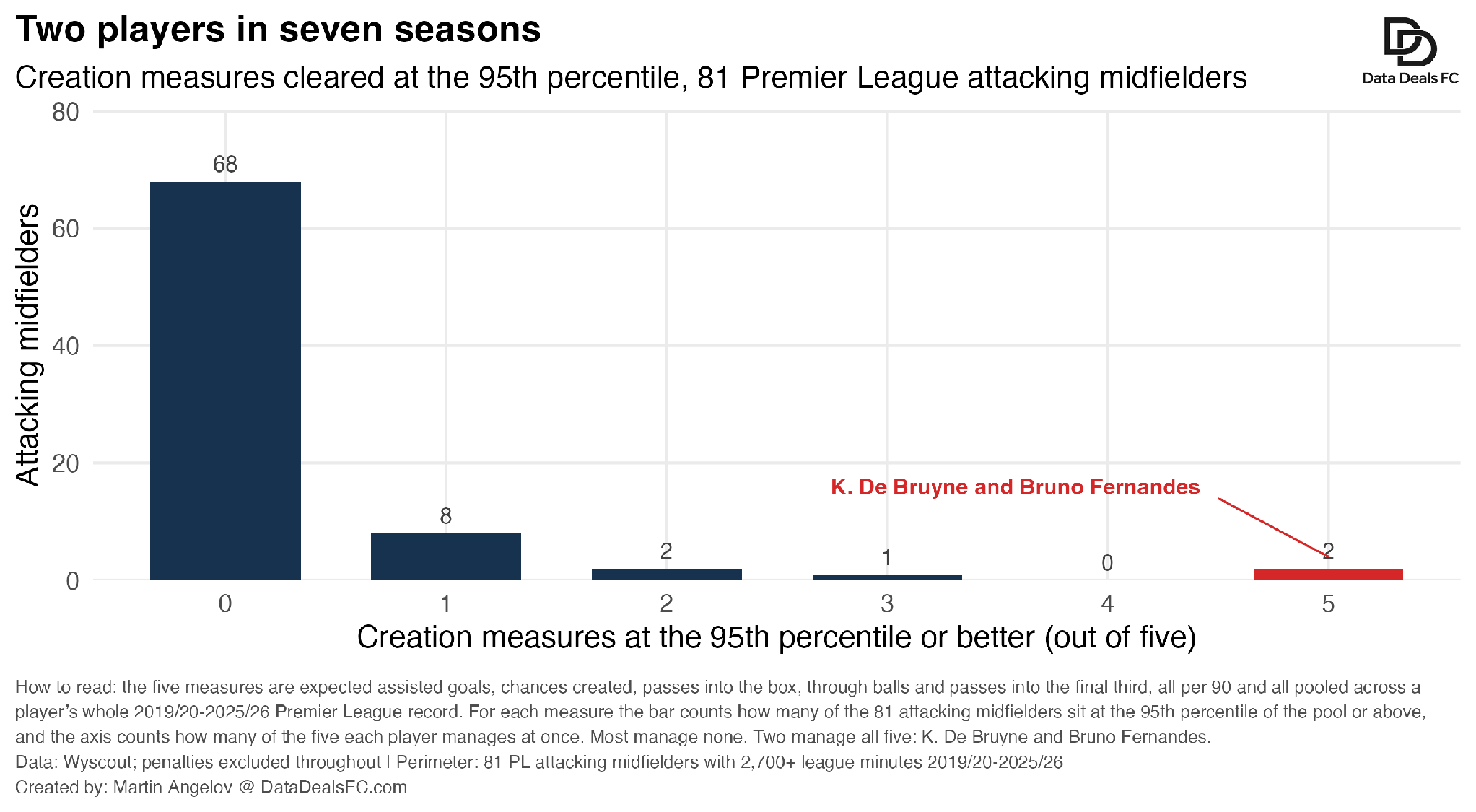
And this isn’t based on one good year. It covers more than 21,000 Premier League minutes.
Which brings us to the decline question.
Because a 32-year-old’s career numbers can hide a recent fall. So here are the same five measures scored season by season, each against that season’s attacking midfielders — the yardstick resets every year, so nothing is inherited from 2021.
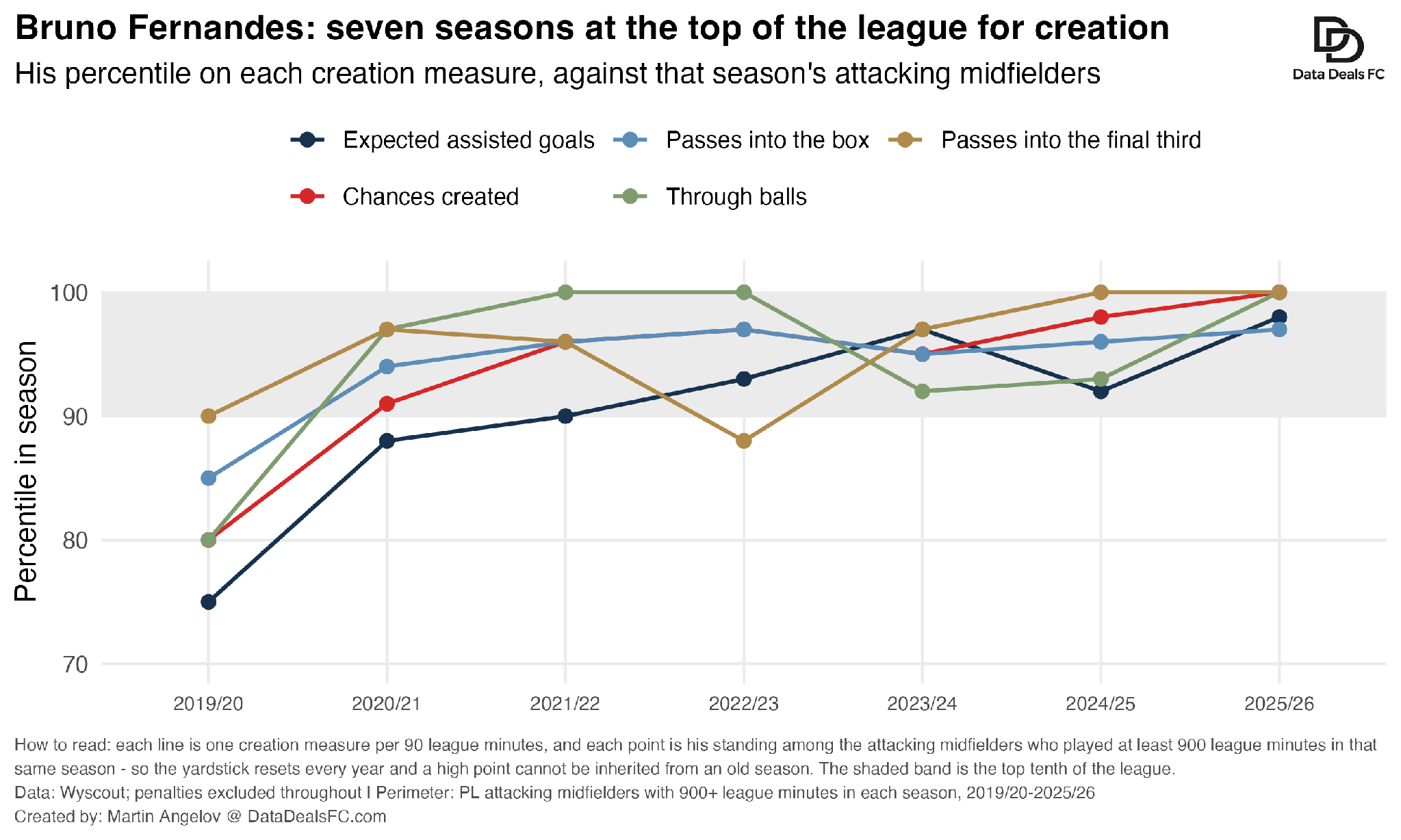
The lines go up. In 2025/26 he finished in the top 3% of the league on all five, and first on three of them: chances created, through balls and passes into the final third. Whatever is going to decline hasn’t started yet.
Bruno’s side does not need to argue that he is perfect.
He isn’t.
His progression by carrying is weak. His box presence is modest. His pass completion could improve.
The interesting point is that none of those things has stopped him being one of the league’s most productive creators.
Which is what United are actually buying.
And now to the really interesting one.
4. The wage model says Bruno is not overpaid
Bruno earns an estimated €18M a year. That sounds enormous. And it is.
He is one of Manchester United’s highest-paid players and among the best-paid midfielders in Europe.
So United’s most intuitive argument writes itself:
You’re already one of the highest-paid players in the league.
True. But salary in isolation tells us almost nothing. The useful question is whether he is paid like the player he actually is.
The obvious place to start is the market. Take every attacking player in Europe’s top five leagues who played at least 900 league minutes last season, 514 of them, and compare two things: what they produce, and what they are paid.
For output, I use expected goals plus expected assisted goals per 90 minutes (xG + xAG).
Bruno produced 0.68 per 90.
That puts him in the 95th percentile.
His wage puts him in the 98th percentile.
He is paid like one of the best attacking players in Europe because he produces like one.
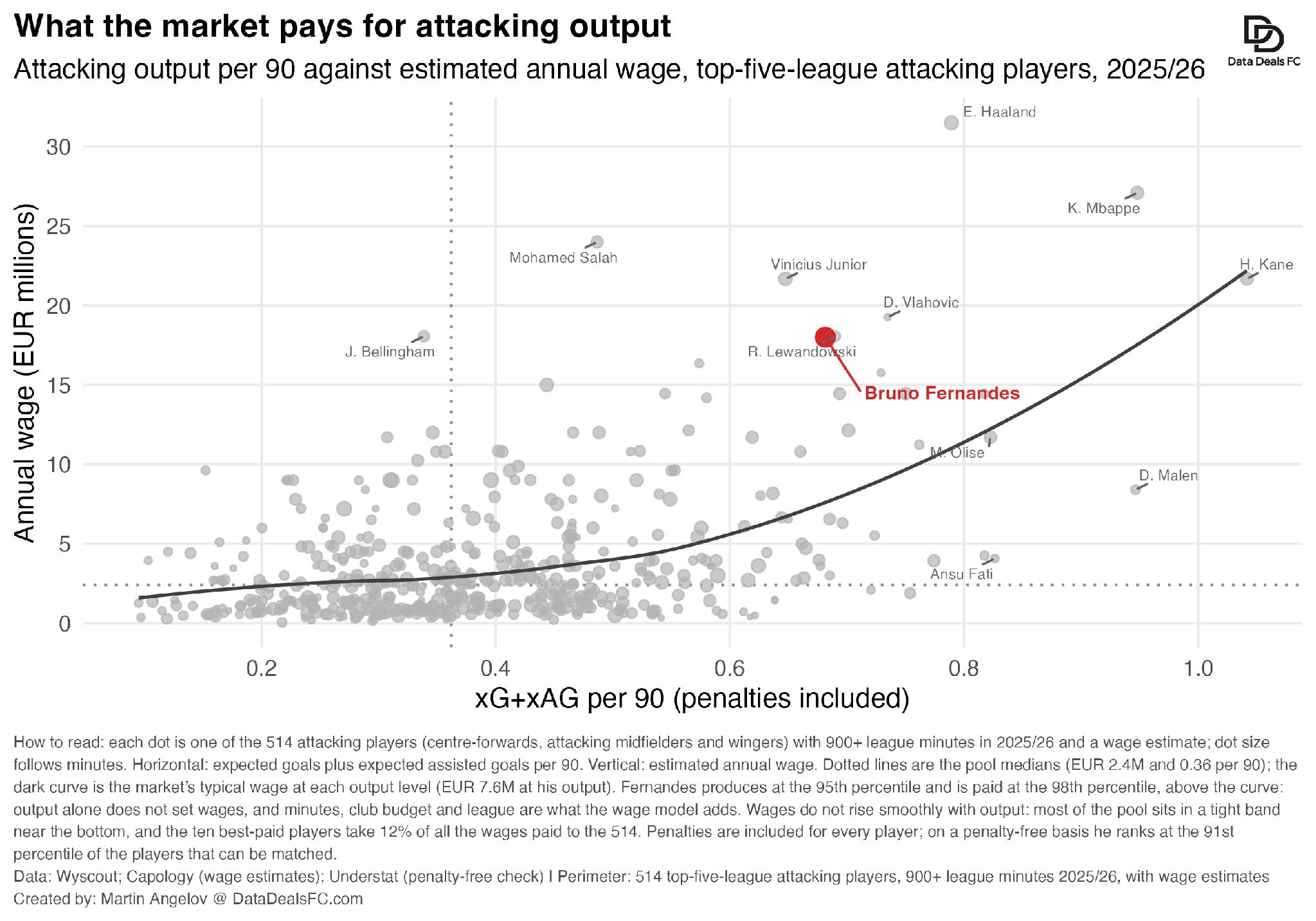
Now look at the shape of that market. For most players, wages barely move with output. The median attacking player earns about €2.4M, and nearly two-thirds earn under €3M. Then, right at the top, wages go almost vertical: the ten best-paid players take close to 12% of all the wages paid to the 514.
Bruno sits right at that edge. He is the ninth-best-paid attacking player in the top five leagues.
That is exactly where ordinary salary benchmarking starts to struggle.
To see what a conventional benchmark says anyway, I built a wage model using 1,817 players across Europe’s top five leagues. It learns what the market typically pays given attacking output (xG + xAG), share of league minutes, age, club wage bill, league and position, and it explains about 73% of the variation in wages.
Then I put Bruno’s actual numbers into it.
Model-predicted wage: €17.2M
Actual estimated wage: €18.0M
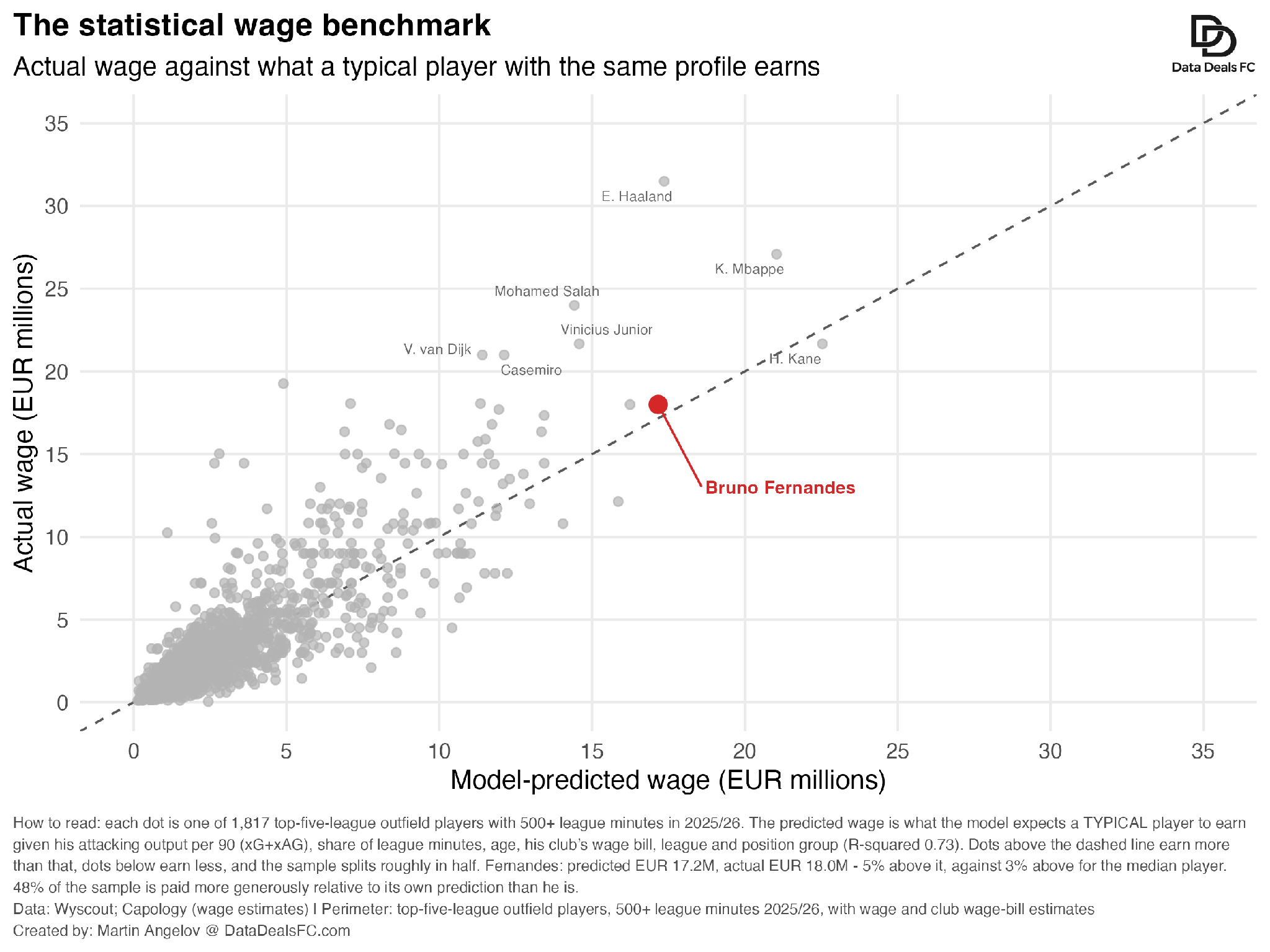
Bruno is paid about 5% more than the model predicts. But the typical player in the sample is also paid a little above their prediction, about 3%.
Put simply: line up all 1,817 players by how generously they are paid compared with what the model predicts for them, and Bruno lands almost exactly in the middle. Just under half of them are paid more generously than he is.
And this is where it gets interesting.
A model like this has a known blind spot. It is fitted across the whole labour market, so it smooths away the premium that superstar markets pay for the last few percentiles of quality. Look at which highly paid players it thinks are furthest above their prediction: Mbappé, Salah, Vinicius. Erling Haaland earns about 80% more than it predicts.
When I ran the same kind of model for Kevin De Bruyne’s 2021 negotiation, it priced him at around €11M against a salary of roughly €22M, and put him in the company of Messi, Neymar and Ronaldo as “overpaid”.
Bruno does not get that verdict. Even a model that tends to call elite players overpaid says he is paid about what a typical player with his profile earns.
So United’s opening line has a second half:
You’re already one of the highest-paid players in the league ... because you’re also one of its most productive and most-used players.
Among the Premier League’s highly paid creative players, Bruno ranks around: 3rd for creation and 2nd for wage.
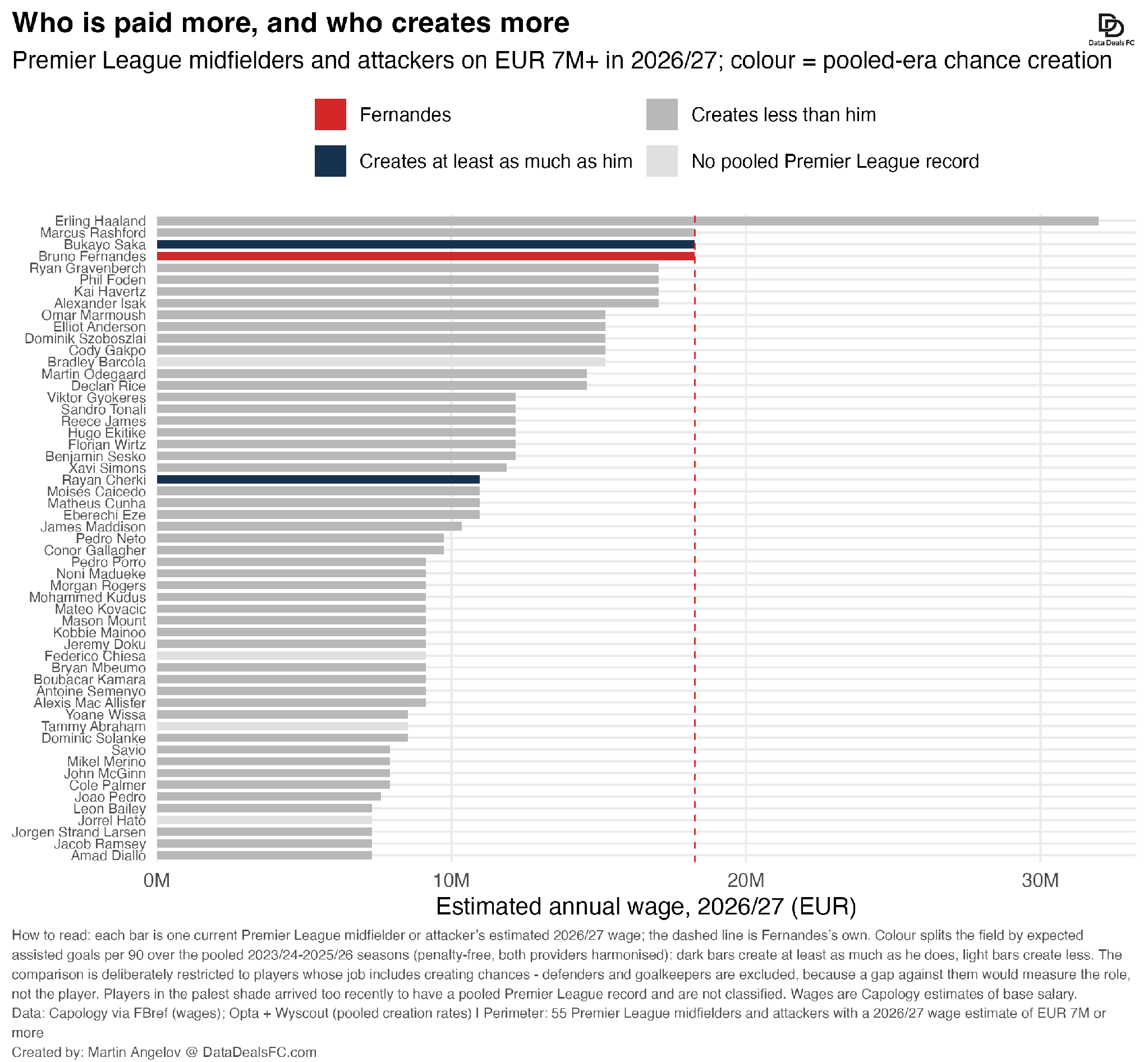
That is not evidence of exploitation. It is something more useful in a negotiation: pay and production are broadly aligned.
And even age does less damage than you might expect. Holding his current performance and usage constant, the model’s benchmark barely moves:
Age 32 → €17.3M
Age 33 → €17.1M
Age 34 → €16.8M
So United’s strongest argument is not:
Bruno is already overpaid.
The numbers don’t really support that. It is:
We don’t know whether today’s Bruno will still exist at 34.
That is a legitimate concern.
It is also a concern about the future rather than a claim about the present, which makes it an argument about how a contract is shaped rather than about what he is currently worth.
But if the wage model says he is paid fairly, where does the case for a raise come from?
From what happens to United without him, which brings us to the last point.
5. Replacing Bruno costs more than paying him
United’s cheapest move is to do nothing. His deal runs to June 2027, and United hold an option to extend it for another season on the existing terms.
So the club can reasonably ask:
Why should we pay you more, when we can keep you another year on what you earn now?
The answer is not in the wage model. It is in the league table.
So I simulated it. Twenty thousand Premier League seasons with Bruno, and twenty thousand with his creative output replaced by a lesser player.
The mechanics are simple. Take the gap between his expected goals and assists per 90 (penalties excluded, because his penalties stay with the club when he leaves) and the replacement’s. Spread it over a full season of minutes. Convert it into league points at the historical rate of about 0.63 points per goal contribution. Then let every simulated season carry the random noise real seasons have, around four points either way.
Losing him costs United roughly:
1.5 points against their next-best creator
4.4 points against a typical Premier League No.10
6.7 points against a league-average midfielder
Six points does not sound like much. For United, it is. Their nine-season average is 66 points; the average fifth-place finish over the same nine seasons is also 66.
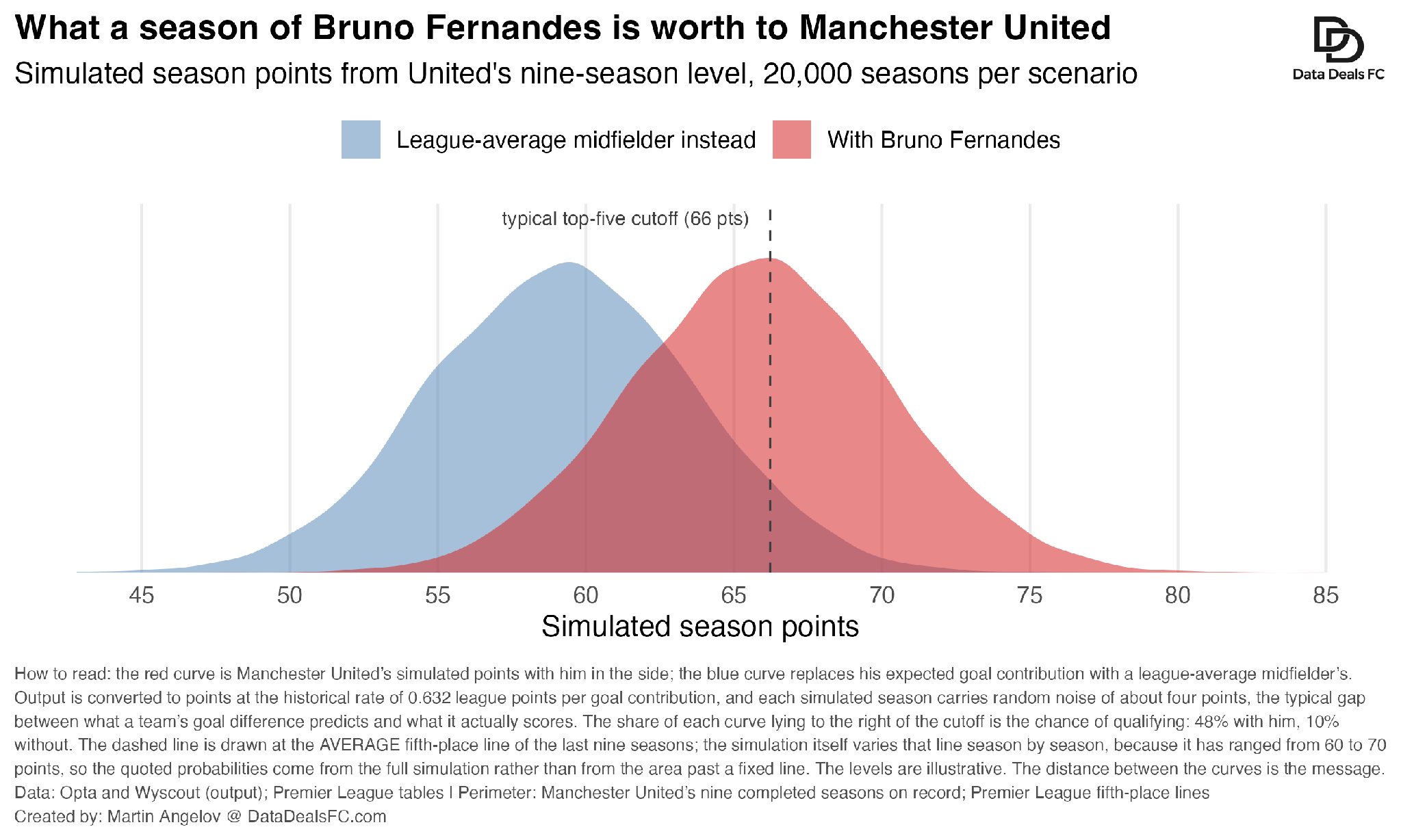
Starting from that normal level, the simulation gives United a 48% chance of a top-five finish with Bruno.
With a typical Premier League No.10 instead: 20%.
With a league-average midfielder: 10%.
The exact percentages are illustrative. The distance between them is not.
What those percentages are worth
For United, top five means the Champions League instead of, at best, the Europa League. That difference has a price, and most of it is public.
UEFA’s own budget for 2026/27 pays the average Champions League club about €67M, and the average Europa League club about €16M.
On top of that, United’s Adidas kit deal deducts £10M, roughly €11.5M, for every season without Champions League football.
So a Champions League season is worth at least €63M more to United than a Europa League one. At least, because the extra home matches and their ticket income are not even counted.
Multiply that by how much each replacement lowers the chance of getting there:
United’s next-best creator: 10 points less likely to qualify, about €6M a season in expected Champions League money
A typical Premier League No.10: 27 points less likely, about €17M
A league-average midfielder: 37 points less likely, about €23M
That last number is more than Bruno’s entire wage.
And a real replacement has to be bought
Those three options are the cheap ones. They cost nothing to acquire.
Replacing him properly means buying a creator. So I took every attacking midfielder a Premier League club has bought for €35M or more since summer 2023, and costed each one as if United had signed them to fill his role: their wage, the fee spread over a five-year contract, and the Champions League money United would expect to lose because they create less than Bruno does.
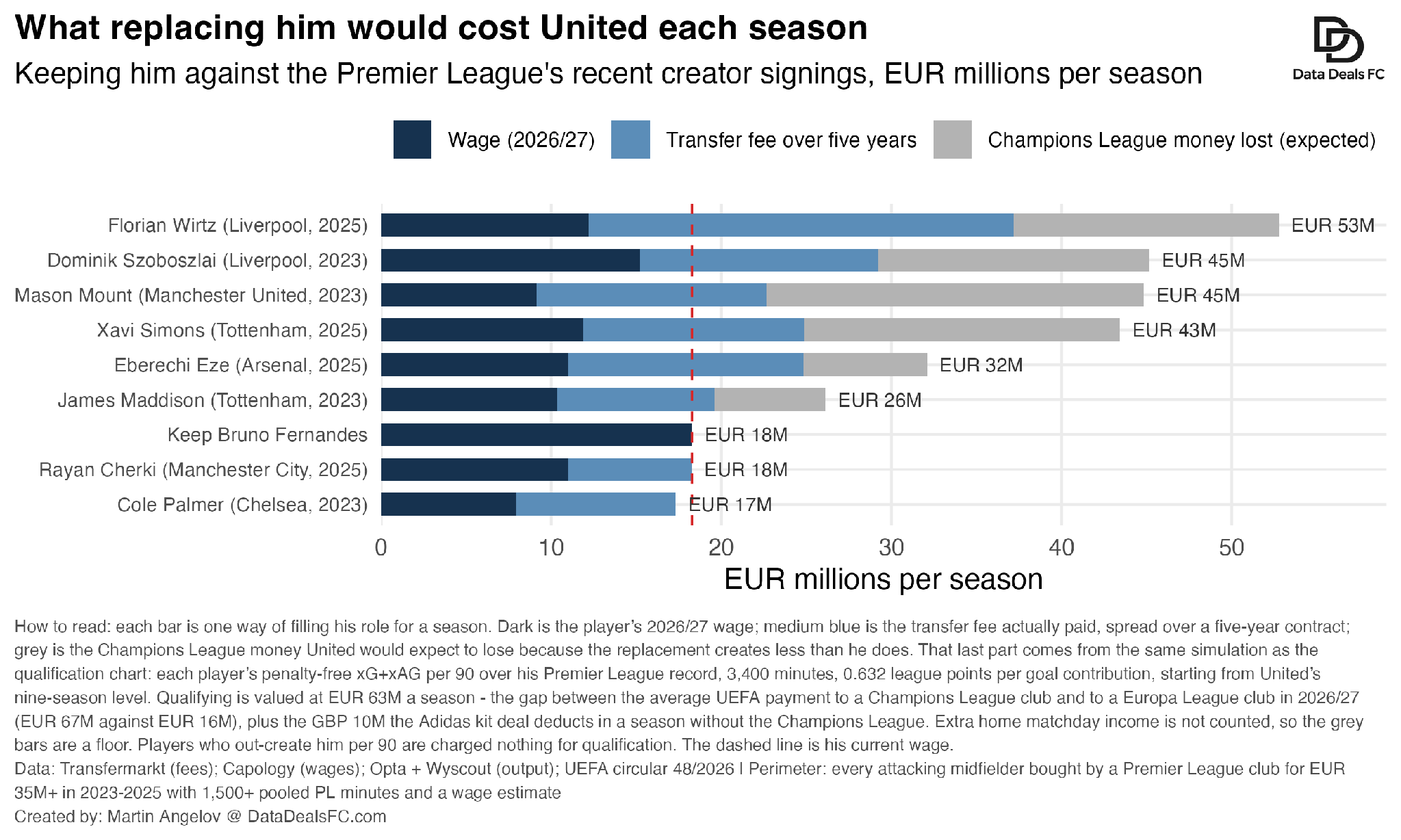
Florian Wirtz comes to about €53M a season. Dominik Szoboszlai, €45M. Xavi Simons, €43M. Eberechi Eze, €32M. James Maddison, €26M.
Mason Mount, United’s own purchase, comes to €45M, because he creates a little over half as much per 90 as the player he would be replacing.
Only two come in at Bruno’s €18M or below: Cole Palmer and Rayan Cherki. Both were bought at 21, before the market had fully priced them, and both have out-created him per 90 (Cherki on only around 2,000 Premier League minutes so far).
That is the replacement route that works. It is also a scouting bet, not a purchase: you have to find the next one before everyone else does.
To be fair to the club, a 21-year-old keeps resale value and a 32-year-old does not, and spreading a fee over five years ignores that.
But the business point is much simpler: United are not deciding between paying Bruno €18M and saving €18M.
They are deciding between paying Bruno €18M and spending somewhere between €26M and €53M a season on somebody who, on the evidence, creates less.
Surely United can price the risk of him getting older. What they may struggle to price is the cost of losing him.
Boom, that was what Bruno’s future data science team would say if they want him to get a salary bump before his time in United is over.
I hope you enjoyed this one as much as I enjoyed creating it.
Thank you for reading until the end ❤️
See you next week,
Martin
P.S. If you enjoyed this one, you might also like my much more detailed 70-page report on Kai Havertz and his upcoming contract negotiation. You can read it here. Cheers!
Top 🙌🏻