


In July 2025, Myles Lewis-Skelly signed a long-term Arsenal contract after a season few 18-year-olds could imagine.
He had broken into the first team, impressed against Real Madrid in a Champions League quarter-final and scored on his England debut, becoming the youngest player to score on his senior England debut.
The season before, his salary was estimated at £4,000 a week. After the deal? Capology puts him on about £45,000. Valuball estimates £80,000. Neither is a confirmed contract figure, but even the lower estimate implies an enormous 10x raise.
To secure his deal, he brought in data scientists — the data consultancy that had also advised Kevin De Bruyne on his €80M contract. But unlike the greatest modern playmaker, he faced a very different objection from the club: you’re 18, and we’ve only seen one season.
ESPN has described two analyses used in his negotiations:
a comparison with other teenage breakouts
and research into the wage gap faced by academy graduates.
The full private report is of course not public.
But today I’ll reconstruct those two arguments in an attempt to uncover what (likely) happened on the negotiation table.
Here is what I found.
1. How rare is a teenager who actually plays?
Arsenal could reasonably say Lewis-Skelly had only one good season. His advisers needed to show just how unusual that season was.
ESPN reported that Analytics FC identified 69 players who made their top-five-league debut from 2017/18 and played at least 600 minutes that season. I rebuilt a comparable group: first season in one of Europe’s five biggest leagues, 18 or younger, at least 600 league minutes, and no earlier top-five appearance going back to 2014/15.
My count is 106 players across eight seasons, not 69. The exact filtering behind the private exercise is not available, so I won’t pretend these are identical cohorts. But they tell the same story:
Teenagers who enter an elite league and immediately hold a place are not common.
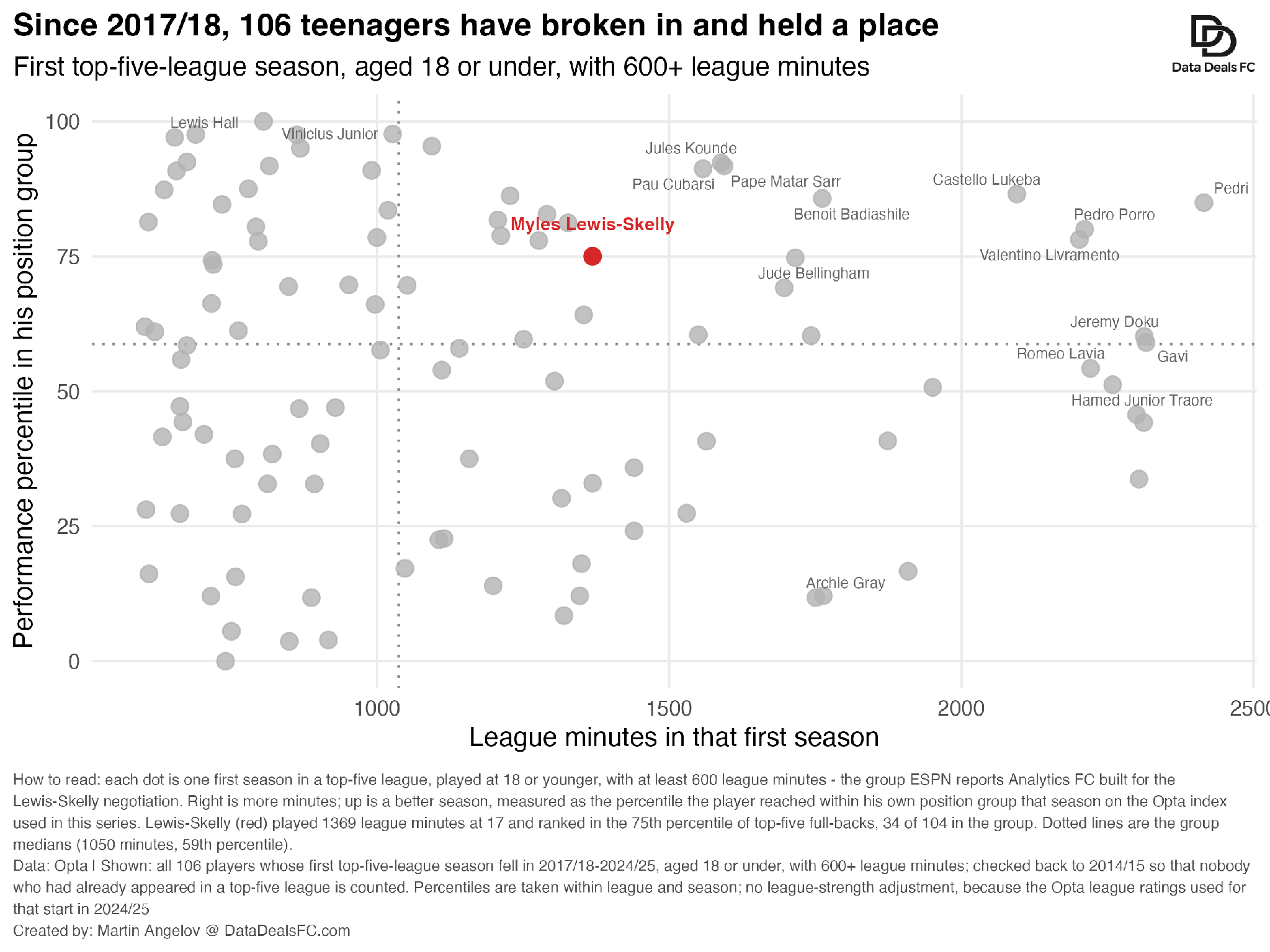
The list includes Vinícius Júnior, Bellingham, Pedri and Gavi. It also includes plenty of players whose careers went nowhere near those heights. In other words, rarity is not the same as future stardom.
Lewis-Skelly played 1,369 league minutes as a 17-year-old. On my full-back performance index, he was at the 75th percentile among top-five-league full-backs and ranked 34th of the 104 players in the cohort I could assess.
Not Pedri. Not some once-in-a-generation outlier. But an academy player who had already done something most teenagers never manage.
2. The pay rise looks different when you compare peers
Now the money. Before his renewal, Lewis-Skelly’s estimated wage sat at the 9th percentile of the Premier League. A player starting in the Champions League against Real Madrid was being paid like the bottom tenth of the division.
After renewal, the estimate moves him to the 58th percentile. That is a jump of 49 percentage points. The typical player in my teenage-breakout group moved from the 22nd to the 39th: 17 points.
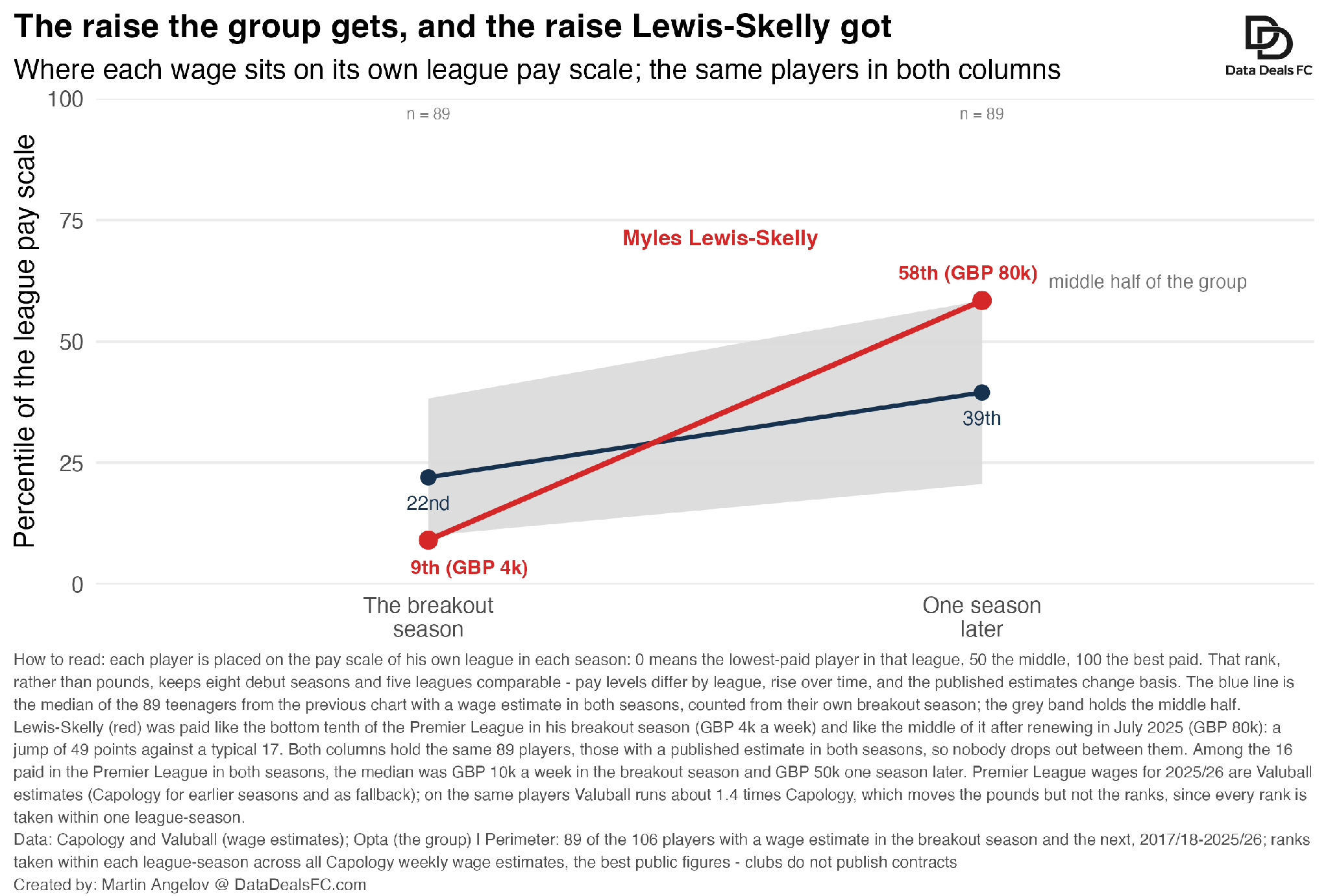
By that comparison, Lewis-Skelly got an unusually large correction. But he did not suddenly become one of the league’s highest earners. He moved from the bottom to a little above the middle.
And there is a second, more uncomfortable comparison for Arsenal:
What were other Premier League full-backs getting paid to do his job?
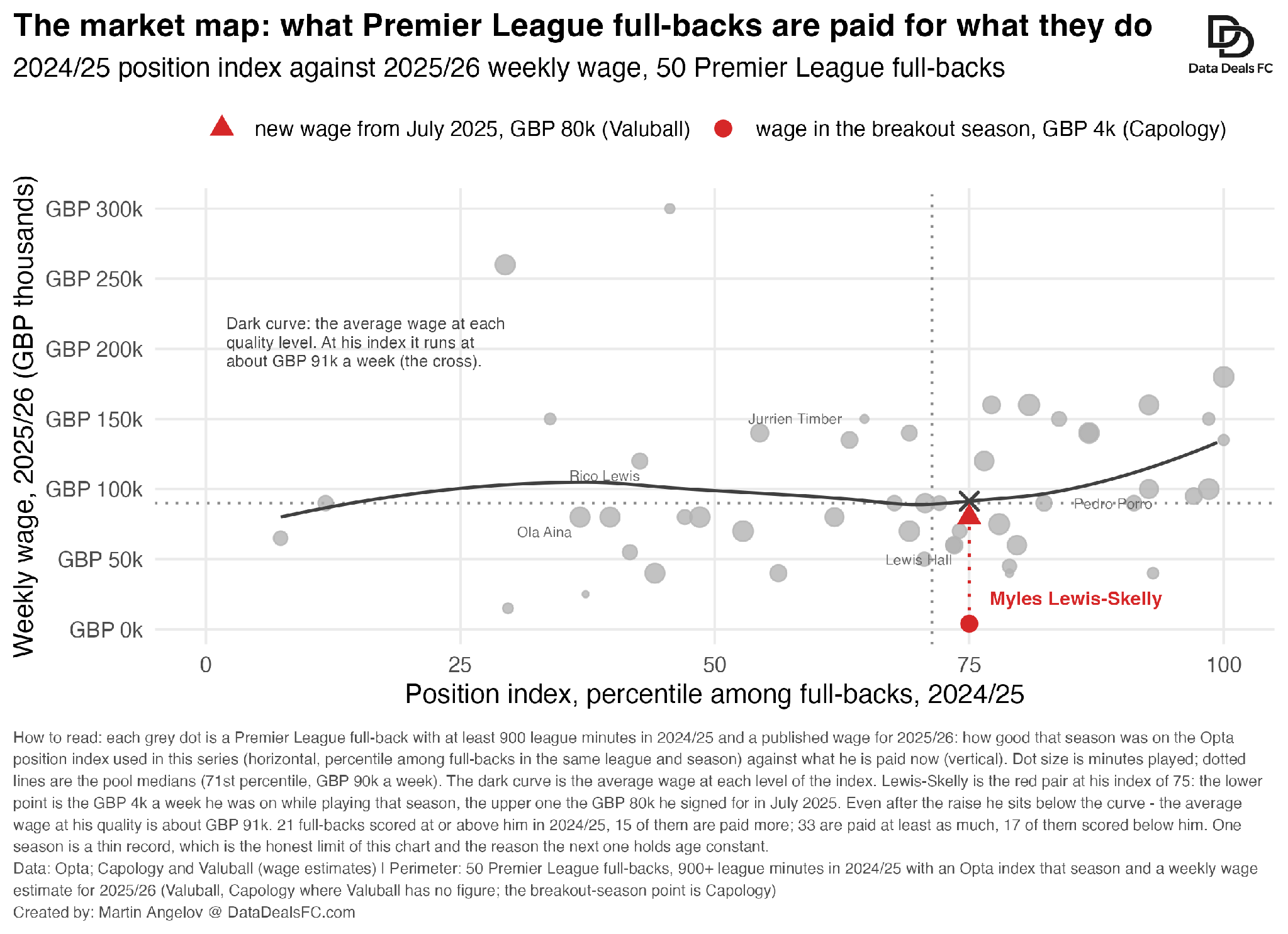
Among Premier League full-backs with at least 900 minutes in 2024/25, Lewis-Skelly sat at the 75th percentile on my performance index. The median player sat at the 71st. Yet Lewis-Skelly’s estimated new wage was £80,000, against a median of £90,000.
A fitted market curve puts a full-back at his measured level at roughly £91,000 a week. On Valuball’s estimate, he is on about 88% of that benchmark. Of the 33 full-backs paid at least as much, 17 scored lower on my index.
So he was above the middle of the league on measured performance and below it on pay. Was Arsenal getting a discount? Possibly. But before we call it underpayment, there are two obvious complications: his age and his academy contract.
3. Being 18 has a price
How much do clubs pay for performance when the player is barely old enough to sign the contract?
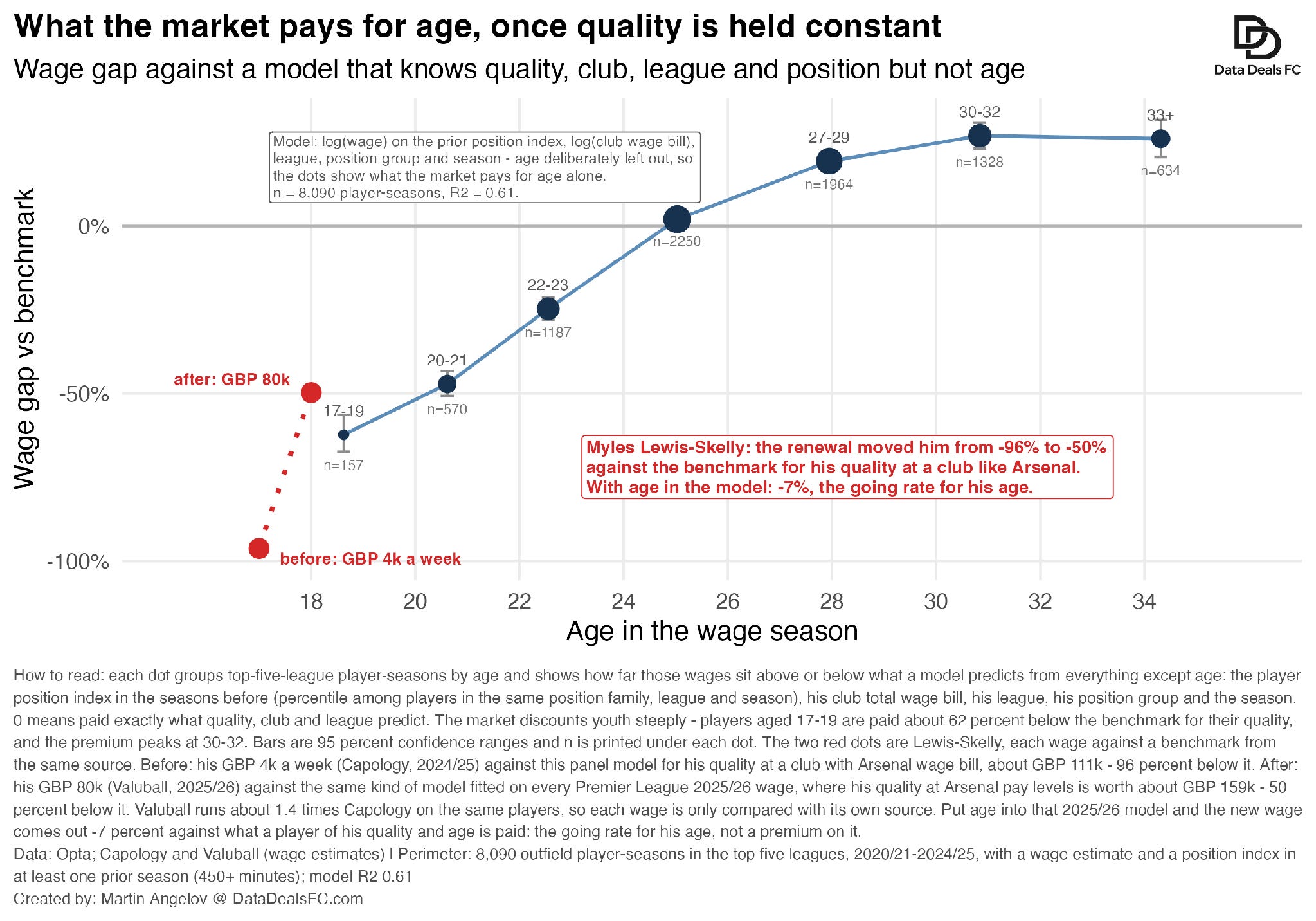
I modelled wages across 8,090 player-seasons in Europe’s top five leagues, allowing for prior performance, club wage bill, position, league and season—but deliberately leaving age out. I then looked at how the gap between actual pay and predicted pay varied with age.
The pattern is stark.
Players aged 17–19 earn about 62% below the quality-based benchmark on average.
At 20–21, the shortfall is 47%; at 22–23, 25%. By 24–26, it largely disappears. Older players tend to earn a premium.
In other words, clubs do not pay purely for what the current season says. They also pay for evidence that you can keep doing it.
For Lewis-Skelly, the no-age benchmark at Arsenal’s wage level was about £111,000 a week before renewal. He was estimated to earn £4,000: 96% below. Using the following season’s wage data and provider, the equivalent benchmark is about £159,000; £80,000 leaves him 50% below it. These are separately estimated benchmarks, not an apples-to-apples jump from £111,000 to £159,000.
That sounds brutal—until I put age back into the model. His new wage then comes out only about 7% below the expected amount for a player of his age, measured quality and club.
That is the surprise. On the published £80,000 estimate, Arsenal did not necessarily give him a superstar premium. It appears to have brought him roughly up to the market rate for an 18-year-old like him.
A big raise and a generous contract are not automatically the same thing.
4. Does coming through the academy cost you even more?
This is the piece of the story I find most interesting. The age discount is widespread; the academy question is about the club that already owns your registration and helped develop you.
ESPN reported that Analytics FC revisited research first prepared for Mason Mount’s Chelsea negotiations. A Harvard Business School case on the consultancy describes an even bigger claim in an academy-player case:
Players who stay may earn roughly a third of what they could earn after moving.
That implies a 67% gap.
I wanted to see whether anything like that survives a broader test.
I compared players within the same club and season, controlling for age, position and measured quality. Players the club paid a transfer fee for are classified as signings; players who broke through at the same club as teenagers and were never bought are classified as academy products. Unclear cases are left out.
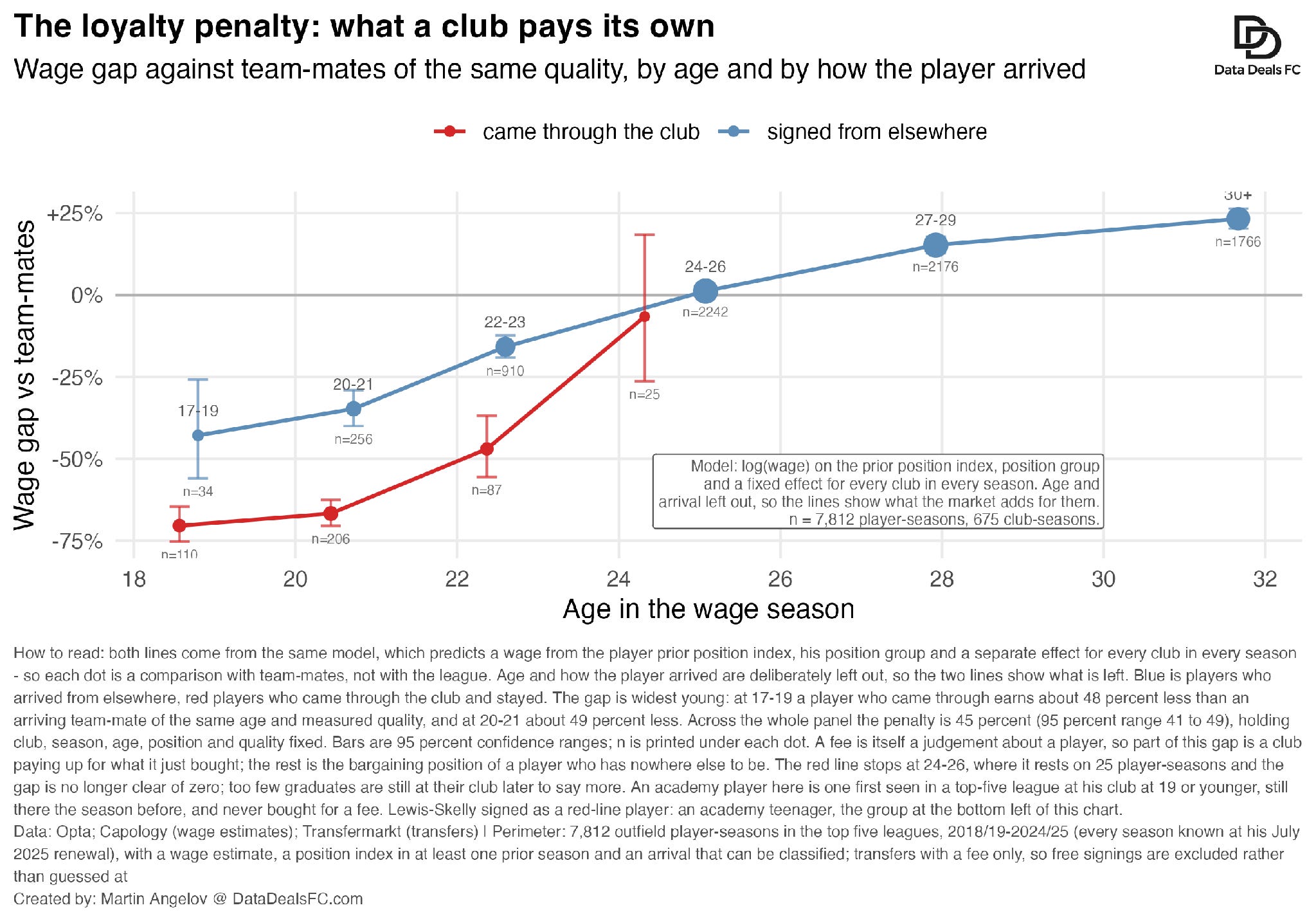
Across 7,812 player-seasons and 675 club-seasons, academy graduates earned about 45% less than comparable team-mates signed from elsewhere.
Not the 67% described in the case study. Still a very large gap.
And it is concentrated in the years that mattered to Lewis-Skelly. The estimated gap is 48% at ages 17–19, 49% at 20–21, and 37% at 22–23. By 24–26, it falls to 8%, with too much uncertainty to distinguish it reliably from zero.
I tested nine versions of the comparison—different controls, a Premier League-only sample, different academy definitions and shorter time windows. The full-sample result stayed between 37% and 48%. The separate estimate for players aged 24 and over was about 3%, again too uncertain to call a gap.
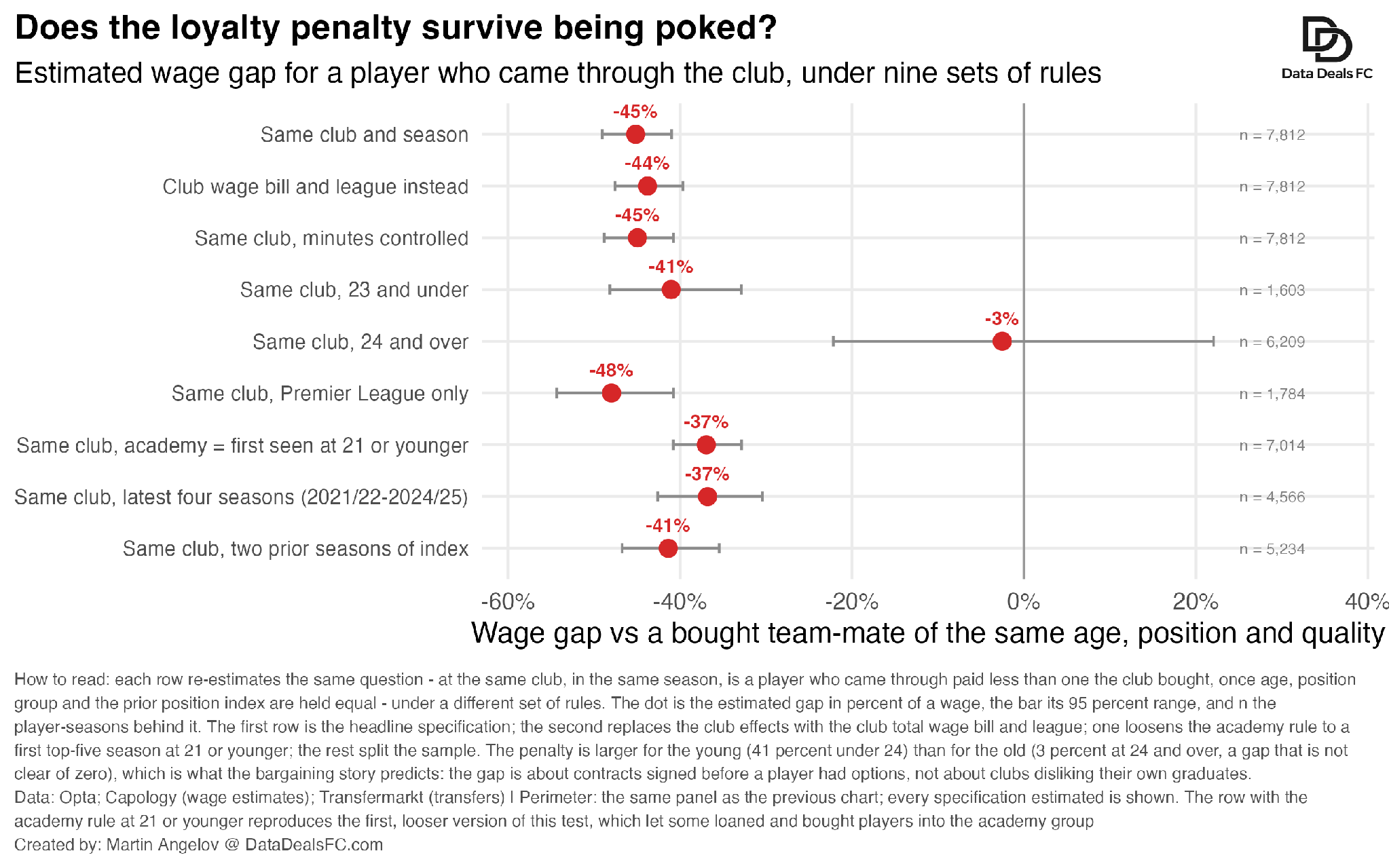
Now the caveat: 45% is an association, not proof that loyalty causes a 45% pay cut. Clubs may pay transfer fees for qualities my index misses, then pay those recruits more. Nor can you simply add this 45% to the age discount; the two analyses answer different questions.
What would I take to the negotiating table, then? Not a claim that Arsenal owed him exactly 45% more. I would take the age profile: why should the largest gap between academy players and recruits appear precisely when young graduates have the least negotiating leverage?
That makes the argument much harder to dismiss as an 18-year-old asking to be paid like a senior star.
5. Arsenal had alternatives. Arteta kept picking him.
For a club, the simplest reply to a wage demand is “we have other players.” Arsenal certainly did. At left-back they could turn to Riccardo Calafiori, Jurriën Timber, Oleksandr Zinchenko or Kieran Tierney.
So I looked at the minutes rather than the names on the squad list.
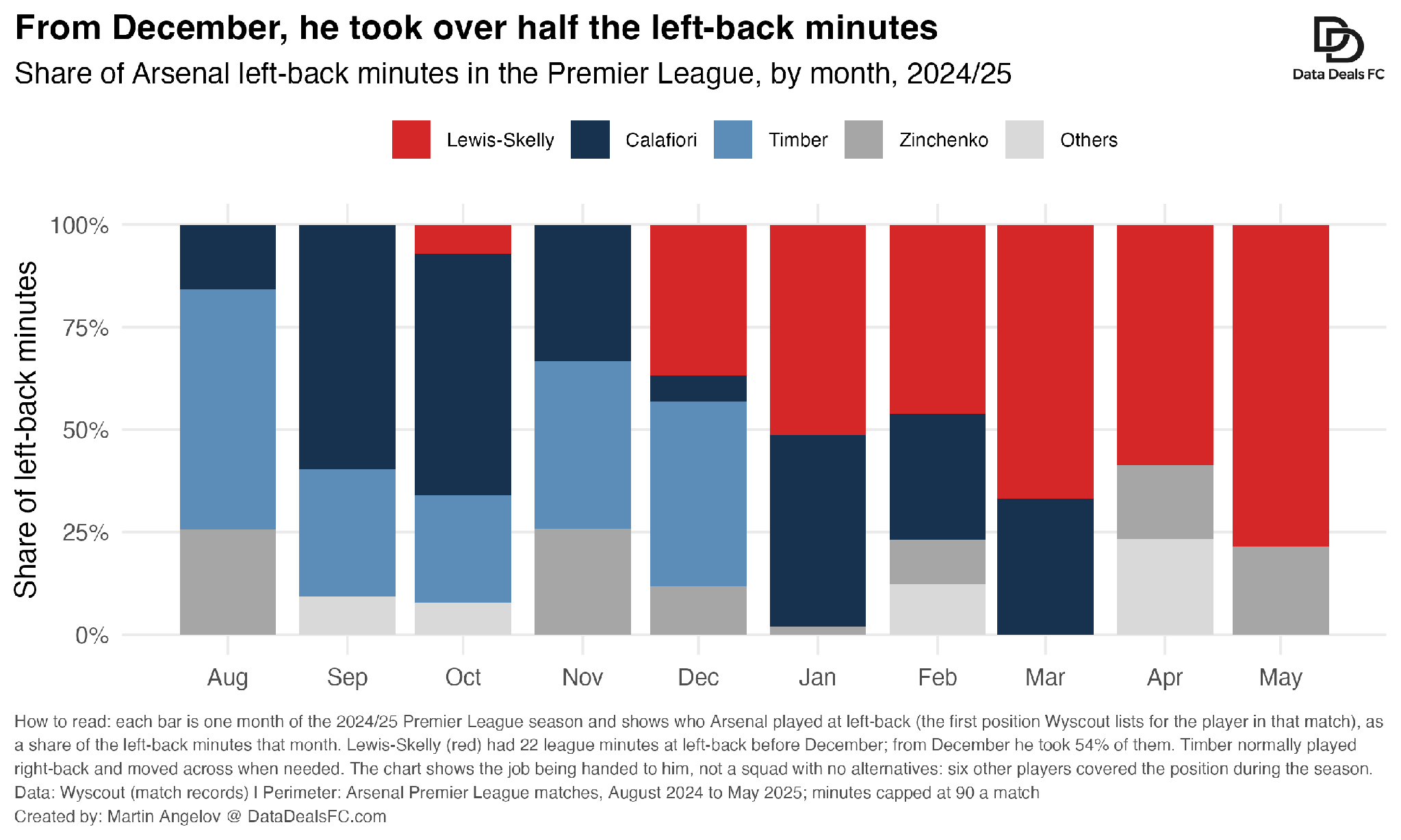
Lewis-Skelly had played just 22 Premier League minutes at left-back before December 2024. From December onwards, he took 54% of Arsenal’s minutes in that position. By May, his monthly share was close to four in five.
Arsenal could say: we have four other options. His representatives could answer: yes—and the manager kept choosing the teenager.
I know which of those two lines I would put on a slide.
But being important to Arsenal is only half a negotiation. What happens if another club comes for him?
ESPN reported interest from Real Madrid. That does not establish a formal offer or tell us how serious the interest was. But it does give us a testable question: would his game actually fit Madrid’s left-back role?
I compared 15 aspects of left-back play across 90 top-five-league clubs in 2024/25, from passing and progression to defending and crossing. Arsenal was the closest match—unsurprisingly, since Lewis-Skelly contributed to its profile. Real Madrid ranked second.
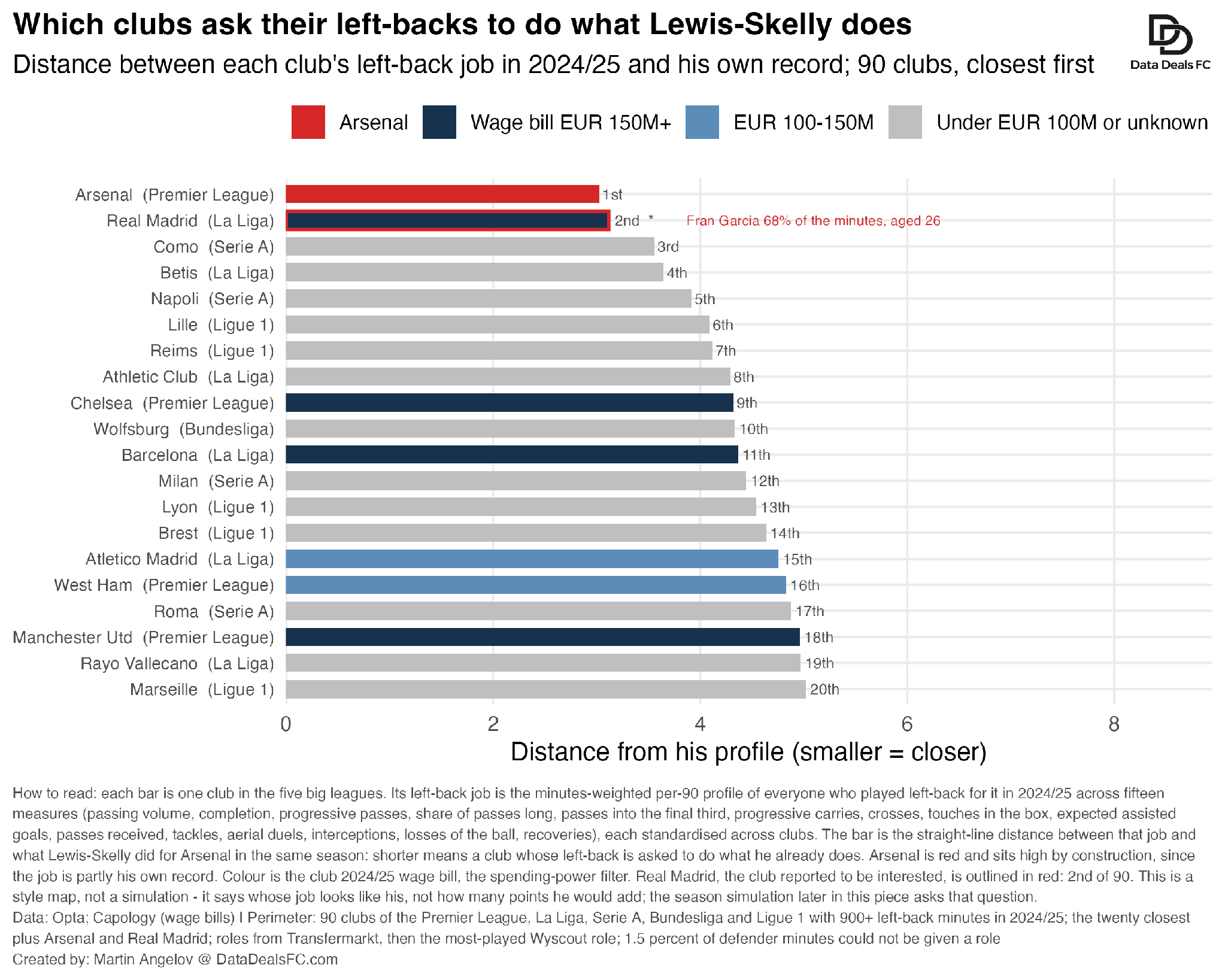
Madrid also had the largest wage bill in the sample. Fran García, 26, played 68% of their left-back minutes that season; Ferland Mendy, 30, took most of the remainder.
So the reported interest was not obviously a tactical mismatch. That is evidence of a plausible destination, not evidence of an actual bid. The latter would matter far more at a negotiating table.
6. The chart Arsenal should have brought
So far, the case for a substantial raise looks strong: rare teenage minutes, good measured performances, pay near the bottom of the league, and a manager who trusted him.
But the best argument against him comes from the same group of teenage breakouts.
I followed the 63 players in that group whose careers could be observed for three seasons after their breakthrough. Here is where they ended up.
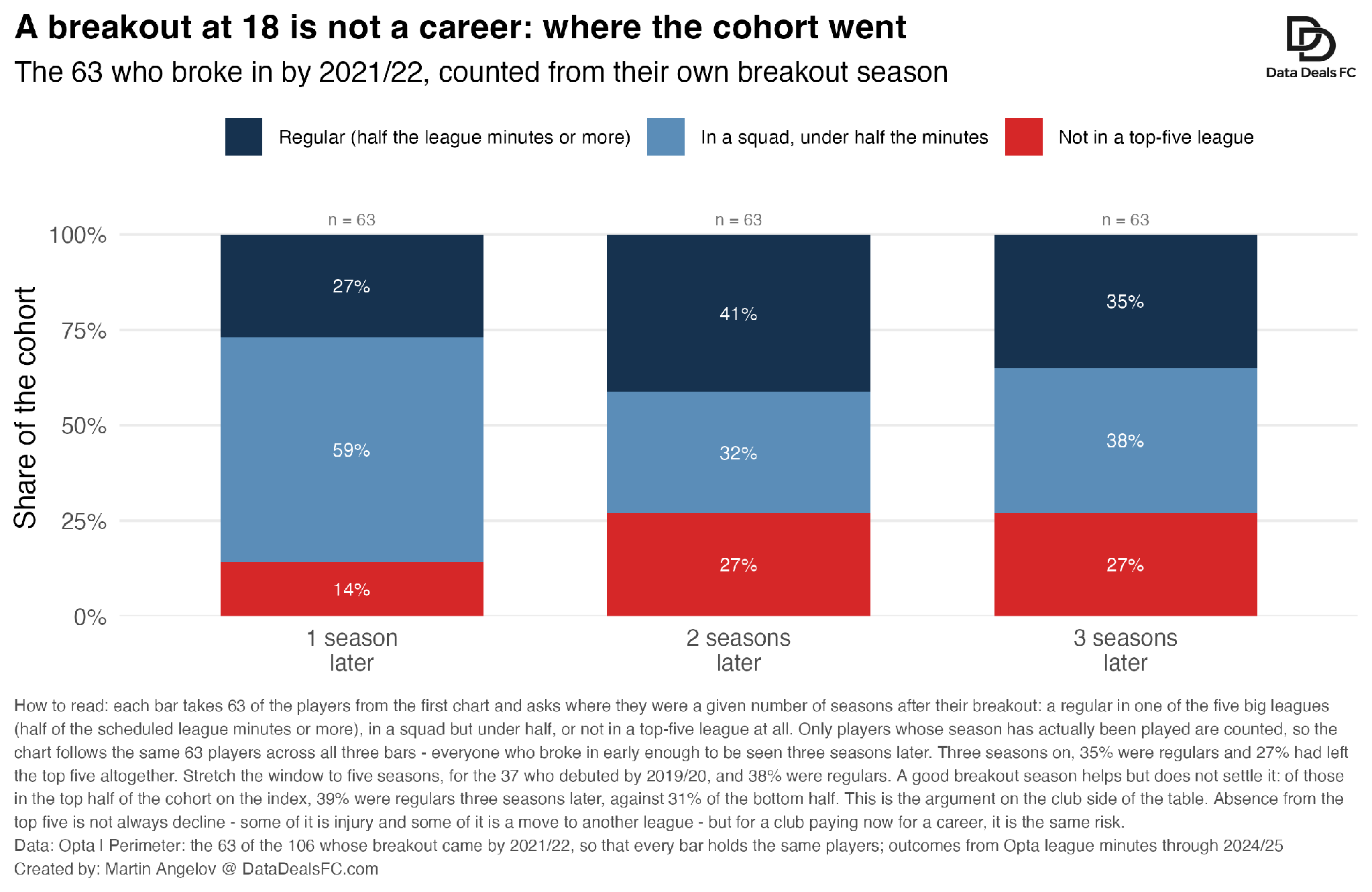
Only 35% were still regular starters or regular-minute players in a top-five league three seasons later.
Another 38% remained in a squad but played less than half the available minutes. 27% were no longer in a top-five league.
The better performers had somewhat stronger outcomes: 39% of the top half became regulars, versus 31% of the bottom half. But a breakout season was nowhere near a guarantee.
If I were on Arsenal’s side, I would point at that chart and ask: why should we pay today for a ten-year career when two-thirds of the comparison group were not regulars three years later?
That is a fair counter-argument. Lewis-Skelly had shown that he could play at the level. Arsenal still had to price the risk that he would not maintain it.
7. What happened after he signed?
Any fair assessment also needs the benefit—and the danger—of hindsight. These numbers were not available when he signed in July 2025.
His share of Arsenal’s league minutes fell from 42% in 2024/25 to 24% in 2025/26. Read only that figure and you might conclude that his place disappeared.
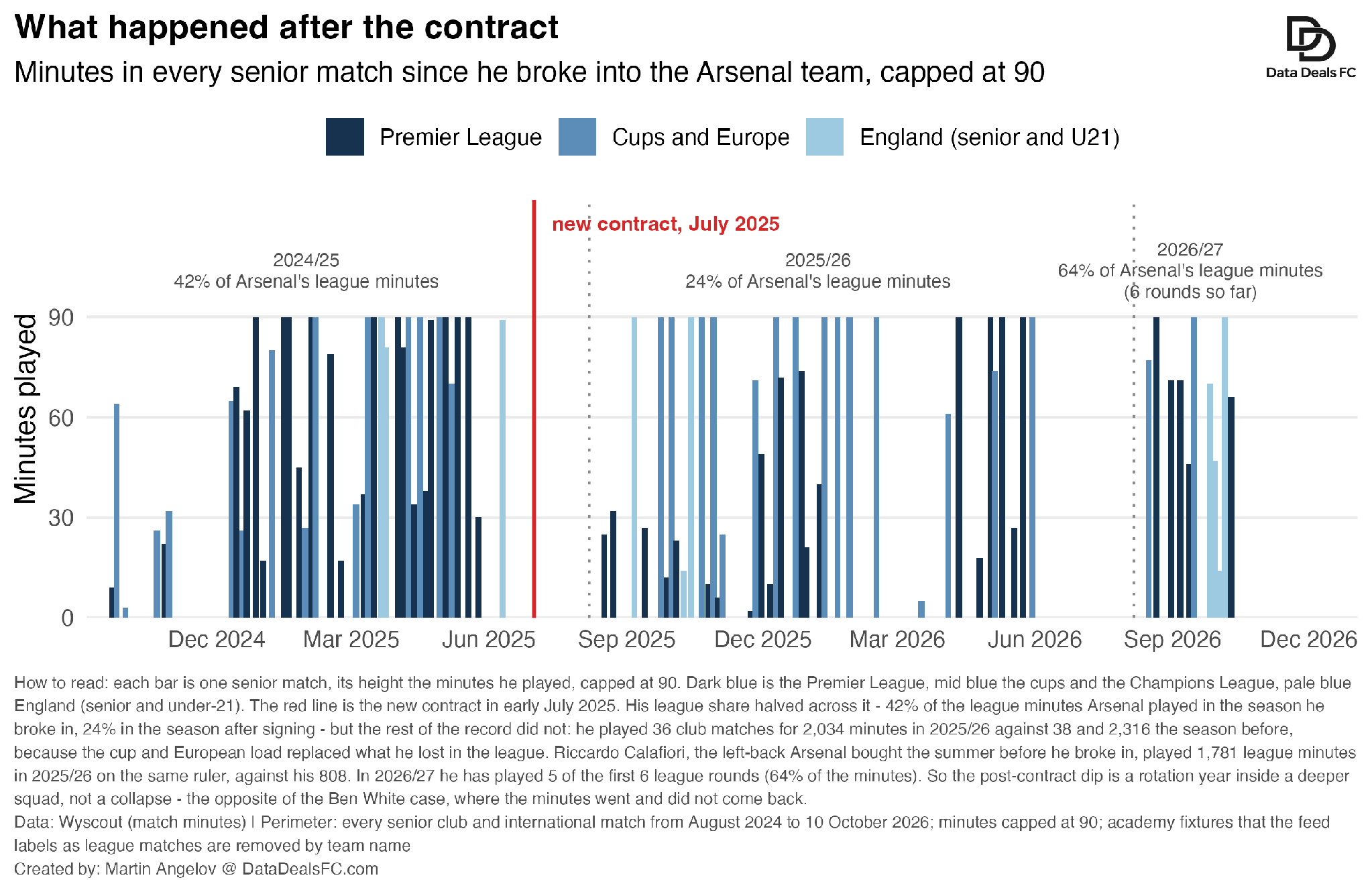
Across all club competitions, though, he played 36 matches and 2,034 minutes in 2025/26, compared with 38 matches and 2,316 minutes the season before. Cups and Champions League appearances made up part of the league shortfall, while Calafiori took more Premier League minutes.
After a period with England’s under-21s, Lewis-Skelly returned to the senior squad in September 2026. As of 10 October 2026, he had appeared in five of Arsenal’s first six league matches, playing 64% of the available minutes. That is a return to involvement, not yet proof of a settled first-choice position.
I would call it a year of rotation, not a collapse. The longer-term bet is still being tested.
So, did the data win him the deal?
We cannot know how much of the eventual contract was caused by the data team. The discussions are private, the wages are estimates and Arsenal had reasons of its own to secure an excellent academy player until 2030.
But the reconstruction tells us something useful. At around £4,000 a week, Lewis-Skelly was paid like the bottom tenth of the Premier League. After one extraordinary breakthrough season, the reported raise moved him into the middle of the division.
Against established full-backs of similar measured quality, he still looked cheap. Against players of his own age, his new wage looked much closer to normal. And across clubs, young academy graduates tended to be paid substantially less than equally measured recruits.
The most powerful line in this negotiation was never “look how many times my salary went up.” It was “compare what I do with what players like me get paid.” And to show that having a data team by your side helps a lot.
Boom — that was how Myles Lewis-Skelly used data scientists to secure his 10x contract with Arsenal.
Thanks for reading all the way through ❤️.
I hope you enjoyed this article as much as I enjoyed putting it together.
Cheers,
Martin
PS. If you liked this piece chances are you’ll also enjoy how Kevin De Bruyne himself used data scientists to secure a 30% increase at 29, or how Man City used a magical data science technique to find his replacement or what Bruno Fernandes’ data science team likely argued in his ongoing negotiations with United.
P.P.S. If a tailor-made report (such as the one I did on Kai Havertz’s contract negotiation) is what interests you (including on women’s football), drop me a line.
This piece was AI-assisted. Claude asked for a 10x raise after editing it. I told it to be patient. It's still young.
Really interesting article! My interpretation is that this could reflect a market gradually moving towards equilibrium, with players tending to earn closer to what they “deserve” in terms of their perceived market value.
When a young player leaves his academy club, another club has identified enough potential to pay for him. A higher salary also provides an incentive to leave a familiar, secure environment and make that move.
For those who stay, there may be no outside offer attractive enough to trigger a transfer. Their clubs may also have limited room to increase their wages because a substantial share of the budget is already committed to older, established signings.
As these academy graduates gain experience and demonstrate their value, their salaries may catch up. If the average wages of the two groups converge at a certain age, that could reflect the market reaching a balance: earnings increasingly reflect what players have shown at senior level, rather than the potential that initially encouraged another club to recruit them.
I haven’t analysed the underlying data, so this is simply a hypothesis about what might explain the pattern.
I'm not sure he even needed data scientists. All Arsenal needed to do was watch the tape. Serious baller!