


Hi friends,
When football is on pause, fans live on transfer rumours. I know I do.
And one question has always bugged me: how often can we really trust them?
So today, I decided to find out.
BBC Sport’s daily gossip column brings together transfer rumours from across the media every day. But how many of those stories actually come true?

I collected all 997 editions published between 31 January 2024 and 29 October 2026, covering 13,356 transfer rumours.
For each one, I extracted the player, his current club, the club reportedly interested in him, whether the story concerned interest, a bid, talks or an agreement, any quoted transfer fee, and the outlet credited.
Then I examined whether the player joined that club before the next transfer deadline.
By the end of this article, you’ll learn:
How many transfer rumours actually come true?
Which sources are the most reliable?
Is Fabrizio Romano more accurate than The Athletic?
How often do “agreed” deals actually happen? (Spoiler: nowhere near 100%)
Are expensive transfers more or less likely to materialise?
Does a second source make a rumour more believable?
And when your club denies a story, should you believe them?
Plus a few other surprises along the way.
Before we get to the nitty-gritty, let’s start with a few descriptive statistics.
1. What’s in the dataset?
First, some basics.
How many rumours appear each day?
Which sources do they come from?
Which clubs dominate the headlines?
And what kind of rumours are we dealing with?
Let’s start with the volume.
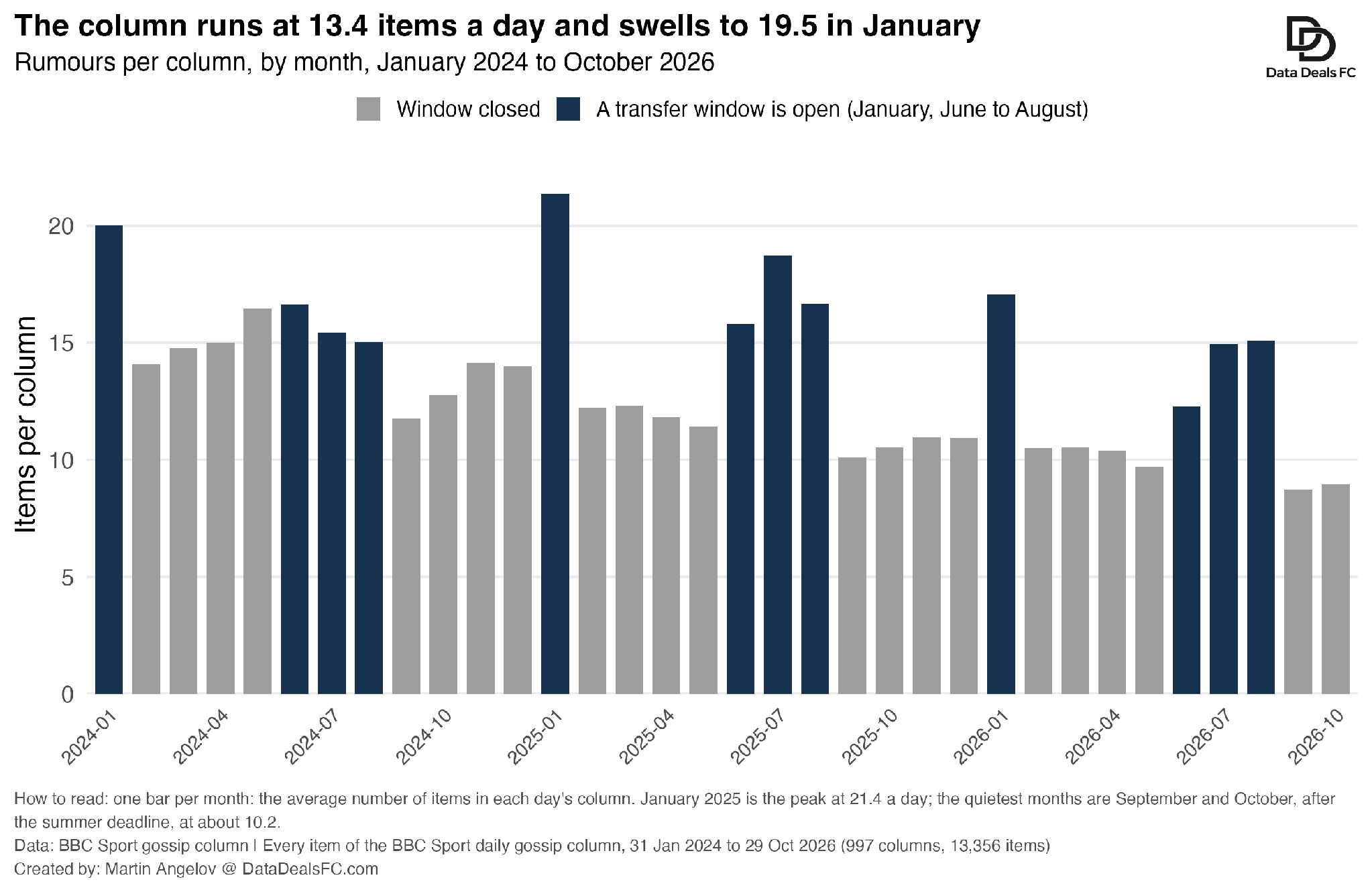
BBC Sport’s daily gossip column contains around 13 items a day on average, with predictable spikes during the transfer windows in January and over the summer. Nothing surprising here.
Now, what about the sources?
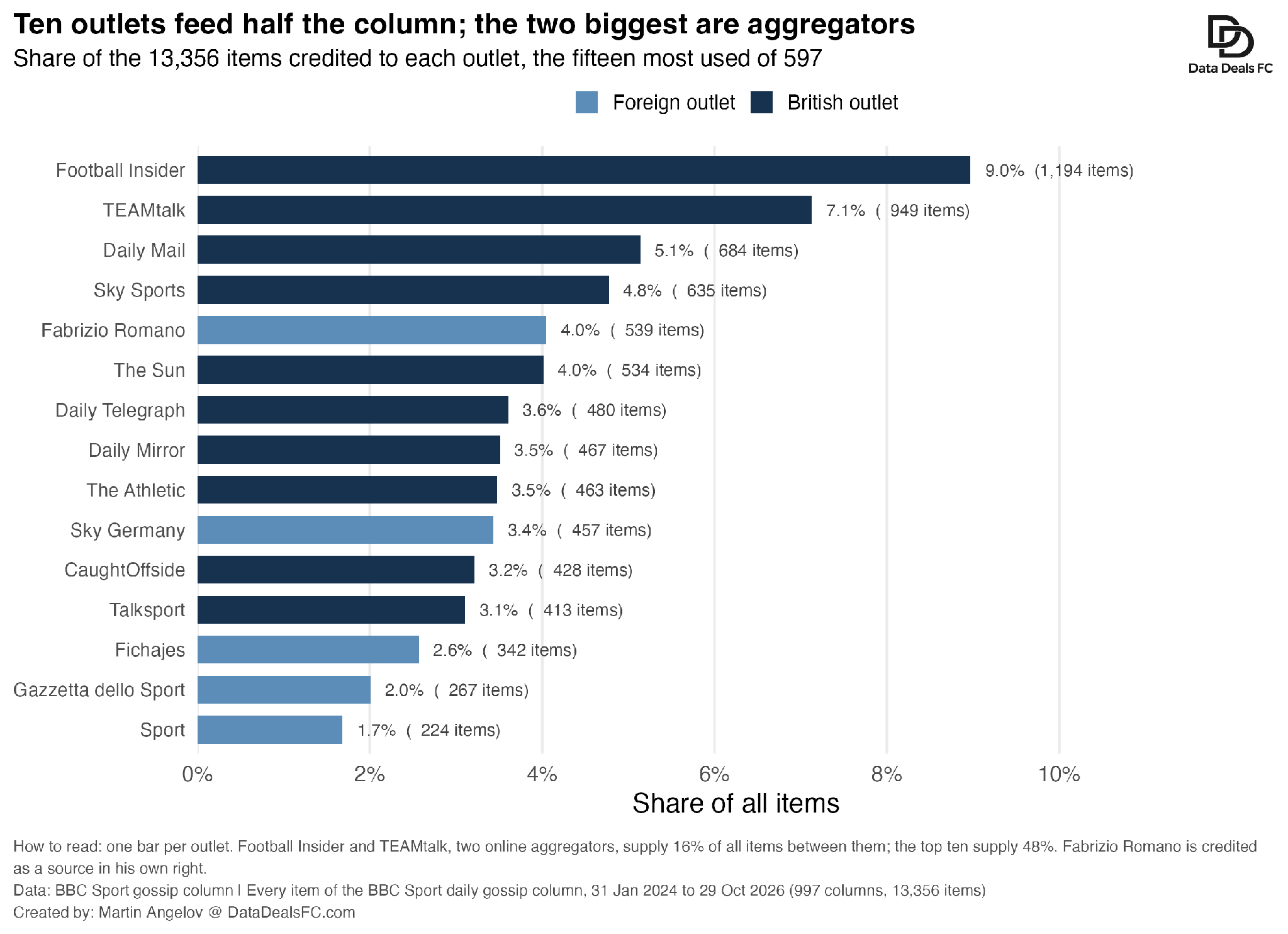
The BBC credits 597 different outlets, but just 10 of them account for half of all rumours.
The two biggest contributors are Football Insider and TEAMtalk, both online football news aggregators. Together, they supply 16% of all items.
Interestingly, Fabrizio Romano is credited as a source in his own right more often than The Athletic.
Around two-thirds of the items cite British outlets, which makes sense given the column’s focus on English football. Italian sources account for 12% and Spanish sources for 9%.
Next, which clubs attract the most rumours?
You probably won’t be surprised by the answer.
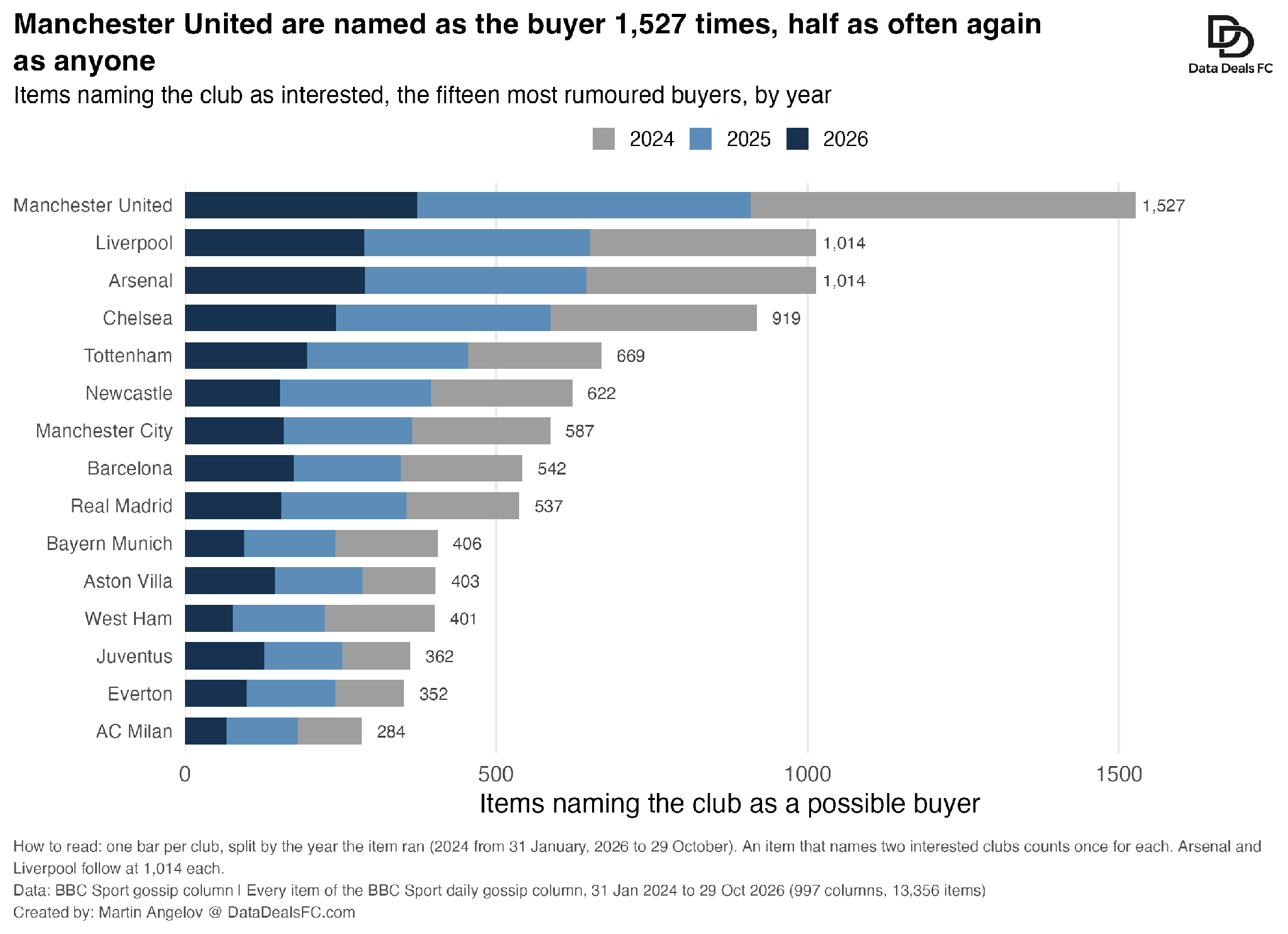
Manchester United. By quite some distance.
United were named as the interested club 1,527 times in less than three years. That’s roughly 50% more often than Arsenal, Liverpool or Chelsea.
Finally, what kind of rumours are we talking about?
Six in ten are simply stories of interest: a club is monitoring a player, considering a move or keeping tabs on him.
Only one in ten reports that a deal has been agreed.
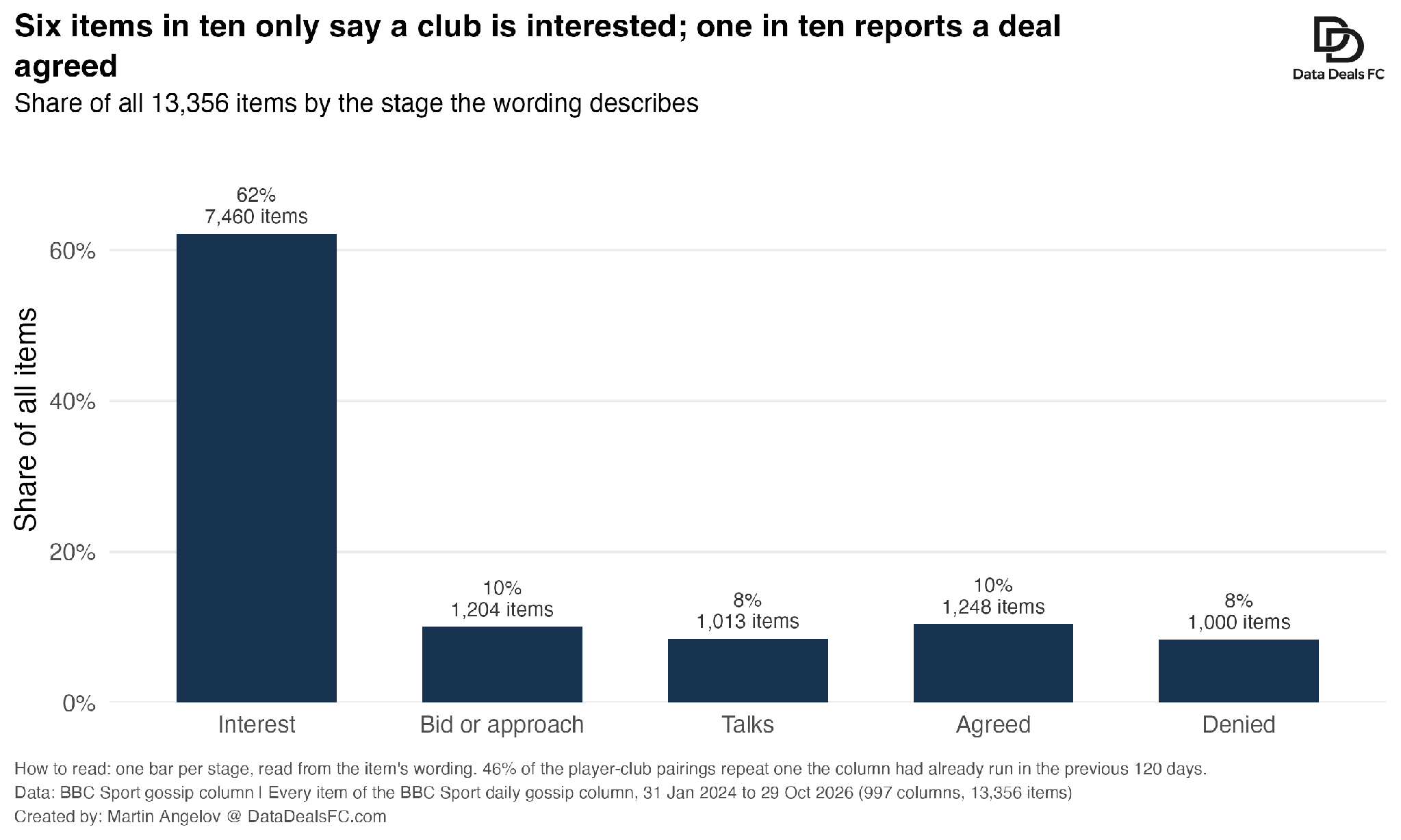
And here’s another interesting detail: 46% of player-club pairings repeat a link the column had already reported in the previous four months. In other words, nearly half the pairings are stories we’ve heard before.
So we have thousands of rumours, hundreds of sources, plenty of Manchester United links and a lot of recycled stories. But how many of them actually come true?
Let’s get into it.
2. 20% of rumours come true
Of the 7,625 rumours old enough to judge, 19.5% ended with the player joining the club the item named by the next deadline. Give it two windows and the figure rises to 21.7%; give it a full year, 22.8%.
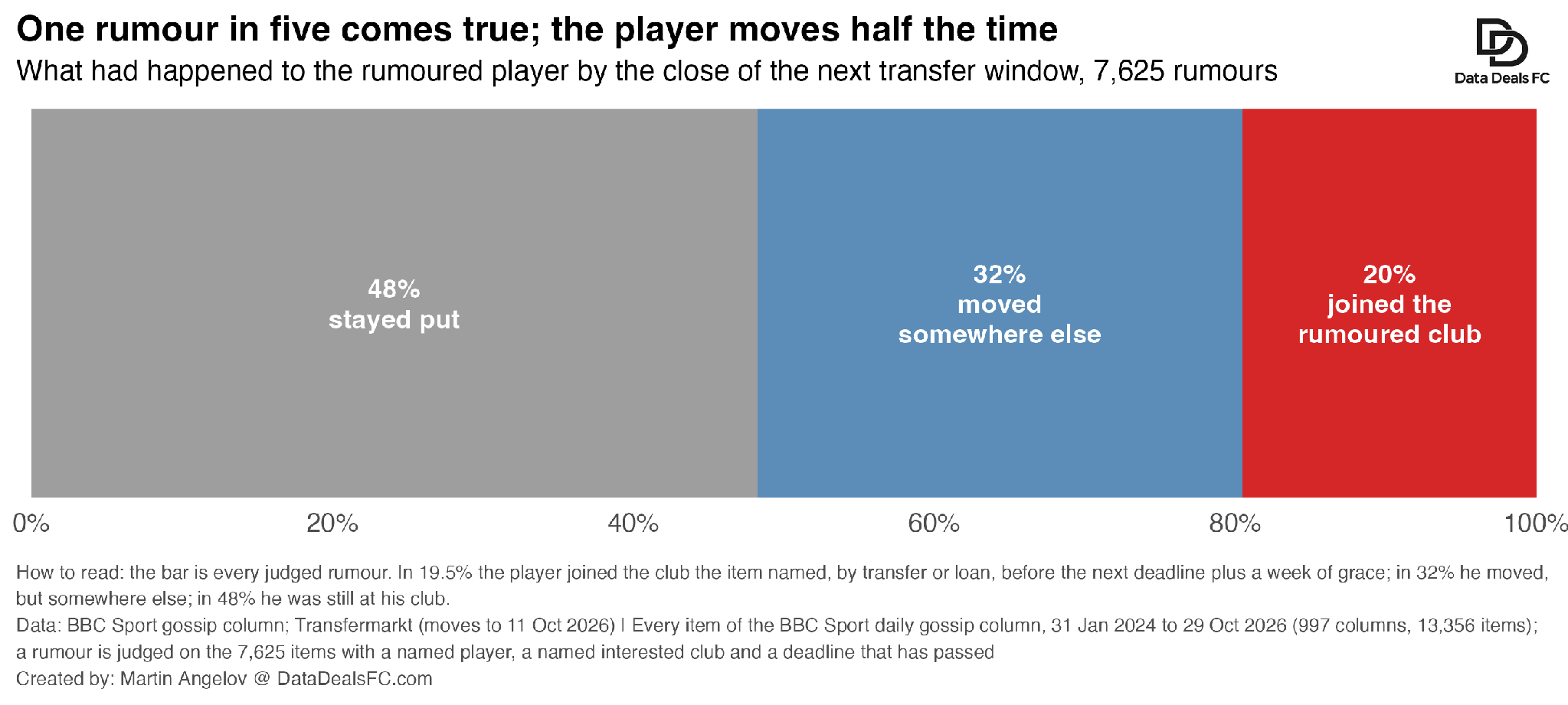
Another 32% of rumoured players did move before the deadline, just not to the club in the story. Put the two together and a rumour correctly predicts that a player leaves half the time; it correctly predicts where he goes one time in five.
Of the players who moved, fewer than four in ten went to the rumoured club.
The column is a good detector of movement and a poor detector of destination.
3. “Agreed” transfers happen 59% of the time
The single most useful thing about a gossip item is its verb.
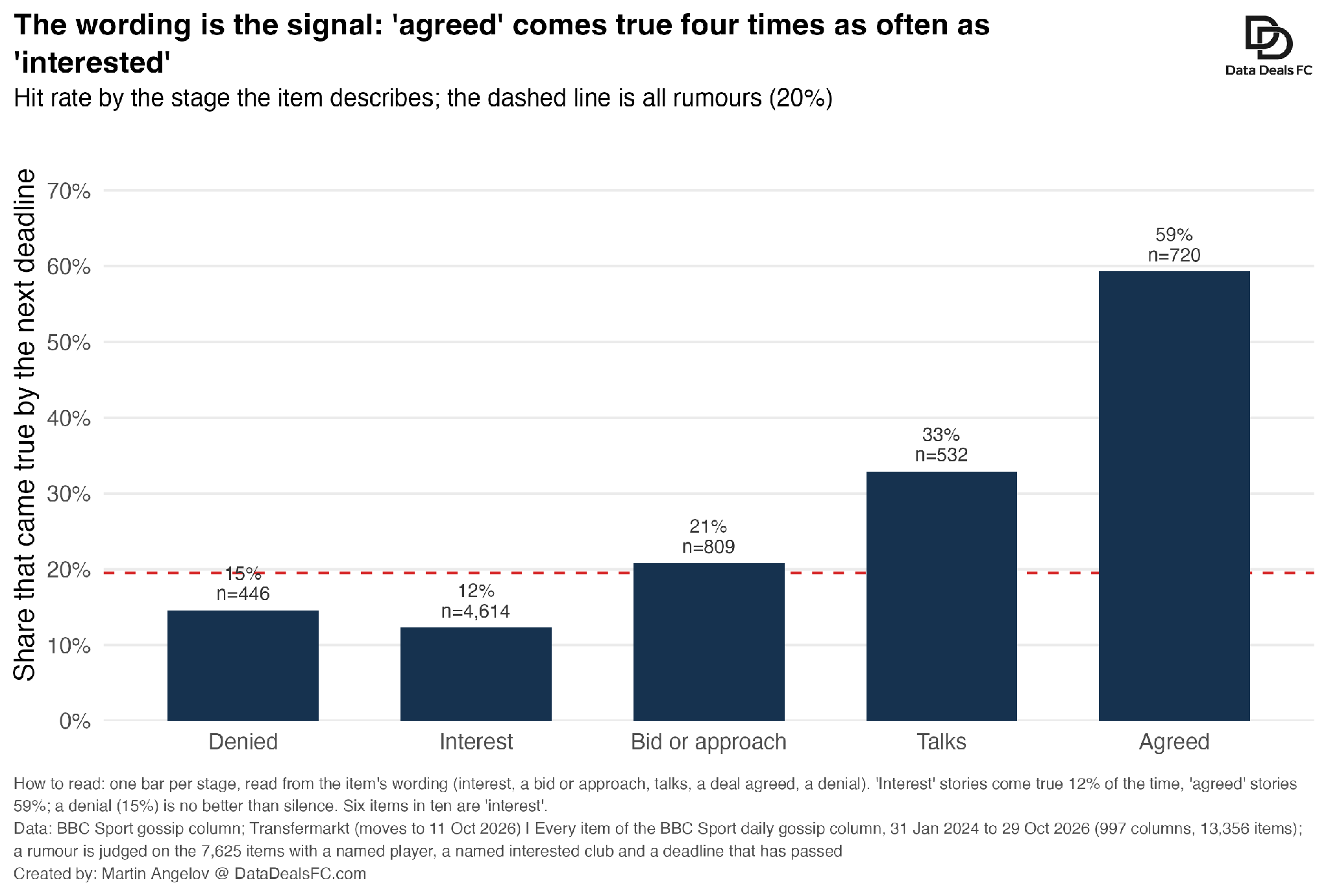
Items that say a club is interested come true 12% of the time.
A bid or an approach: 21%.
Talks: 33%.
A deal agreed: 59%.
So a reader who only acts on “agreed” items is right three times in five; one who acts on “interested” is right one time in eight.
A denial is worth less than you would think
Take every item where somebody said no: the club said the player was not for sale, the player said he was staying, a bid was turned down. One in seven of those deals happened anyway. West Ham “rejected” Tottenham’s £50m for Mohammed Kudus a week before selling him; Borussia Dortmund “walked away” from Fabio Silva a fortnight before signing him.
15% is not far below the 20% for the rest of the column, and the gap is bigger than it looks. Denials come late in a saga, in the summer, from the better outlets, and those are the rumours that come true anyway. So I compared each denial only with items that looked the same in every other way: the same point in the saga, the same month, the same sort of outlet.
On that fairer test a denial takes a story from about a 20% chance to about 13%. It lowers the odds. It does not kill the deal. And the player’s word is no firmer than the club’s: “wants to stay” came true 9% of the time, “not for sale” 13%.
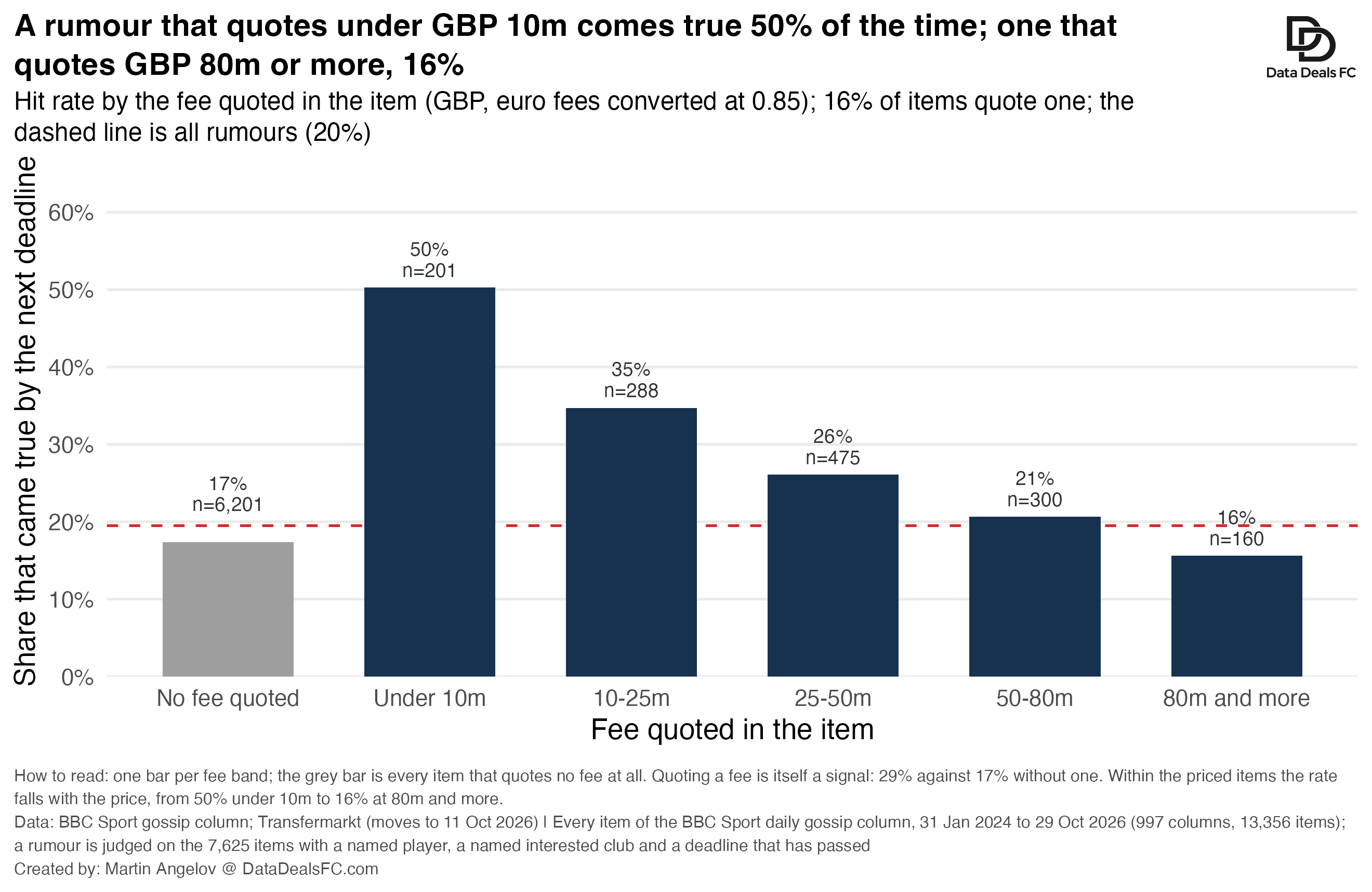
One more cue is in the wording. And the cheaper the fee quoted, the more likely the deal: items quoting under £10m came true 50% of the time, items quoting £80m or more 16%. Expensive players are rumoured for a living.
4. Which outlets to trust
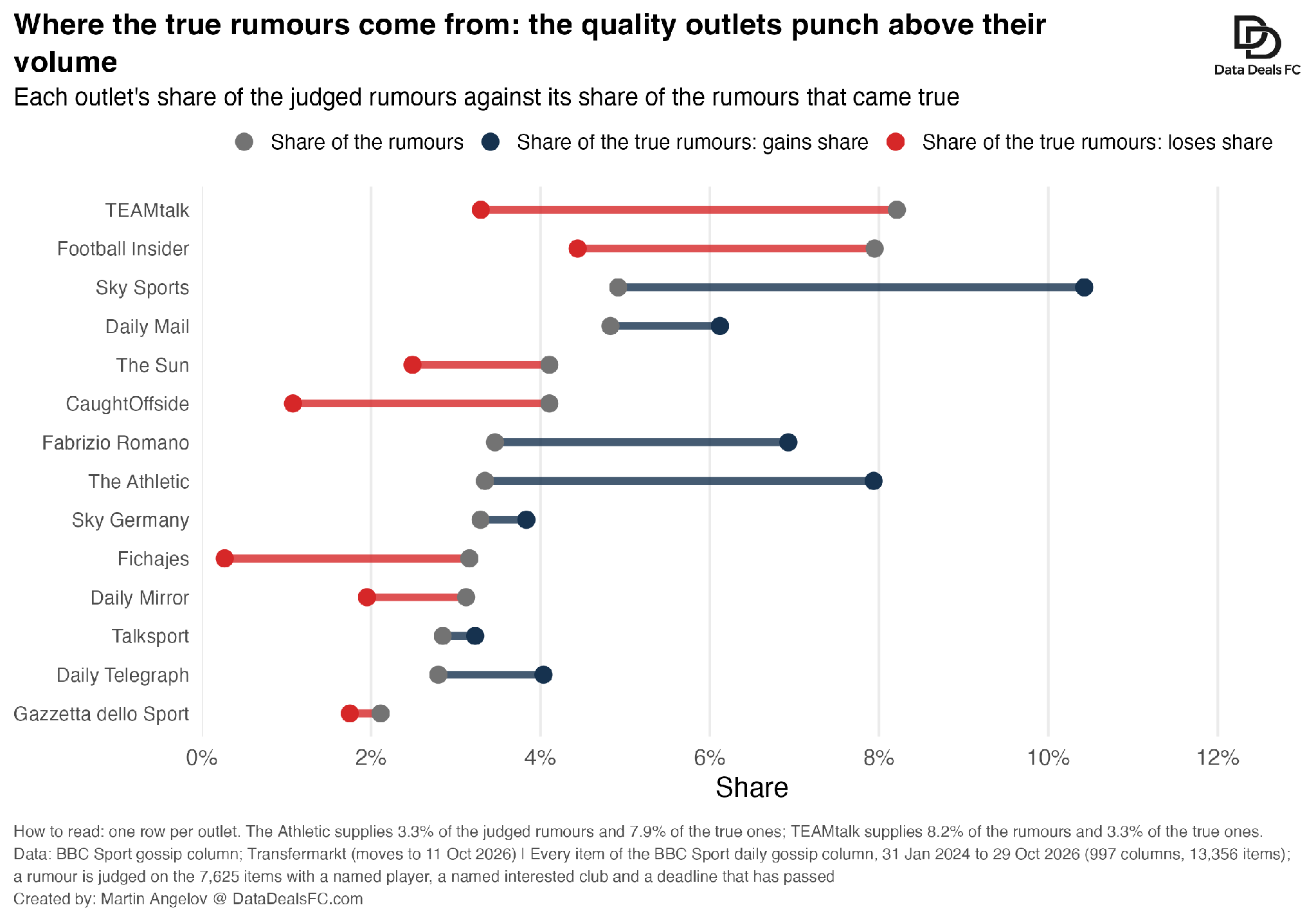
This is the chart I built the dataset for. Among outlets with 50 or more judged rumours
The Athletic’s came true 46% of the time
Sky Sports’ 41%
Fabrizio Romano, The Guardian and The Times sit at 30% or above,
the Telegraph and the Evening Standard just below.
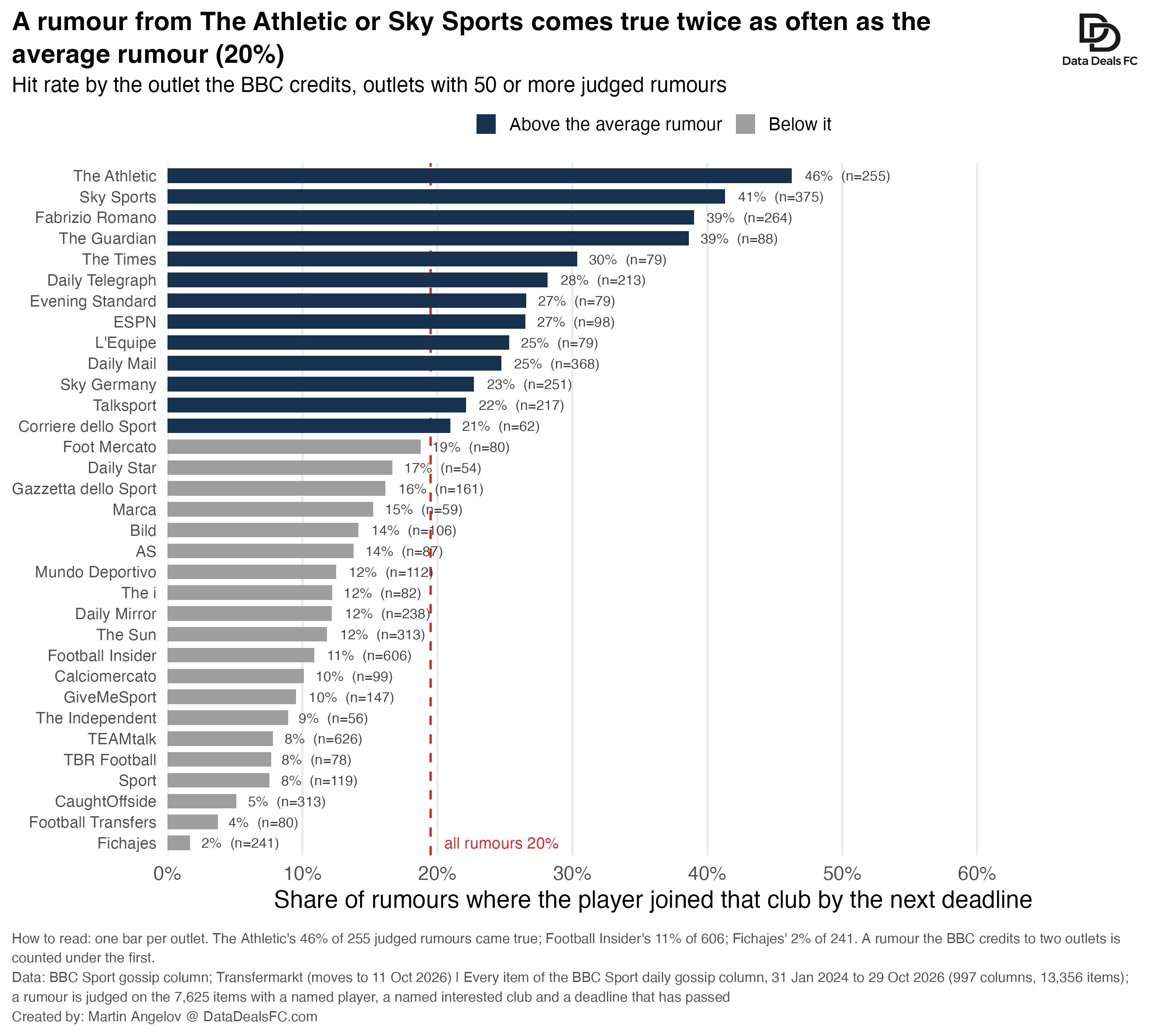
At the other end, Football Insider is at 11%, TEAMtalk at 8%, CaughtOffside at 5% and Fichajes, a Spanish rumour site, at 2% of 241.
The two outlets the column uses most are among the four it should trust least. Together they supply 16% of the judged rumours and 8% of the true ones.
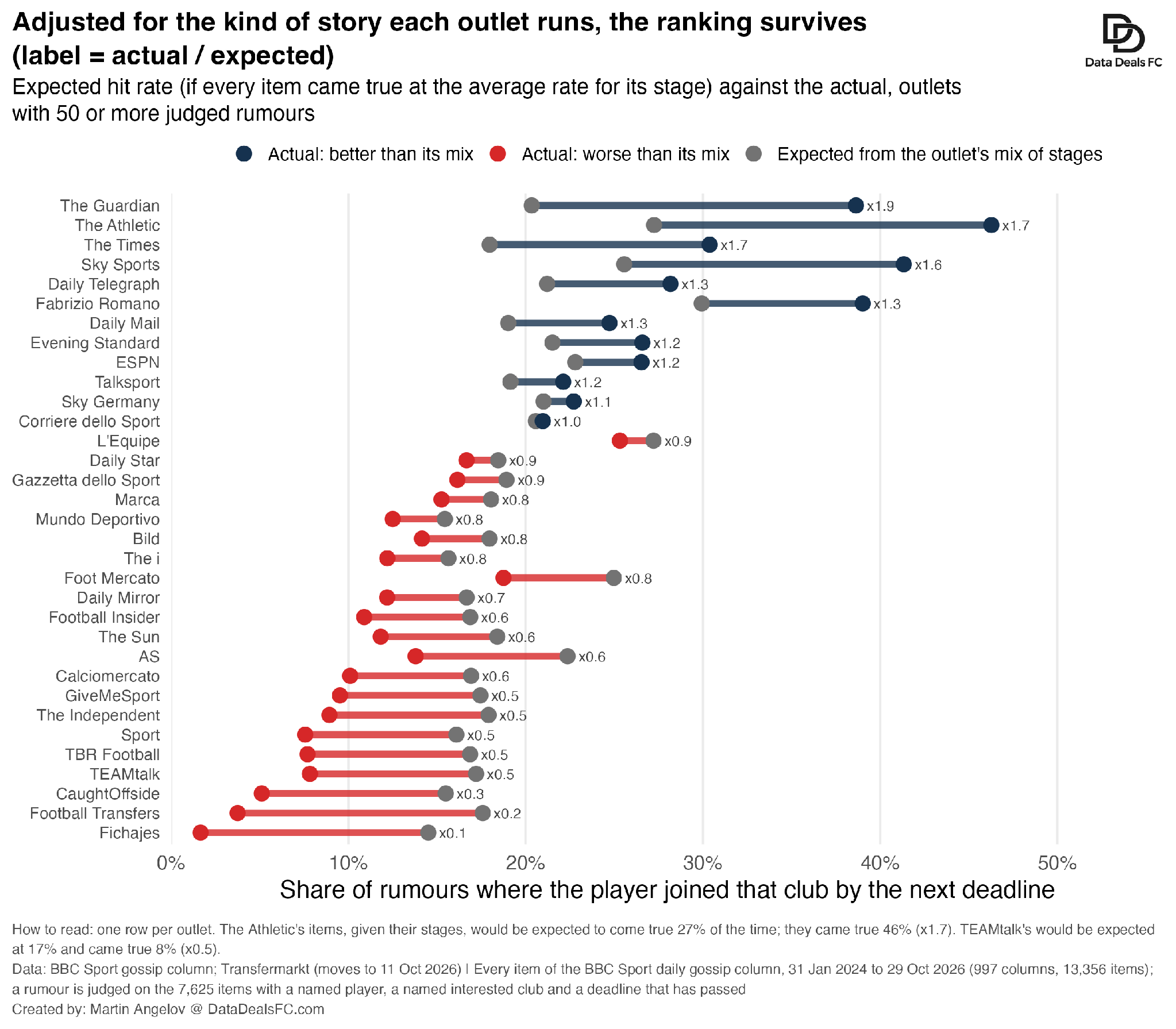
One nuance. The Athletic reports a lot of agreed deals; an aggregator reports a lot of interest. Perhaps the top outlets are simply running later-stage stories. So I gave each outlet the hit rate it would have had if every one of its items came true at the average rate for its stage, and compared.
The Athletic beats its expected rate by 1.7 times, Sky by 1.6, the Guardian by 1.9.
Football Insider reaches two thirds of its expected rate, TEAMtalk less than half, Fichajes about a tenth.
So the ranking survives.
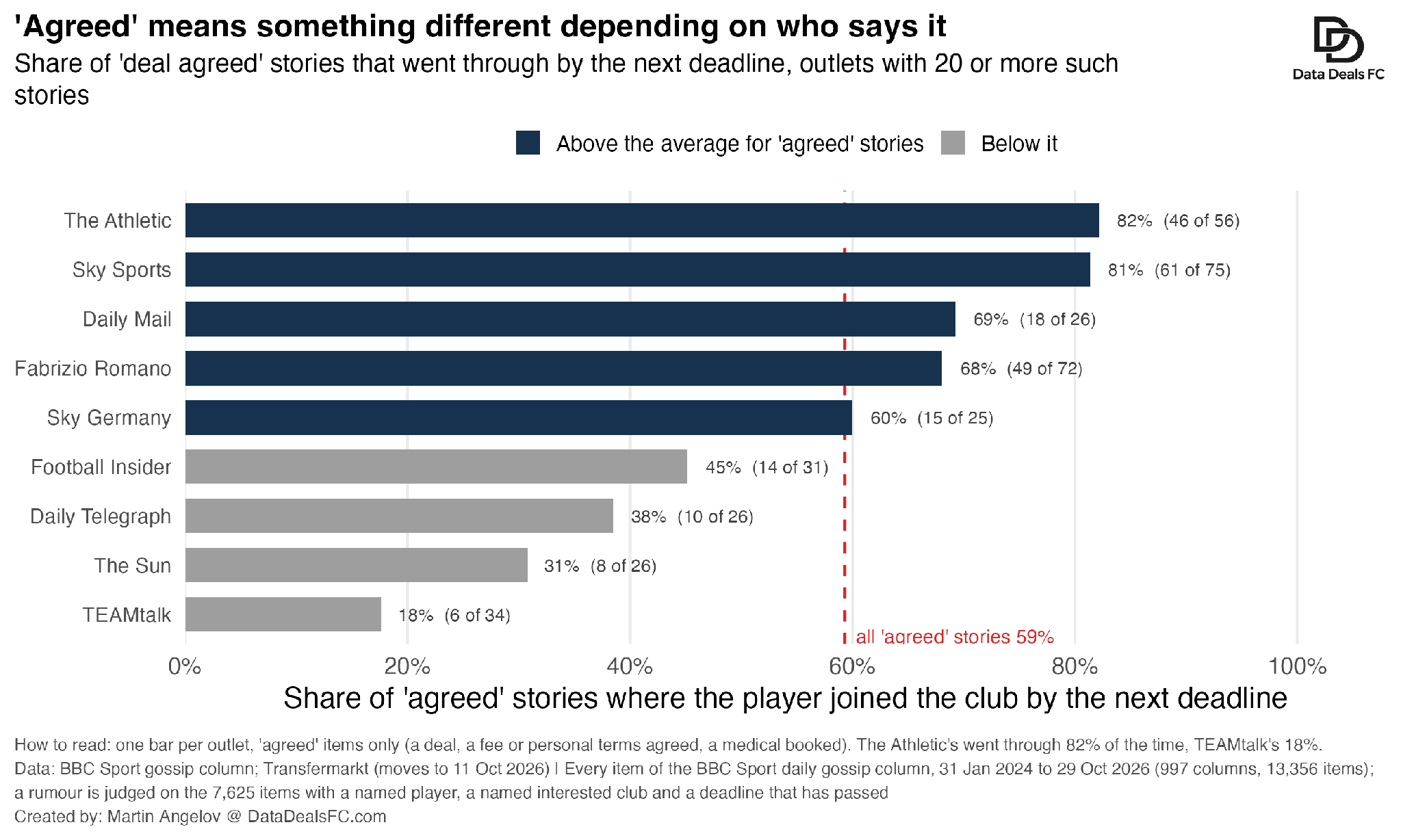
The sharpest version of course is to hold the stage fixed and look only at “agreed” stories.
When The Athletic says a deal is agreed, it goes through 82% of the time.
Sky Sports, 82%; Romano, 68%. When TEAMtalk says a deal is agreed, it goes through 18% of the time. The word means something different depending on who is using it.
5. David Ornstein or Fabrizio Romano?
The question I also wanted to answer, given the twitter storm on the subject in the summer, was: who is more reliable, David Ornstein or Fabrizio Romano?

Unfortunately, the data cannot answer it as asked. The BBC credits “The Athletic” rather than its reporters, and names Ornstein in four items out of 13,356, so the comparison has to be the outlet against the man.
On the raw numbers The Athletic is ahead, 46% to 39%.
Having said that, in 2024 Romano was slightly ahead, 38% to 36%. The Athletic’s lead comes from 2025 and 2026.
So I asked a sharper question. Who was first to link the player and the club, and were they right?
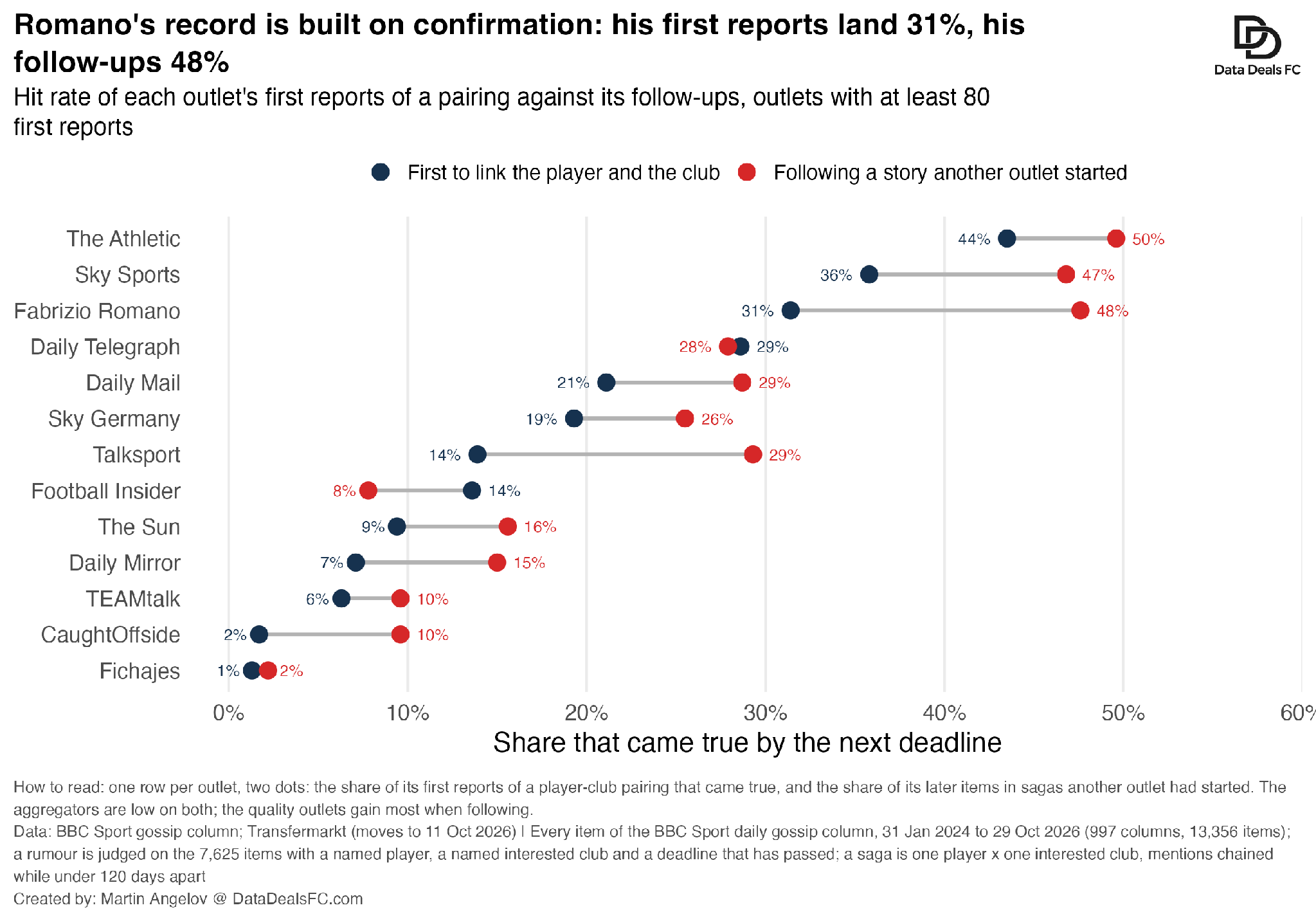
On that, the two separate. The Athletic’s first reports of a pairing came true 44% of the time (60 of 138), Sky Sports’ 36% (67 of 187), Romano’s 31% (44 of 140).
On follow-ups, items in sagas another outlet had started, the three are level at about half: 50%, 47% and 48%. Romano’s record in this column is built on confirmation. The Athletic’s is built on breaking.
Having said that, being first by itself is worth nothing. TEAMtalk was first 335 times and right only 21 of them; CaughtOffside was first 177 times and right three. Their true first reports ran a median 39 and 112 days ahead of the deal, which is not breaking news, it is guessing early and often. The outlets that break real stories do it four to six days before the announcement.
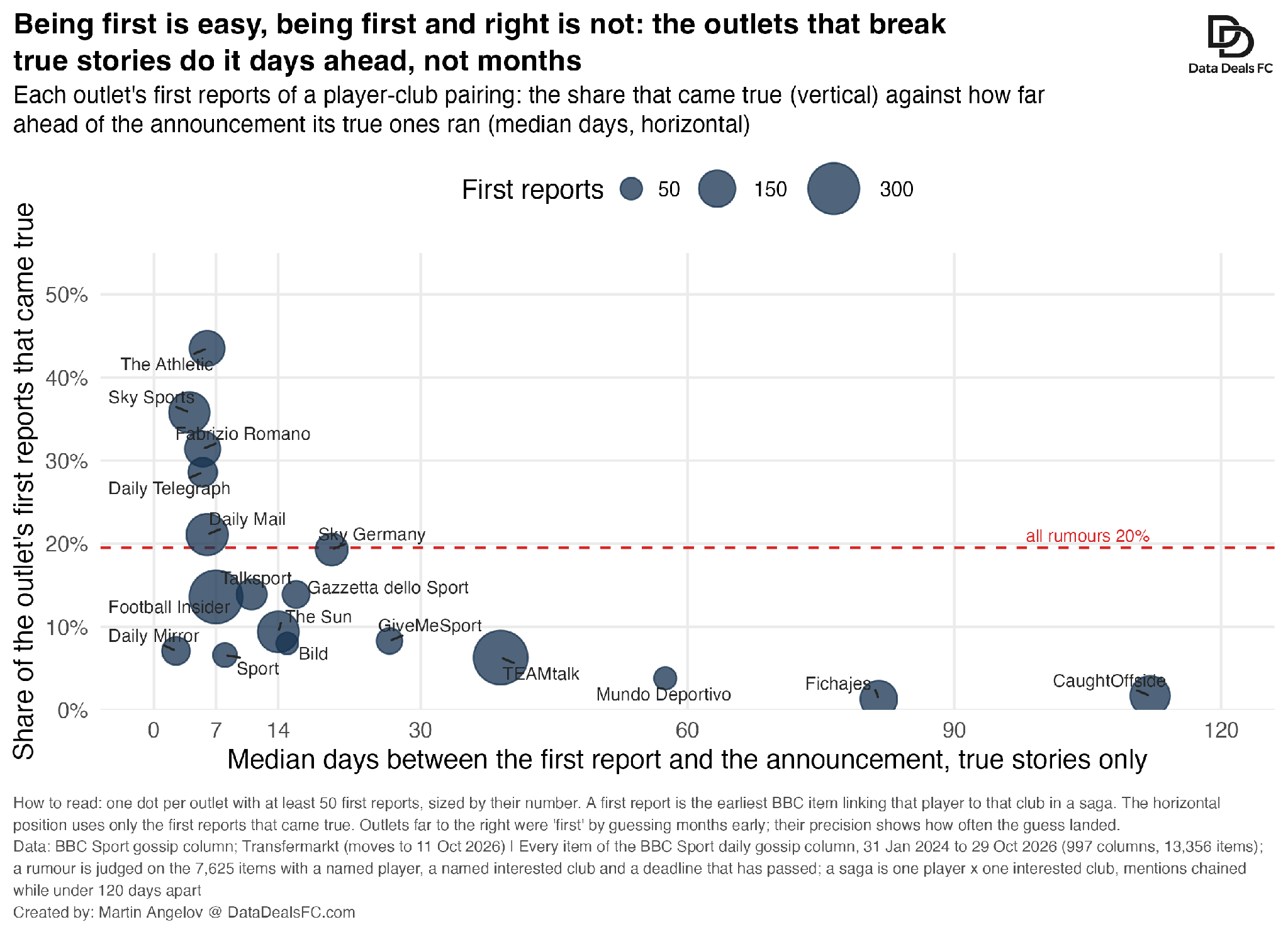
Two caveats before anyone tweets it. “First” means first in the BBC column, which credits one outlet per sentence and often picks a story up on its second day, so the world’s first report is not observed. And this measures the Romano stories the BBC chose to quote in a gossip column, not everything he posts. A “here we go” that the BBC runs as news rather than gossip is not in this data at all.
Two patterns by country. Rumours credited to Spanish outlets came true 8.5% of the time against 23.5% for Italian ones and 19% for English ones; Marca, AS, Mundo Deportivo and Sport are all below the line. And paywalled sources (The Athletic, The Times, the Telegraph) came true 31% of the time against 18% for free ones. In this market you get roughly what you pay for.
6. When the rumour runs
Timing matters almost as much as wording.
A rumour that runs while a window is open comes true 32% of the time; one that runs while the window is shut, 8%.
August is the best month at 38%, July next at 36%.
October is the bottom: two of 346 October rumours were true by the January deadline, and November and December are barely better at 2% and 5%. Part of that is composition, four October items in five are “interest” stories, but only part: on that mix October should have run at about 15%.
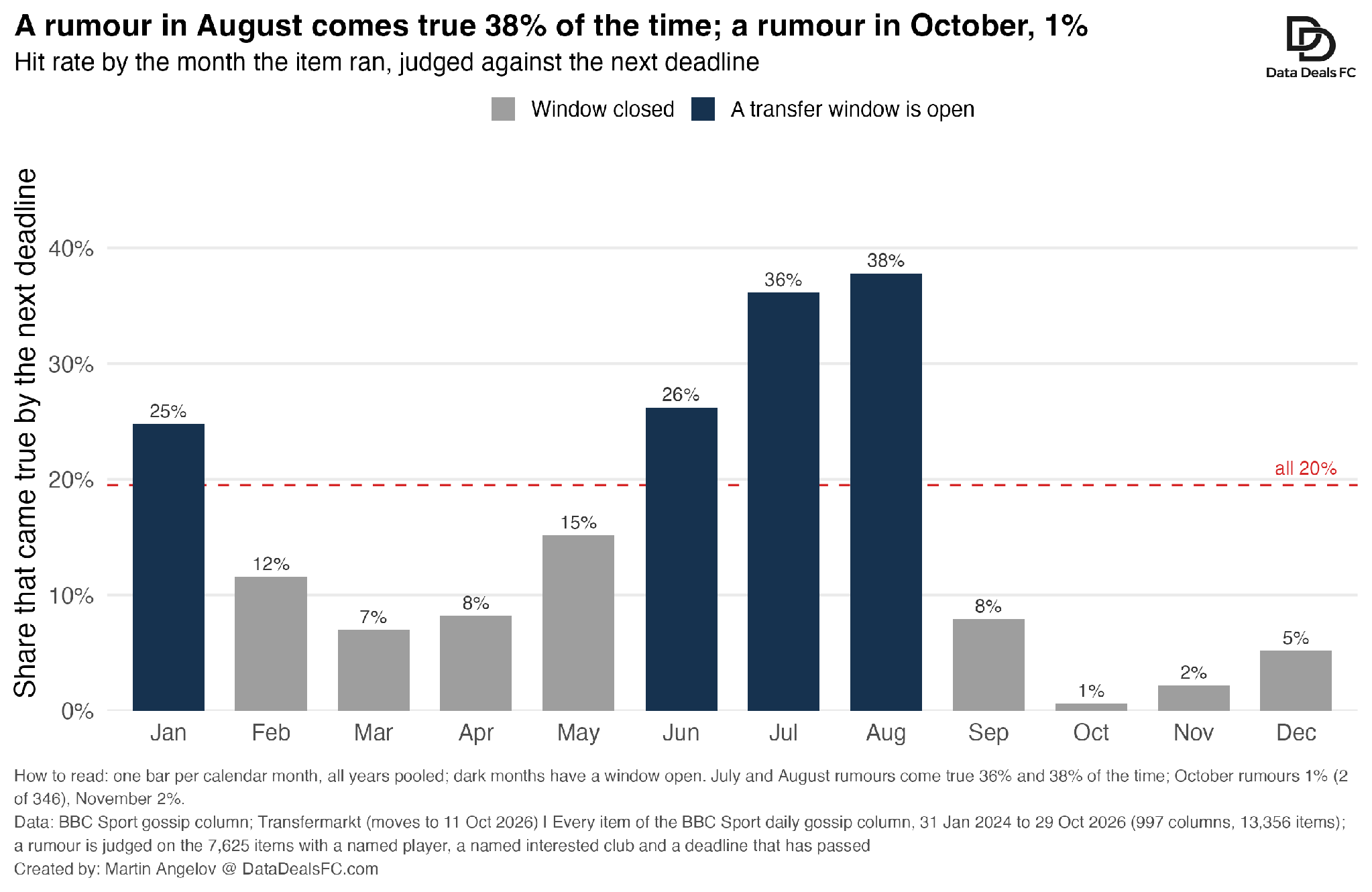
The better reading is that the autumn column is not wrong so much as early. Judge the same October rumours a year out instead of at the January deadline and 9% had come true, and 57% of the players had moved somewhere. The autumn is when the column writes next summer’s shopping list, and almost none of it is for sale in January.
7. The clubs: Manchester United are linked with everyone and sign 9%
Manchester United were the rumoured buyer in 835 judged items and signed the player in 75 of them: 9%, the lowest hit rate of any club with 100 or more rumours, level with Juventus (though 7 times more rumours).
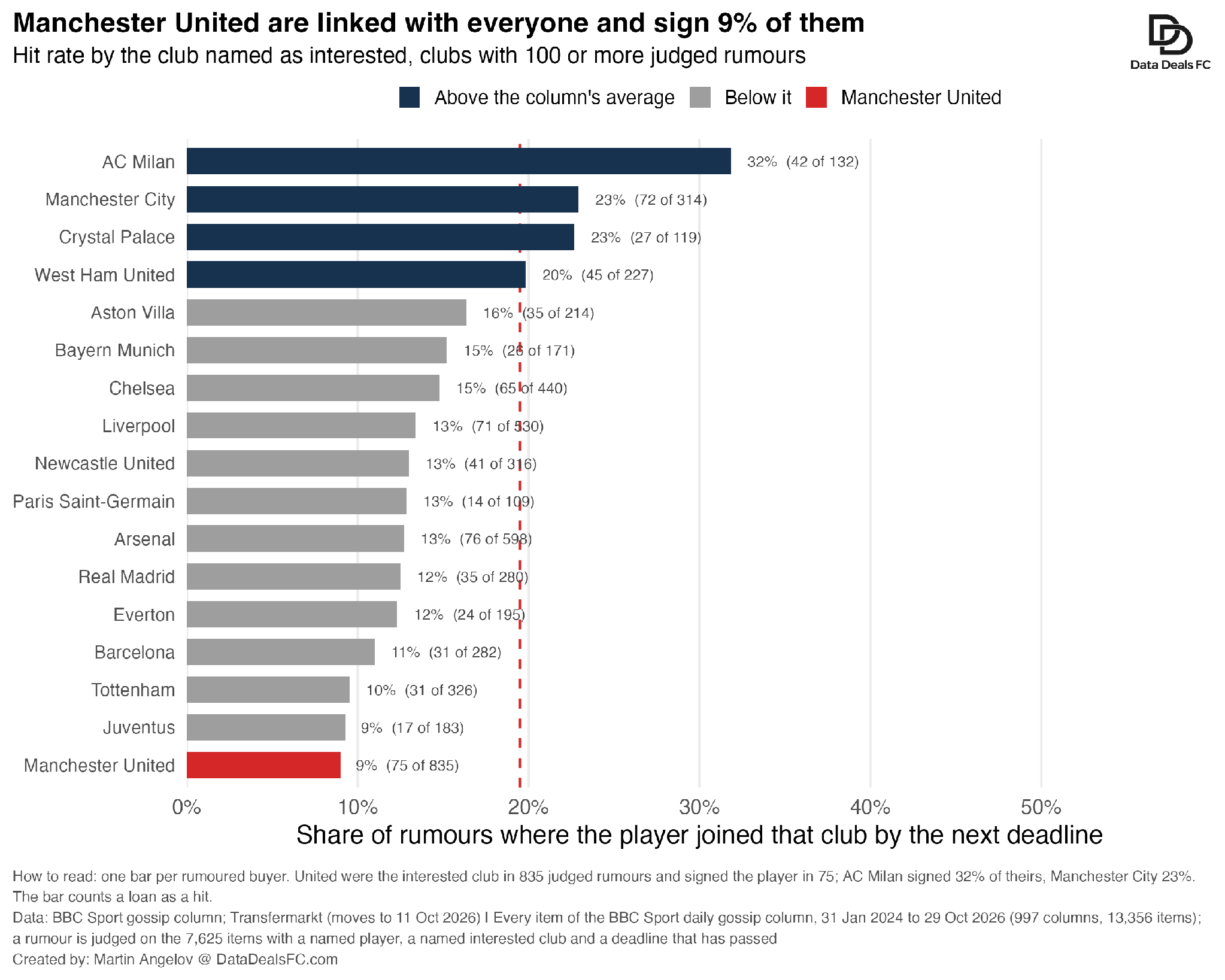
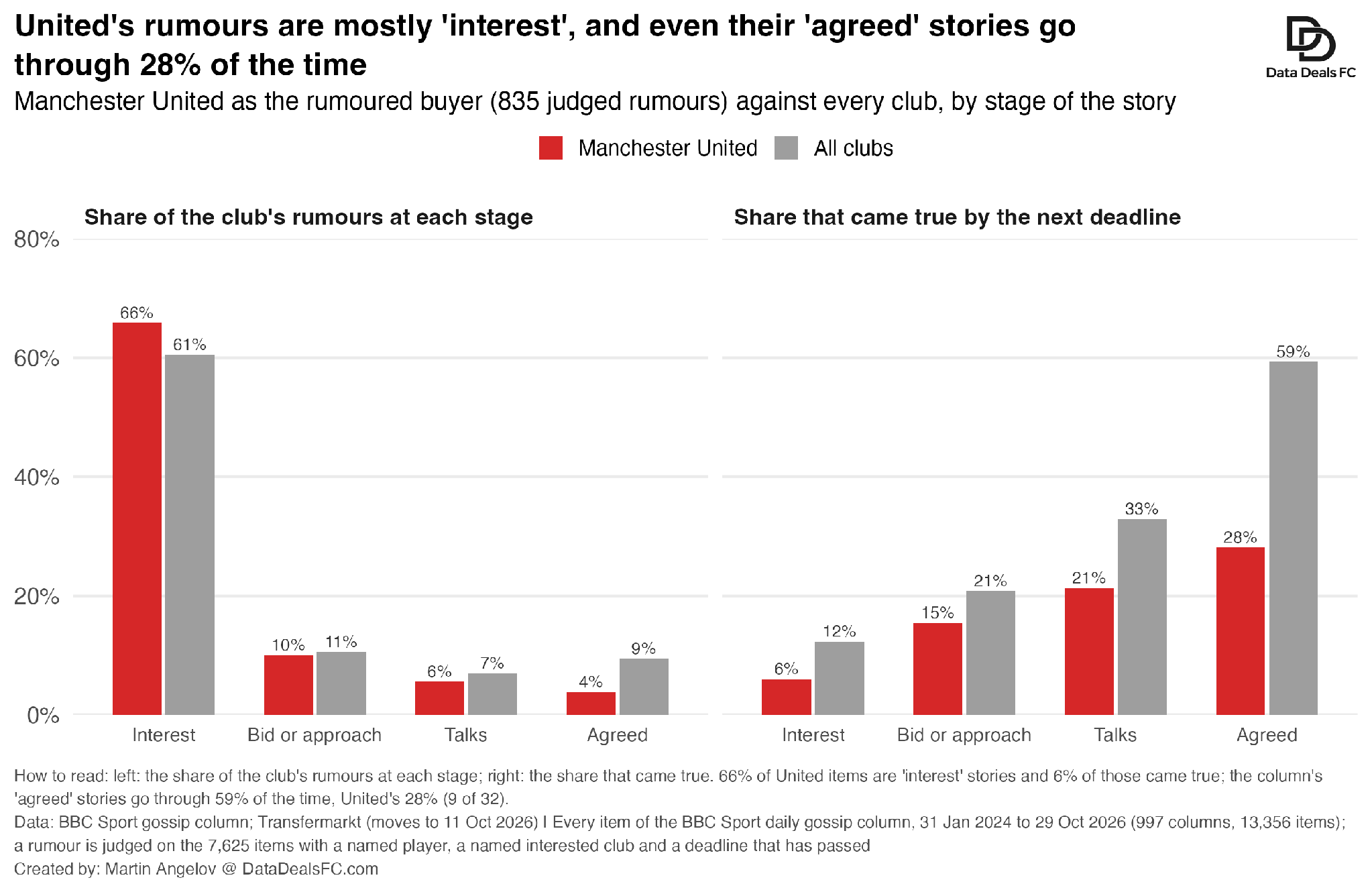
Part of that is composition. Two thirds of United items are interest stories, the kind that rarely come true for anyone, and those came true 6% of the time against 12% for everyone else’s.
But the gap is there at every stage. Even United’s “agreed” stories came true 28% of the time (9 of 32), against 59% for the column as a whole, so some of it is the club. A club in flux is linked with everyone, and most of those links are somebody’s wish.
The contrast is AC Milan at 32% and Manchester City at 23%. When the column links Milan with a player, it is usually because the deal is close.
Turn the question around and ask which clubs’ players actually leave when the column says they might. Chelsea’s did, 73% of the time, to somewhere. Real Madrid’s did 14% of the time. The column was right to keep writing about Chelsea departures and wrong to keep writing about Madrid’s.
8. How many rumours does a real signing carry?
Everything so far starts from the rumour and asks whether it happened. Start from the signing instead. Take every transfer or loan into a Premier League club since the summer of 2024, 541 signings of 491 players, and count the BBC items that had linked the player to that club between the previous transfer deadline and the day he arrived: the window’s own run-up, a median of 164 days.
Manchester United first, because they are the club the column talks about most.
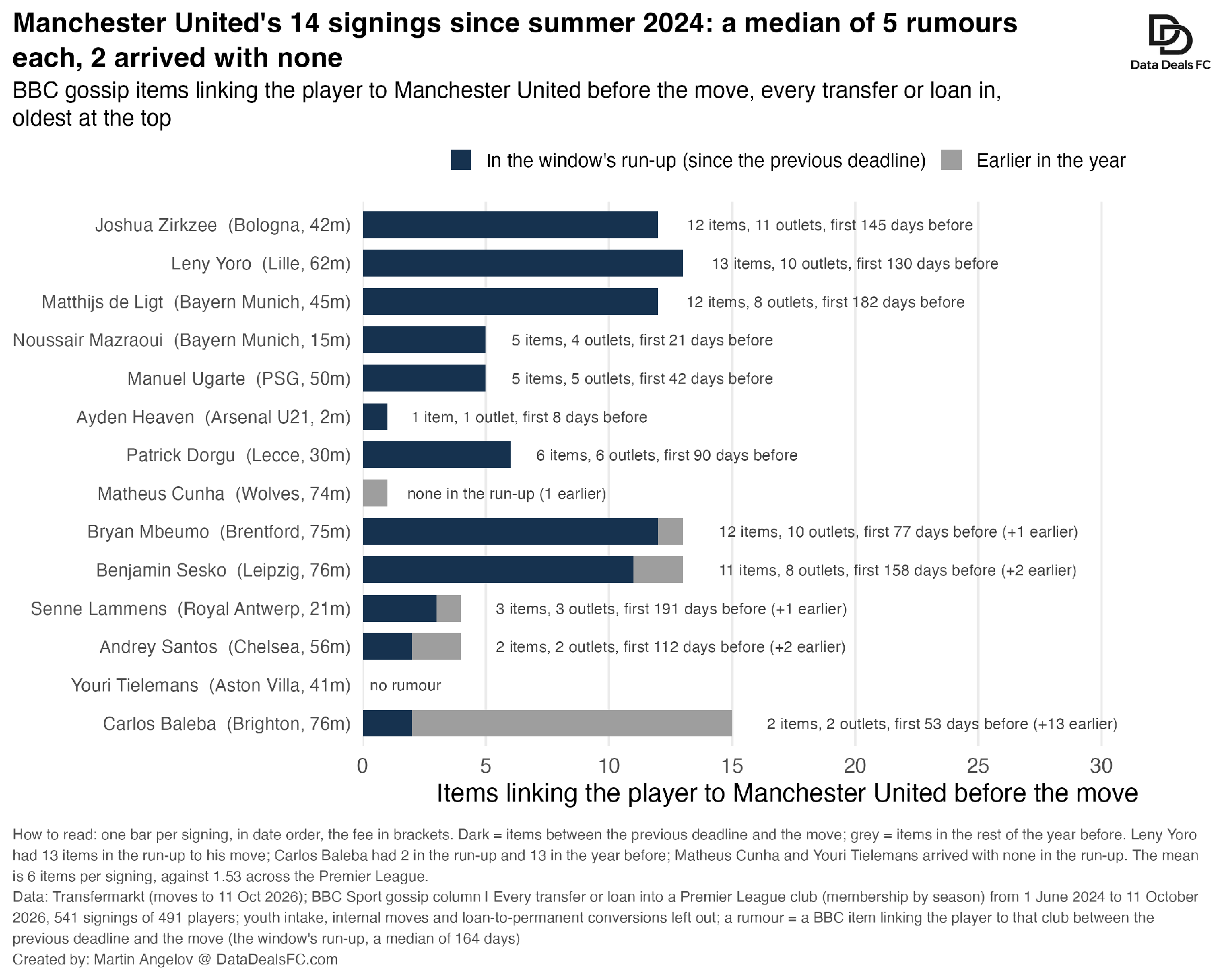
United’s 14 signings carried a median of 5 items each. Leny Yoro had 13 in the run-up to summer 2024, Joshua Zirkzee and Matthijs de Ligt 12 each; Bryan Mbeumo had 12 and Benjamin Sesko 11 the following summer. Carlos Baleba is the odd one: 2 items in the run-up to his move in August 2026 and 13 in the year before, a saga the column had already tired of. Two arrived with nothing in the run-up, Matheus Cunha, linked once the year before, and Youri Tielemans, never. Even at the most-rumoured club in the column, one signing in seven comes unannounced.
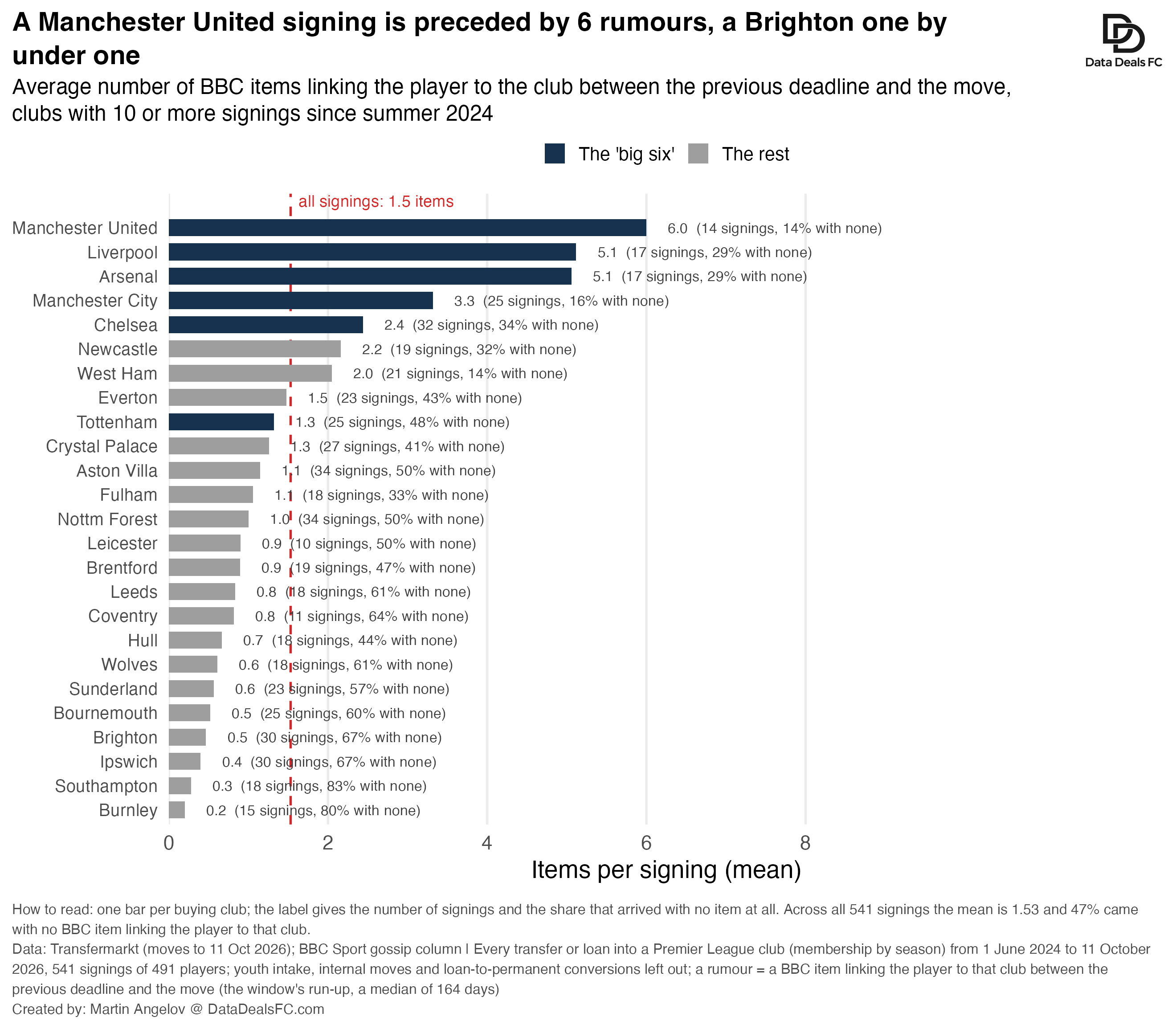
Across the Premier League a signing is preceded by 1.5 items on average, and 47% of signings had no item linking the player to the buyer at all.
The column reads clubs as much as players: a Manchester United signing carries 6 items, Liverpool 5.1, Arsenal 5.1, City 3.3, Chelsea 2.4, and then a long tail down to Brighton at 0.5 and Southampton at 0.3.
At Brighton, two thirds of arrivals had never been linked with the club in the column; at United, one in seven.
The one club that breaks the money pattern is West Ham: 21 signings at a median fee of about €17m, and only three arrived without a prior link, where the fee mix would predict about half.
Brighton, Wolves, Burnley and Southampton are quieter than their spending predicts; City, United and West Ham are louder.
Part of that is simply money. A €50m signing has been in the column for months; a loan has not.
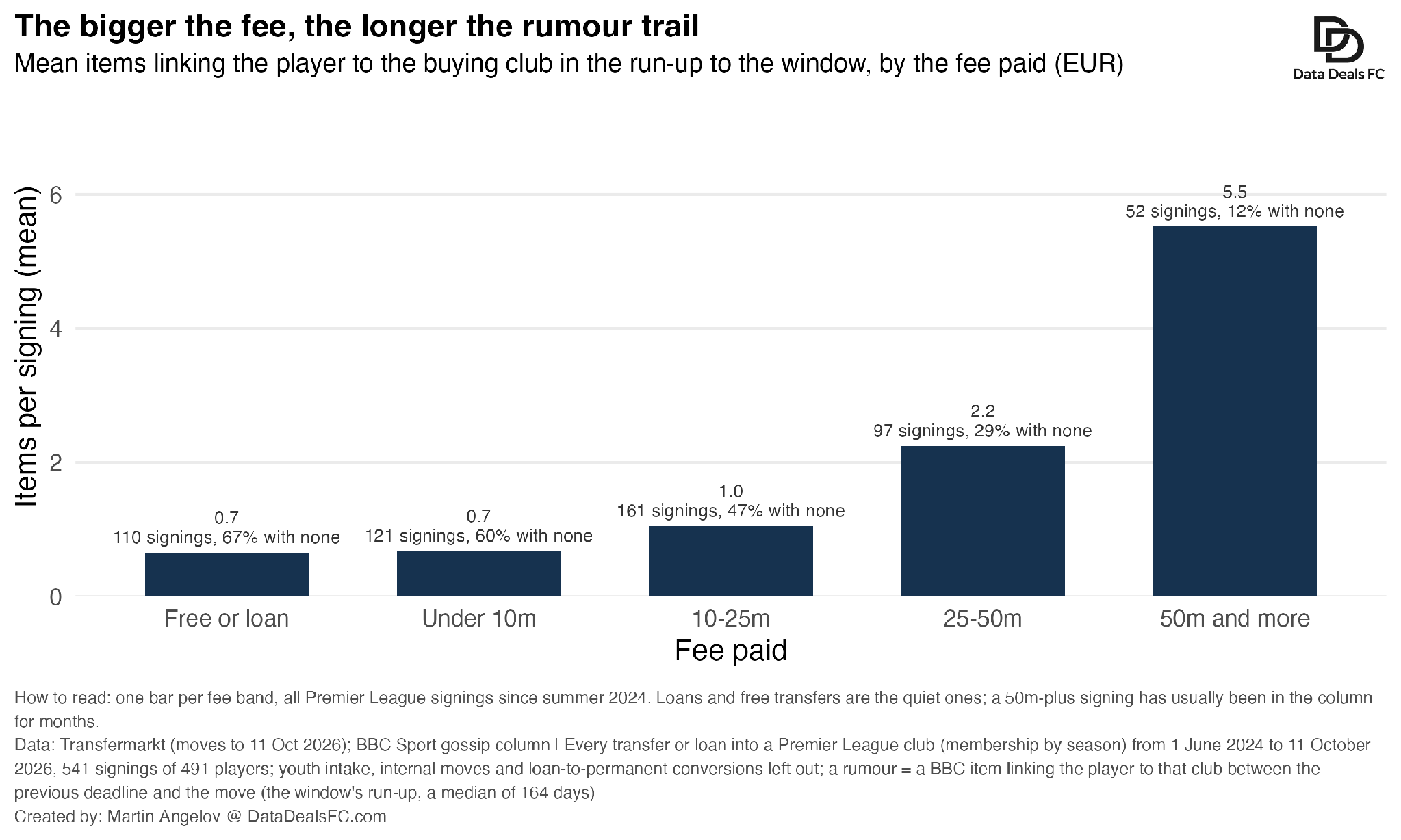
Signings of €50m or more carried 5.5 items each and only 12% of them arrived unannounced. Loans and free transfers carried 0.7 and 67% arrived unannounced. The big clubs buy expensively, so they get talked about; the clubs that buy cheaply are also the clubs whose business the column misses.
The windows differ too.
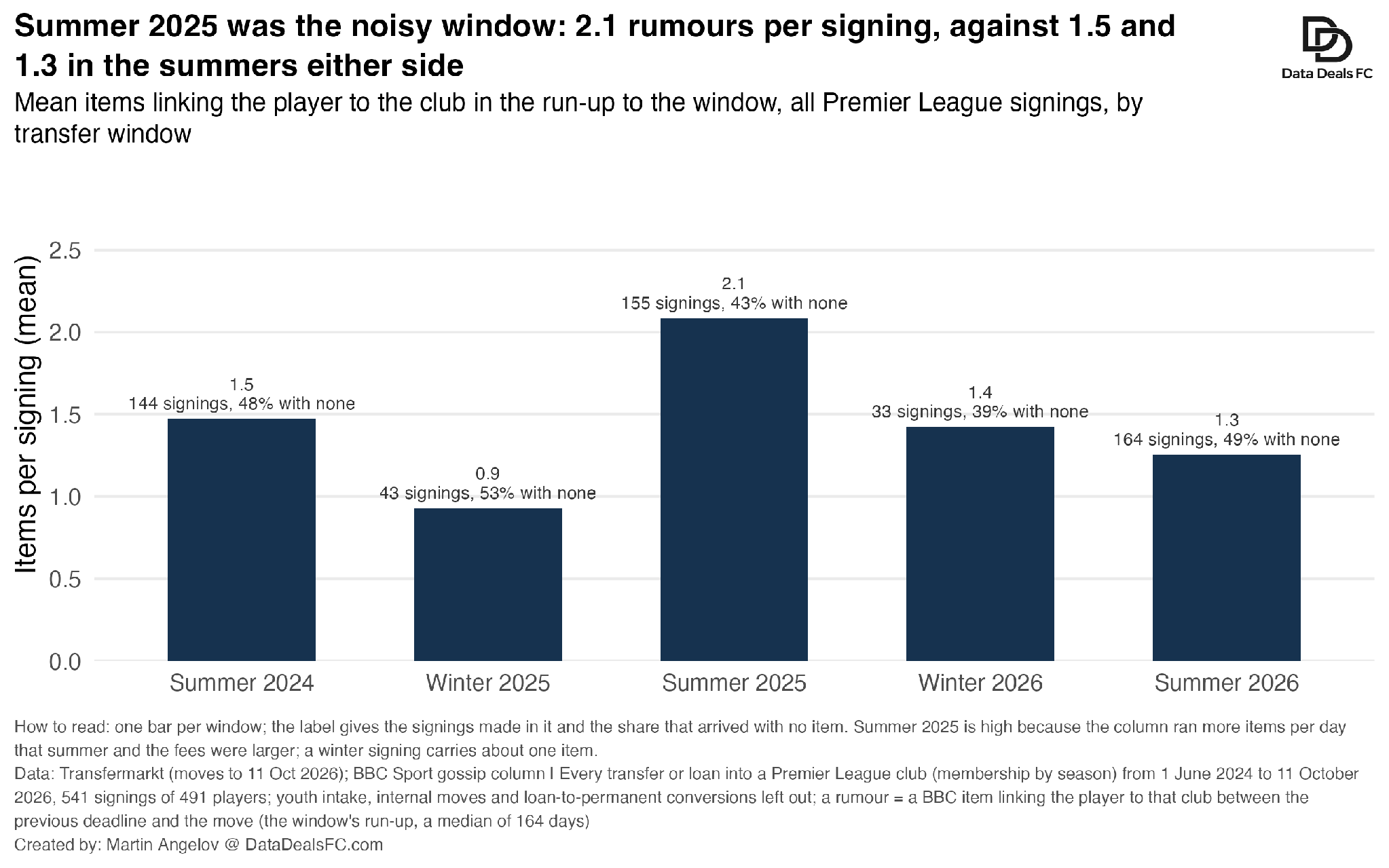
Summer 2025 was the noisy one, 2.1 items per signing against 1.5 and 1.3 in the summers either side: the column ran more items a day that summer and the fees were larger. A winter signing carries about one item.
The other way to read the same data is the ratio of names to deals. For each window, count the different players the column linked with a club in the run-up, April to the deadline for a summer window, November to the deadline for a winter one, and divide by the signings the club made.
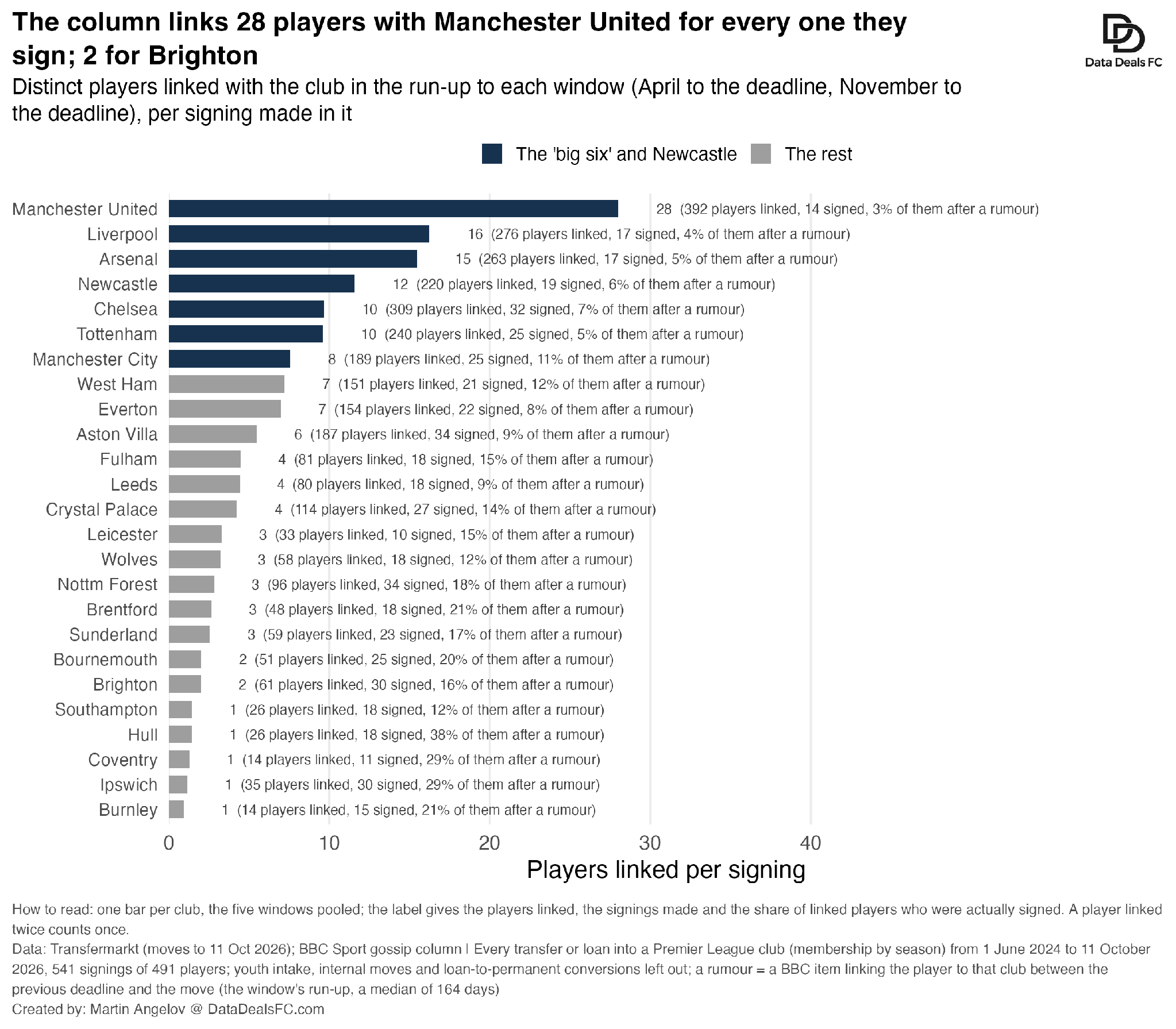
The column linked 28 different players with Manchester United for every one they signed. Liverpool 16, Arsenal 15, Newcastle 12, City 8. Brighton and Bournemouth, 2. Only 3% of the players linked with United in a window’s run-up were actually signed, 5% at Arsenal; at Brentford and Brighton it is about one in five or six.
Two readings here.
The first is that the column is a measure of attention rather than of activity: the clubs with the most readers get the most names, whether or not the names go anywhere.
The second is that the big clubs genuinely run longer lists, and the column sees the list.
Either way, the rumour-to-signing ratio is a usable number. An agent who wants a client’s name next to Manchester United’s knows it will sit among 28 names; next to Brighton’s, among two.
9. Sagas: a second outlet helps
A rumour that keeps coming back is more likely to be true. It is still, more often than not, false.
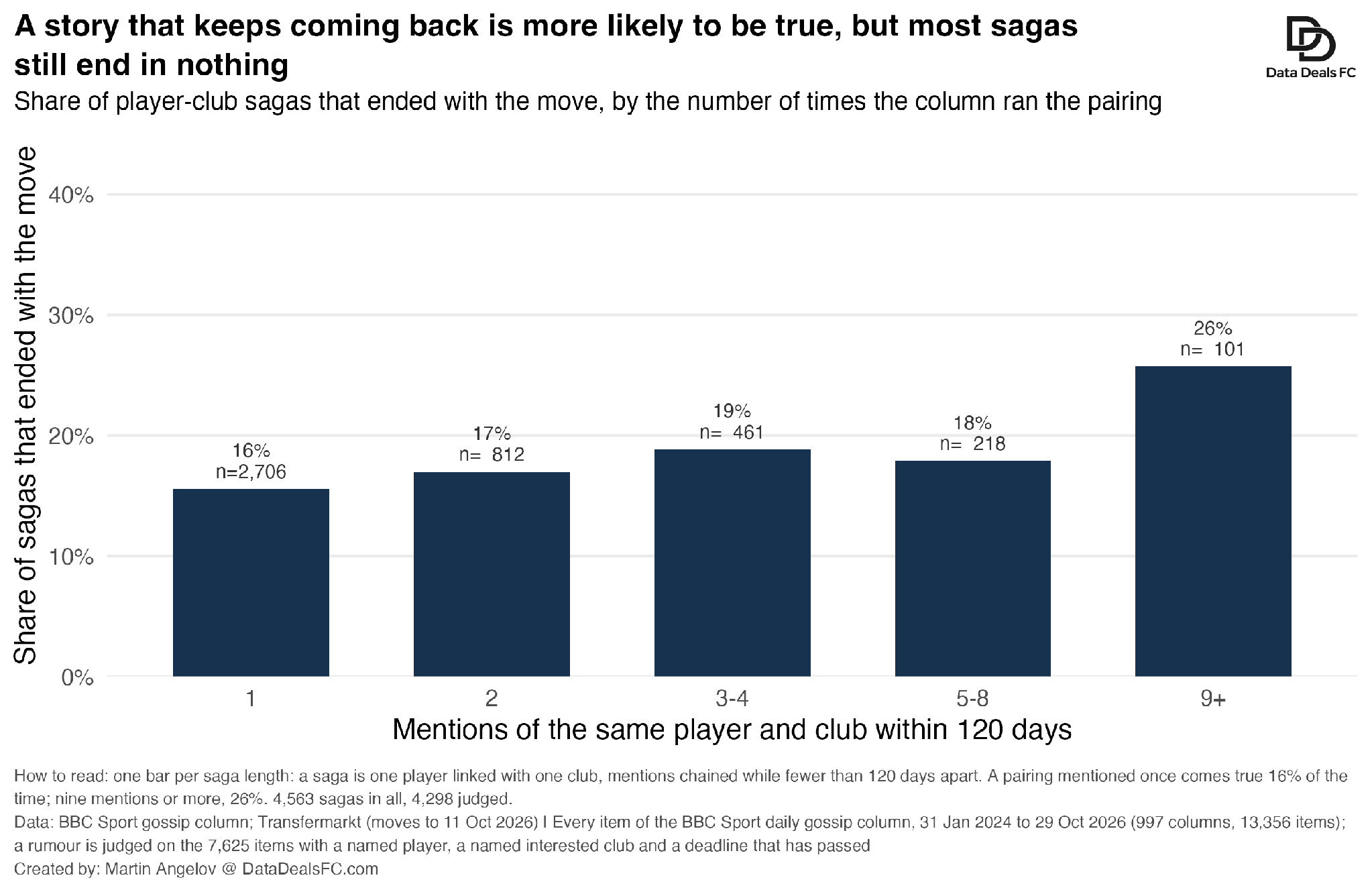
Chain every mention of the same player and club within 120 days into one saga, and the judged rumours fall into 4,563 sagas. A pairing mentioned once ended with the move 16% of the time; nine mentions or more, 26%. Repetition helps. It does not help much.
The longest sagas tell both halves of the story.
Rashford to Barcelona ran 52 times across 22 outlets and happened.
Gyokeres to Arsenal ran 50 times and happened.
Marc Guehi to Liverpool ran 43 times across 21 outlets and never did.
Jarrad Branthwaite to Manchester United ran 42 times and never did.
Sesko to Arsenal ran 39 times, and he went to Manchester United.
Those are different kinds of failure, and the column cannot tell them apart. Guehi to Liverpool was agreed and collapsed on deadline day when Palace could not land a replacement: the reports were right and the deal failed.
Branthwaite to United never got past talks in 421 days and 42 items: a rumour that did not materialise, not a report that was false. The clearest false one is Joan Garcia to Arsenal, 14 items across 11 outlets, three of them “agreed”, and he signed for Barcelona.
A denial inside a long saga changes little: once you allow for how far the saga got and how often it ran, sagas with a denial came true about as often as sagas without one.
10. Does a second source help?
Every fan does the same thing with a rumour. One outlet says Arsenal want a player; you wait to see whether anyone else says it too. Is that worth doing?
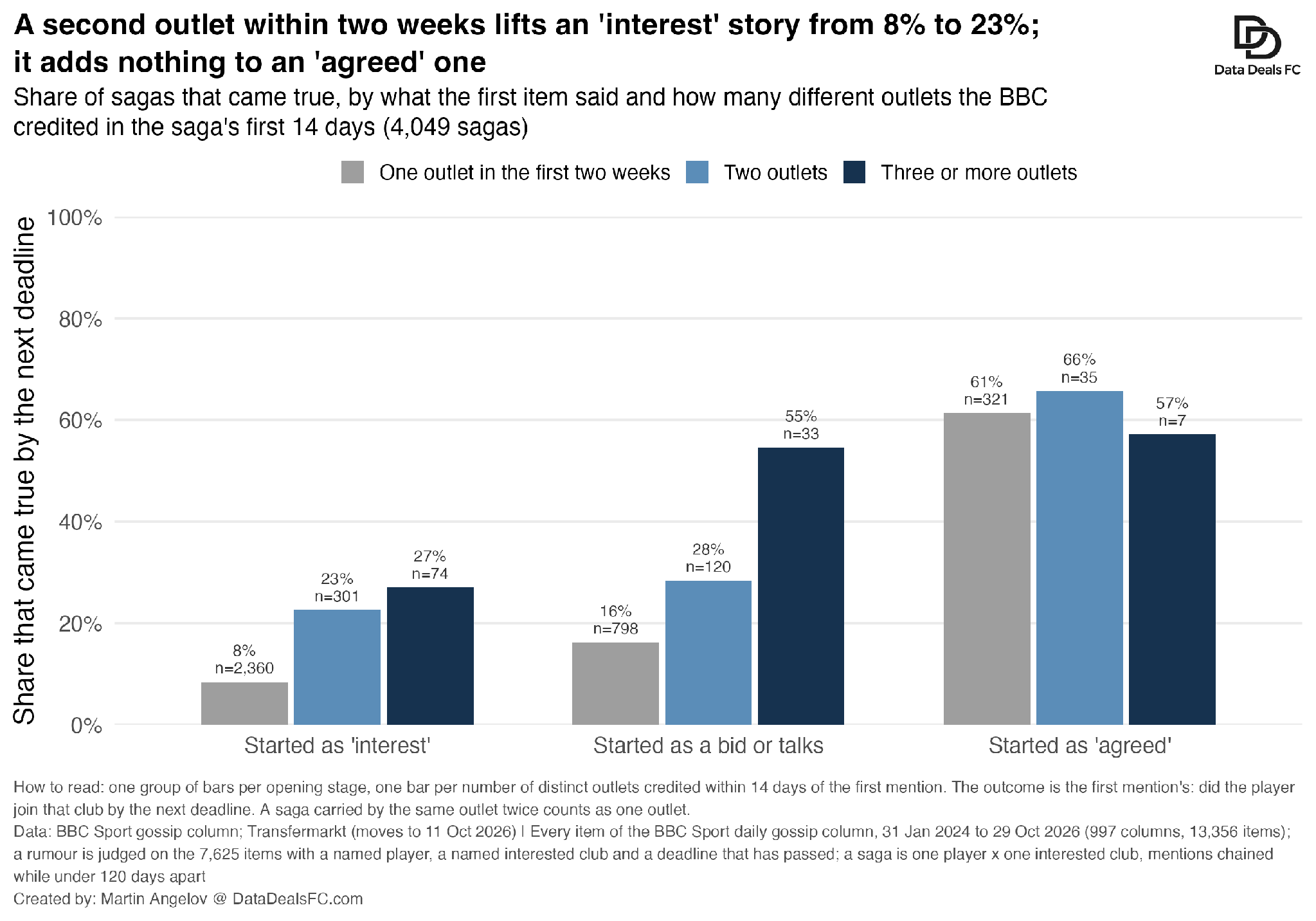
It is, with one condition. I took every saga and counted how many different outlets the BBC credited in its first two weeks.
A story that opened as “interest” came true 8% of the time when one outlet carried it, 23% with two, 27% with three or more.
That holds after allowing for how far the story had got in those two weeks, who started it and when it ran.
The condition is that the first story was thin. A story that opened as “agreed” came true 61% of the time on one outlet and 66% on two. Once someone reliable says the deal is done, the chorus adds nothing. Confirmation is for rumours, not for news.
One thing the column cannot tell me is who is copying whom. The same outlet repeating itself within a fortnight did as much as a second outlet, 31% against 29%, so the signal may be persistence rather than independence. A second outlet from another country did better than one from the same country, 26% against 18%, which is the closest thing to independence the data offers. Either way, a story that is still being written about a week later is a different story from one that appeared once.
Concluding remarks
Boom — that was my attempt at putting some realible numbers on BBC Sport’s transfer gossip column.
If you remember only eight things from this analysis, make them these:
Transfer gossip is better at predicting departures than destinations. In roughly half the rumours, the player eventually moved. But only one in five joined the club named in the story. The journalists often spotted the right player, just not the right destination.
The value of a rumour depends on four things: who is reporting it, what verb they use, what month it is, and how long the story has been running. A Sky Sports “agreed” in August deserves your attention. A TEAMtalk “interested” in October? I wouldn’t buy the shirt just yet.
Not all sources mean the same thing when they say “agreed”. When The Athletic or Sky Sports reported an agreement, the transfer happened 82% of the time. For TEAMtalk, just 18%. Same word. Different odds.
A second source helps, especially when the first report is thin. An early “interest” story carried by one outlet came true 8% of the time. With two outlets, 23%. But be careful: two publications repeating the same story aren’t necessarily two independent confirmations.
A denial lowers the odds. It doesn’t kill the deal. A denial reduced a rumour’s chance of materialising from roughly 20% to 13%. So when a club says a player isn’t for sale, take note. Just don’t take it as the final word.
October gossip is mostly next summer’s shopping list. Just 1% of October rumours materialised by the January deadline, compared with 38% of August rumours by the next deadline. Give those October stories a full year and the figure rises to 9%. Sometimes the story is simply six months too early.
Manchester United are a rumour factory. The BBC linked 28 different players with United for every one they signed. Arsenal had 15, Brighton just two. Meanwhile, 47% of Premier League signings arrived without a single preceding BBC link. The column measures media attention as much as actual transfer activity.
Hearing the same rumour 20 times doesn’t make it true. A player-club pairing mentioned once materialised 16% of the time. With nine mentions or more, the rate rose to just 26%. Rashford to Barcelona happened after 52 mentions. Guéhi to Liverpool didn’t after 43. Sometimes where there’s smoke, there’s fire. Sometimes there’s just a lot of smoke.
So no, I’m not giving up transfer gossip.
I’ll just be a little more selective about which rumours get me excited.
Thank you for reading until the end❤️.
See you next week,
Martin
PS. If you liked this piece chances are you’ll also enjoy how Kevin De Bruyne himself used data scientists to secure a 30% increase at 29, or how Man City used a magical data science technique to find his replacement or what Bruno Fernandes’ data science team likely argued in his ongoing negotiations with United.
P.P.S. If a tailor-made player report (such as the one I did on Kai Havertz’s contract negotiation) is what interests you, drop me a line.