


Hi friends,
Harry Kane just won the 2026 Ballon d’Or. After 73 goals for club and country in 2025/26, nobody needed another chart to prove he could score.
I made five anyway.
Because the remarkable number in Kane’s record is not 73. It is 29: the extra non-penalty league goals he has scored, beyond what the quality of his chances would normally produce. And that gap has survived two clubs, 12 seasons and 1,469 shots.
Here’s Harry Kane’s career in 5 figures.
1. Kane scores more than his chances are worth. Every year.
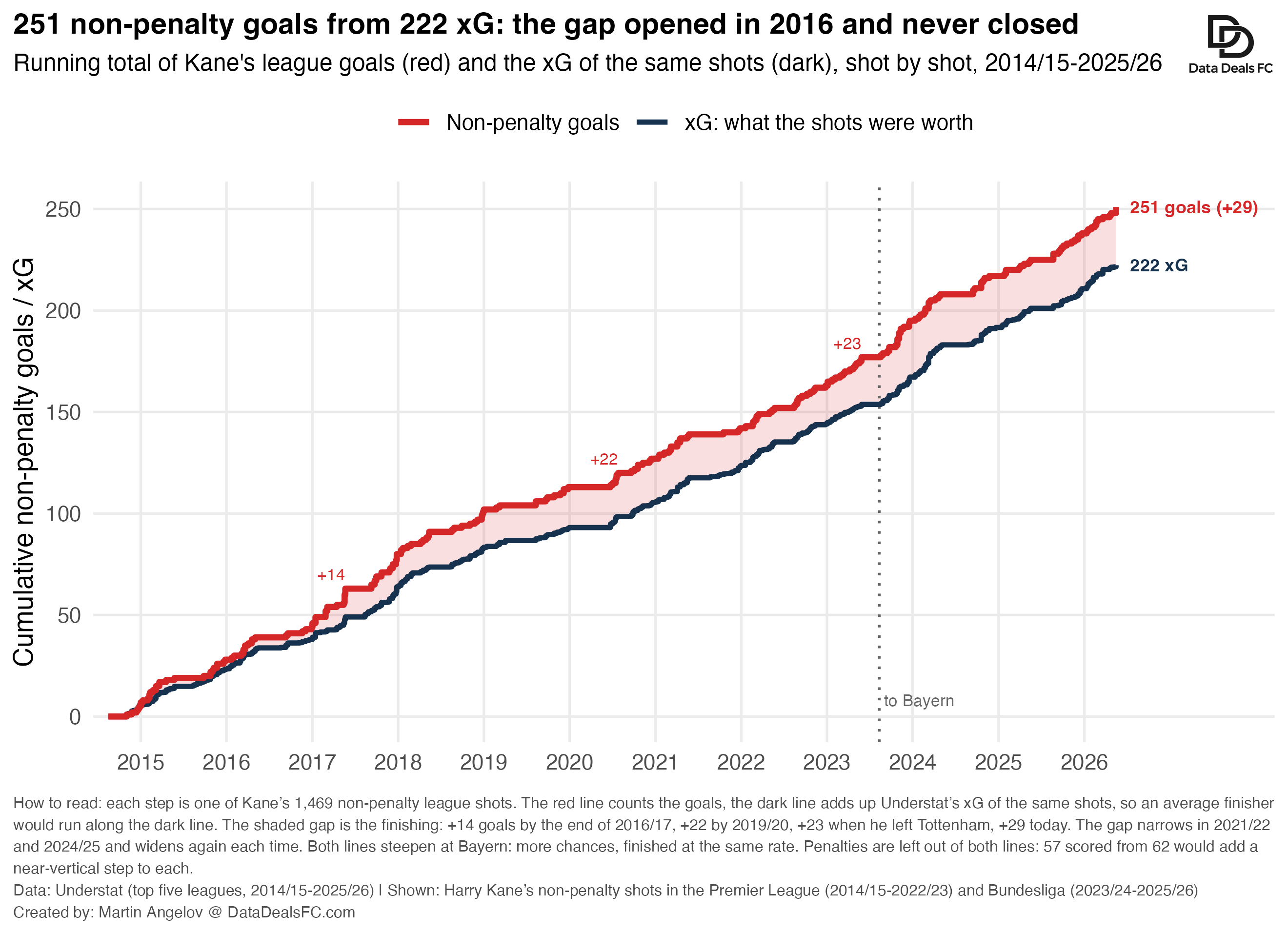
Expected goals (xG) assigns every shot a probability of going in. Add those probabilities together and you get the goals an average finisher would be expected to score from the same chances.
Across Tottenham and Bayern, Kane’s 1,469 non-penalty league shots were worth 222 xG. He converted 251. That is 29 goals above expectation.
But the chart is more interesting than the final number. The red line broke away from xG in 2016/17. It has never caught up. The lead narrowed in some seasons, including 2021/22 and 2024/25, then widened again.
The move to Bayern did not reset it. New league, more chances, same knack for turning a little more of them into goals. One hot season can be luck. A gap that lasts this long demands a closer look.
2. An average finisher gets there once in 102 careers
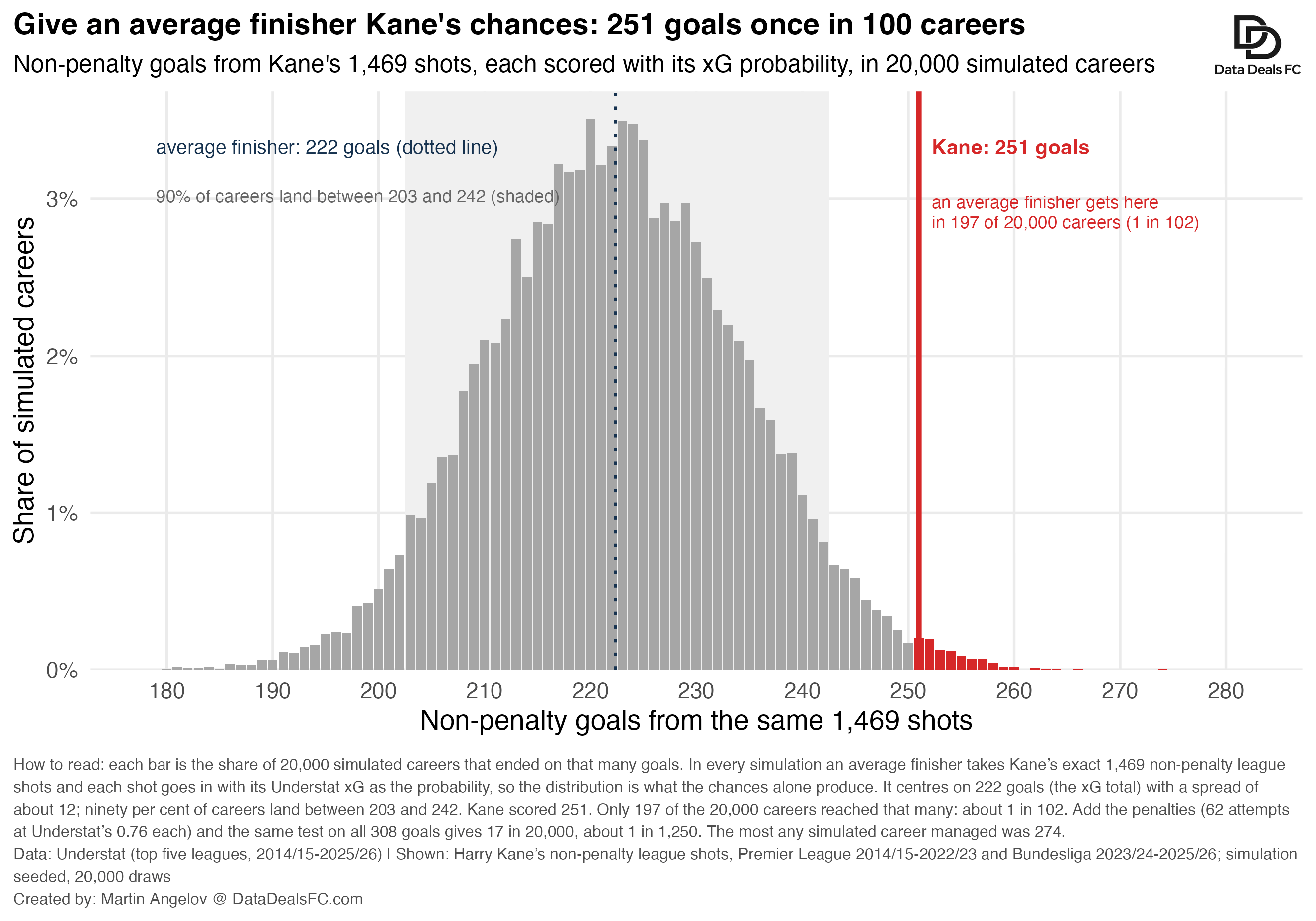
So how unlikely is 251? I simulated 20,000 alternative careers using Kane’s exact 1,469 shots. Same chances, same xG probabilities. But each shot went in or stayed out as it would for an average finisher, with luck doing the rest.
Most simulated careers ended near 222 goals. Nine out of ten finished between 203 and 242. Kane scored 251.
Only 197 of the 20,000 simulations got to 251 or higher. That is 0.985% — about one in 102 careers.
This does not mean there is a 99% probability that Kane has special finishing skill. It means that if he finished like an average striker, his actual record would be an extraordinarily unlikely result. The simulation does not know his name. That is rather the point.
3. Even among elite scorers he is an outlier
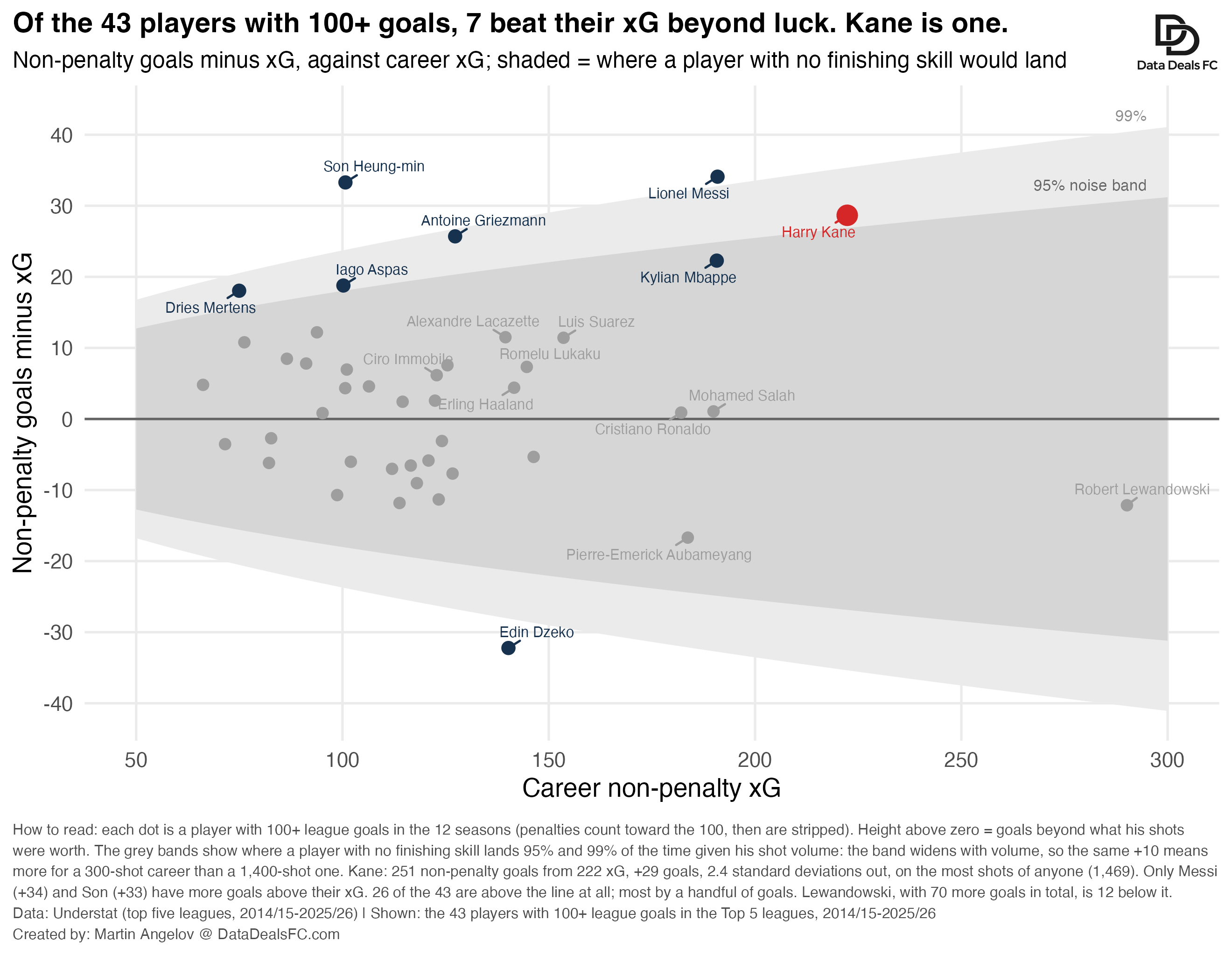
Perhaps every great striker beats xG. They are great strikers, after all.
I compared 43 players who scored at least 100 league goals across Europe’s top five leagues since 2014/15. Penalties were removed from their finishing records. Then I measured each player’s goals above xG against the random variation expected from that volume of chances.
Only seven finished above the 95% noise band: Son Heung-min, Lionel Messi, Antoine Griezmann, Kylian Mbappé, Iago Aspas, Dries Mertens — and Kane.
Son is the wildest case: 134 non-penalty goals from 101 xG. Messi finished 34 goals above expectation. Kane’s surplus is 29, but he sustained it over more shots than anyone else in this comparison.
Seven names out of 43 does not, by itself, prove a permanent finishing talent. But the company Kane keeps — and the scale of his sample — make it hard to wave his record away as a lucky streak.
4. Even his worst spell was fairly ordinary
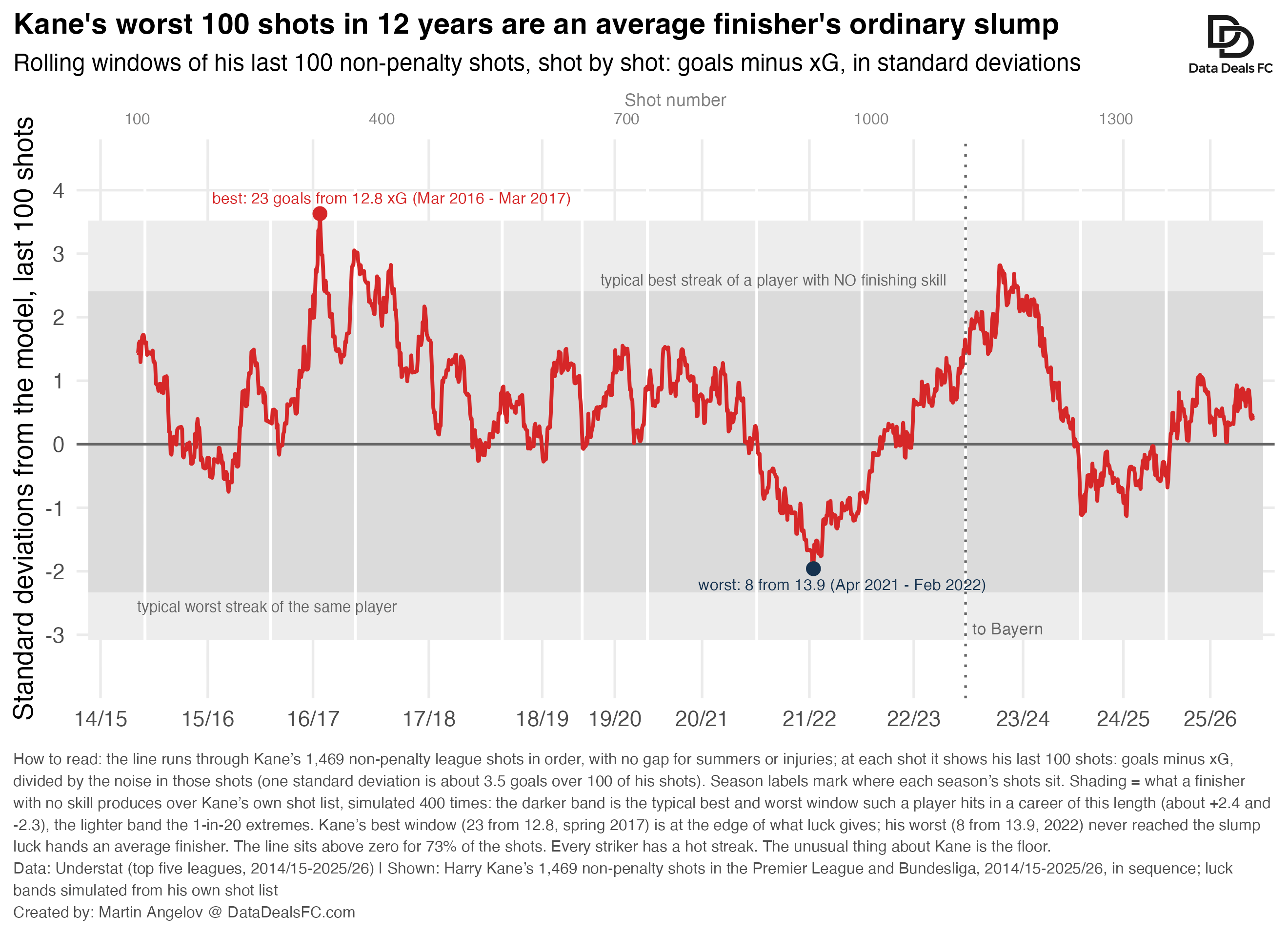
Did Kane ever go cold? Of course he did.
His worst stretch of 100 consecutive non-penalty shots came between April 2021 and February 2022: eight goals from chances worth 13.9 xG. Almost six goals short.
That sounds miserable until you see the comparison. Simulate an ordinary finisher across a career as long as Kane’s and the worst 100-shot spell is typically even worse. Kane’s lowest point sits comfortably inside that normal range.
His hottest stretch was 23 goals from 12.8 xG between March 2016 and March 2017. But even an average finisher can hit an exceptional purple patch. What makes Kane unusual is not just his ceiling. It is his floor.
For 73% of his shots, the preceding 100-shot window was above xG. When he cooled off, he rarely stayed there for long.
Monday’s Ballon d’Or recognised one extraordinary season. The 1,469 shots tell the longer story: an extraordinary habit.
xG is sometimes used to explain away goals. With Kane it does the opposite. It measures just how much more he has given his teams than his chances would normally buy.
Or, put less statistically: the model has been waiting 12 years for him to come back to earth.
5. Kane doesn’t just finish chances. He creates them.
Everything so far has been about the shots Kane takes. But what about the shots he creates for others?
Here is where his case gets even more interesting.
I compared 32 centre-forwards with at least 100 league goals since 2014/15.
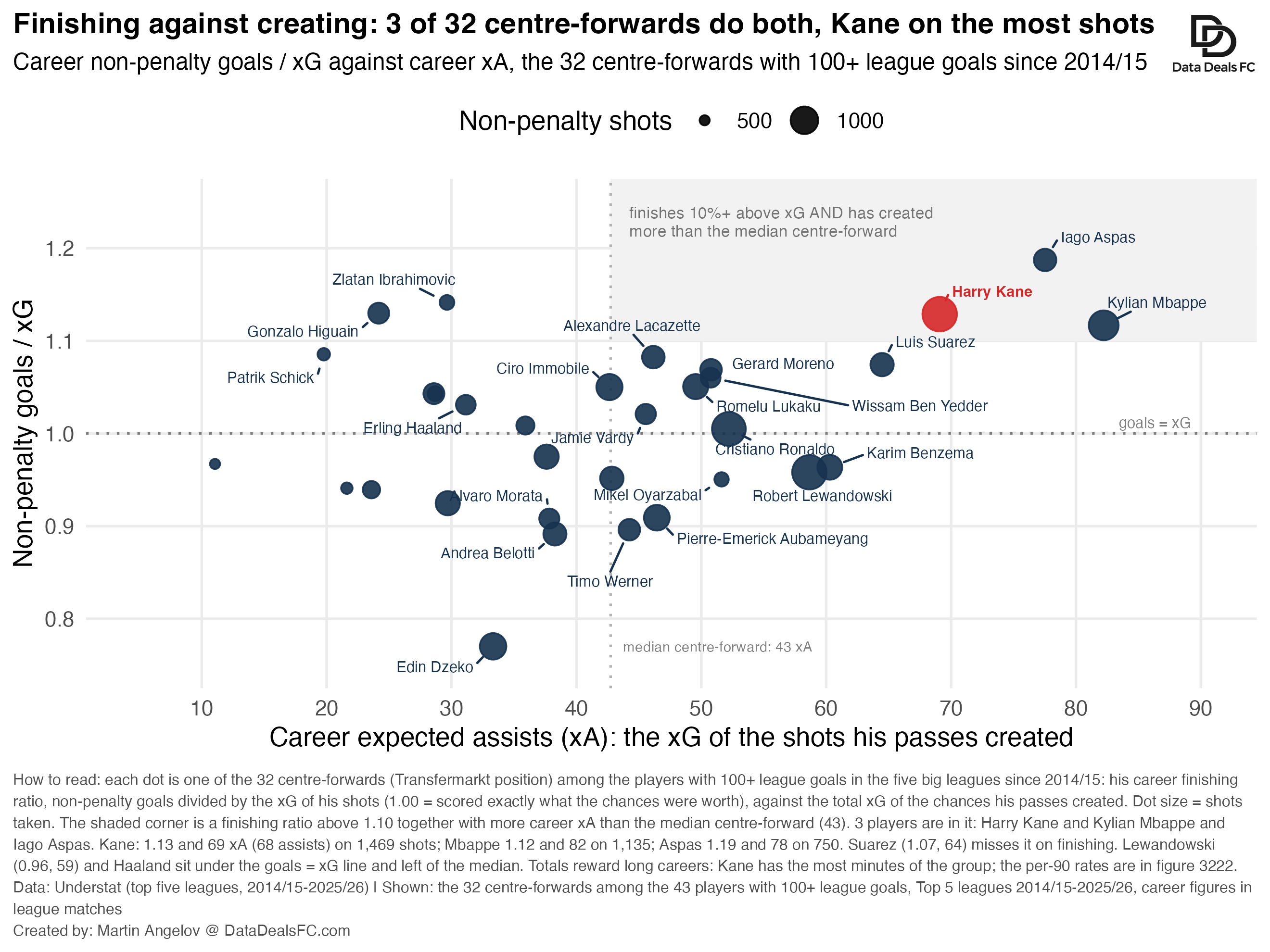
Only three finished at least 10% above their xG and create more chances than the median centre-forward.
Iago Aspas. Kylian Mbappé. Harry Kane.
Kane has scored 13% more non-penalty goals than his chances were worth. But he has also created 69 xA — chances that, on average, should have produced 69 goals for his teammates. His actual assist count? 68.
Aspas is a more efficient finisher (19% above xG). Mbappé has created more (82 xA). But Kane has combined both skills while taking 1,469 non-penalty shots, more than anyone else in the comparison.
Of course, career totals reward longevity. Kane has also played the most minutes of these 32 strikers. This is a measure of sustained contribution, not a per-90 ranking.
But perhaps that is the point.
For 12 seasons, Kane hasn’t had to choose between scoring goals and creating them. He has done both, at extraordinary volume.
The Ballon d’Or recognised a great goalscorer. The data reveal a complete centre-forward.
Talk soon,
Martin
PS. If you liked this piece chances are you’ll also enjoy how Kevin De Bruyne himself used data scientists to secure a 30% increase at 29, or how Man City used a magical data science technique to find his replacement or what Bruno Fernandes’ data science team likely argued in his ongoing negotiations with United.
P.P.S. If a tailor-made player report (such as the one I did on Kai Havertz’s contract negotiation) is what interests you, drop me a line.
It is great seeing him getting his flowers.
Great analysis!
Maybe I'm reading the plot wrong, but it looks like Mbappe's numbers are within the 95% confidence band.