

The City Files is a series on the Man City verdict and the compensation claims that will follow it.
Part 1: Manchester City’s 115 Charges, Explained in Plain English (you are here)
Part 2: The £35M Playbook: How Burnley Made Everton Pay, and How City’s Rivals Could Do the Same
Part 3: What Arsenal Could Claim
Part 4: What Manchester United Could Claim
Part 5: What Tottenham Could Claim
Part 6: What Liverpool Could Claim
Hi friends,
Unless you live under a rock, you’ve probably already heard that Manchester City have been found guilty of virtually all the charges relating to their alleged breaches of the Premier League’s financial rules.
Over the next few posts, I’ll look at three things:
what City were actually accused of doing,
why they should be worried about what rival clubs do next, and
how much those clubs could realistically try to claim.
For the last two, I’ll use the methods used in the Burnley v Everton precedent as a reference point.
But first, the basics. You’ll hear the “115 charges” through everywhere on twitter, but very few people can say what the charges actually are. The short answer is that they are mostly about one question:
Did City’s accounts tell the truth about where the club’s money came from and where it went?
Everything else follows from that.
So in this piece I explain the allegations one at a time:
what each one says,
how the practice would work if it happened, and
what it would change in the numbers.
For that last part I went through Manchester City’s own annual accounts, every year from 2003/04 to 2024/25.
One rule throughout. At the time of writing, the panel’s decision, and its reasons, remain unpublished. City deny wrongdoing and are expected to appeal. The money amounts attached to the allegations come from the Football Leaks documents published by Der Spiegel in 2018, and from the UEFA case that followed. City have always disputed the context of those documents. So everything below should be read as: if the allegations are as they were reported, this is what they mean.
Now that we got this out of the way, let’s explain how we got here.
1. How we got here
The case is much easier to follow once the dates are in order.
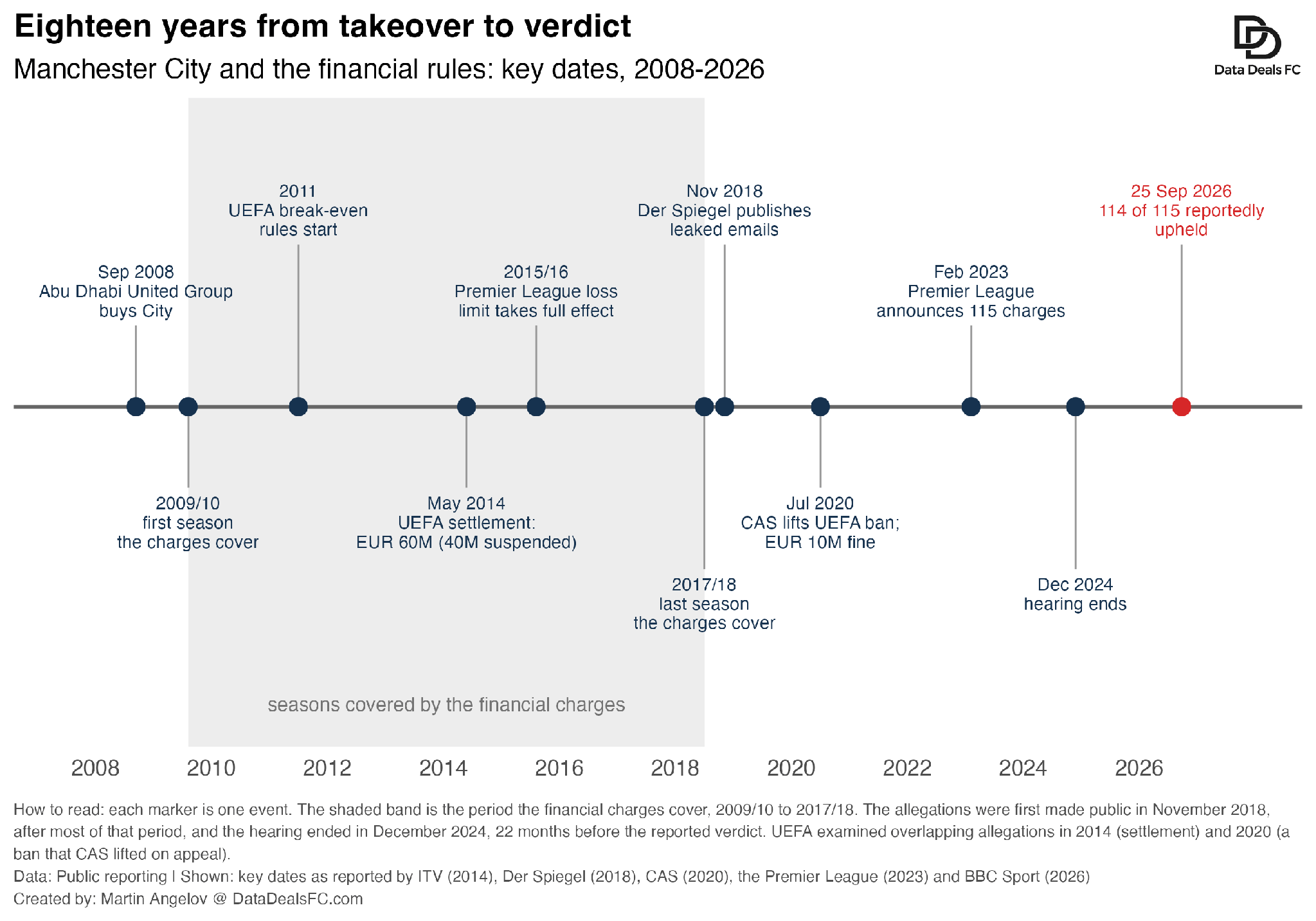
The story starts in September 2008, when Sheikh Mansour’s investment company, Abu Dhabi United Group (ADUG), bought the club.
In November 2018, Der Spiegel began publishing internal City emails obtained through Football Leaks, the platform set up by the Portuguese hacker Rui Pinto. They suggested that City had inflated the value of several commercial deals to get around UEFA’s financial rules.
⚠️ What does an inflated commercial dial mean in plain English? — The rules let clubs spend what they earn, and sponsorship counts as earnings while owner money mostly doesn’t. City are accused of passing the owner’s money through sponsors like Etihad, so it looked like earned income and let them spend more than the rules allowed.
UEFA opened an investigation in March 2019, and in February 2020 banned City from European competition for two seasons and fined them €30M, finding that the club had overstated its sponsorship income between 2012 and 2016. City appealed to the Court of Arbitration for Sport (CAS), which lifted the ban in July 2020. Most of UEFA’s allegations, CAS said, were either not proven or too old to be punished under UEFA’s five-year limit. It kept a €10M fine for City’s failure to cooperate.
The Premier League had opened its own investigation in 2019. In February 2023 it announced 115 charges. The hearing ran from September to December 2024, behind closed doors. Then came almost two years of silence, until The Athletic reported on 25 September 2026 that the independent panel had found City guilty on 114 of the 115.
In the nine seasons the charges cover, City won three league titles, two FA Cups and four League Cups.
2. The rules you need to know
Football’s financial rules rest on one simple idea: a club should not spend much more than it earns.
A worked example makes it concrete. Imagine a club that earns £300M a season from tickets, television and sponsors, and spends £350M on wages, transfers and running costs. It has lost £50M. Under the Premier League’s Profitability and Sustainability Rules (PSR), which took full effect in 2015/16, that is acceptable, as long as the club’s losses over three seasons stay under £105M and the owner covers them. UEFA’s Financial Fair Play rules, introduced from 2011, work on the same principle with tighter limits.
Now imagine the same club finds an extra £60M. What happens next depends entirely on where the money comes from.
If a sponsor pays it, it is income. The club now earns £360M, has a £10M profit and can spend more next season.
If the owner simply transfers it, it is not income. It covers the loss, but under the rules the club still lost £50M, and the owner cannot keep doing that beyond the limit.
The money is identical. The label decides whether it counts.
Four terms will come up repeatedly, so it is worth defining them now.
Related party. A company or person closely connected to the club, such as its owner or a company the owner controls. Deals with related parties are allowed, but they must be disclosed and valued at a fair price. Otherwise an owner could inflate a club’s income simply by overpaying for a sponsorship (as defined above).
Disguised equity funding. Owner money presented as something else, usually as commercial income from a third party. This is the central allegation against City.
True and fair view. The standard that club accounts, and the financial information clubs give the league, must meet. The Premier League cannot audit every contract. It relies on clubs describing their finances accurately.
Time-barred. Too old to be prosecuted under the applicable rules. This is why City escaped most of UEFA’s case in 2020. The Premier League’s rules have no such limit.
3. What the 115 charges are
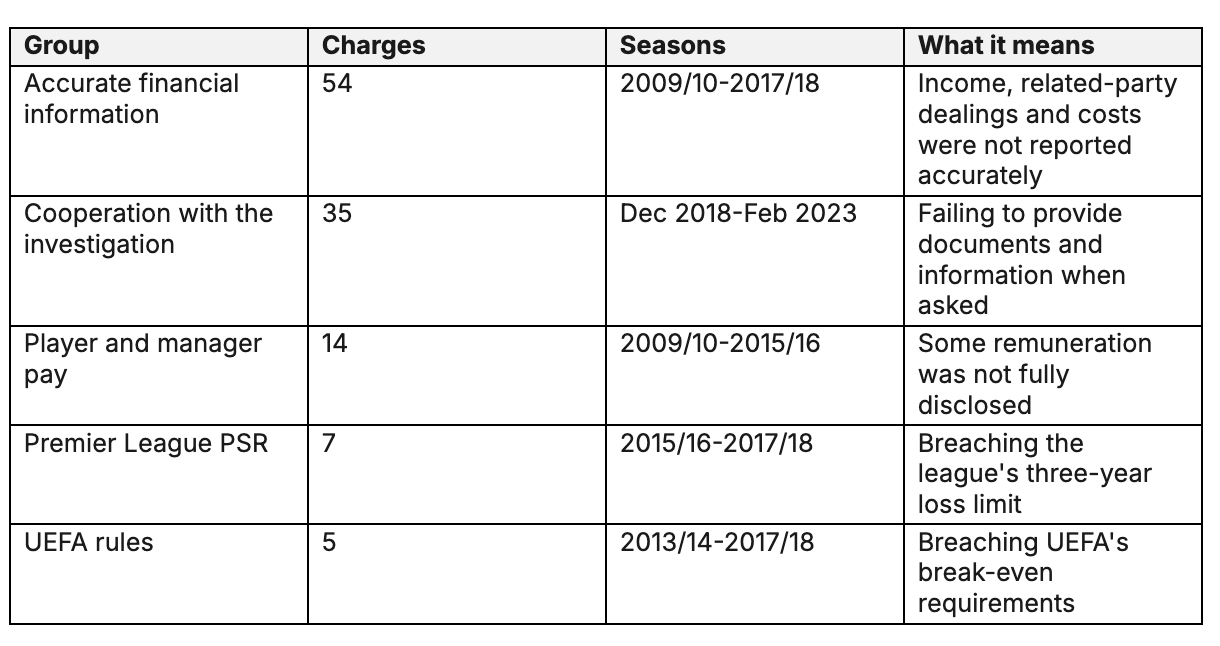
When the Premier League announced its case in February 2023, the charges fell into five groups.
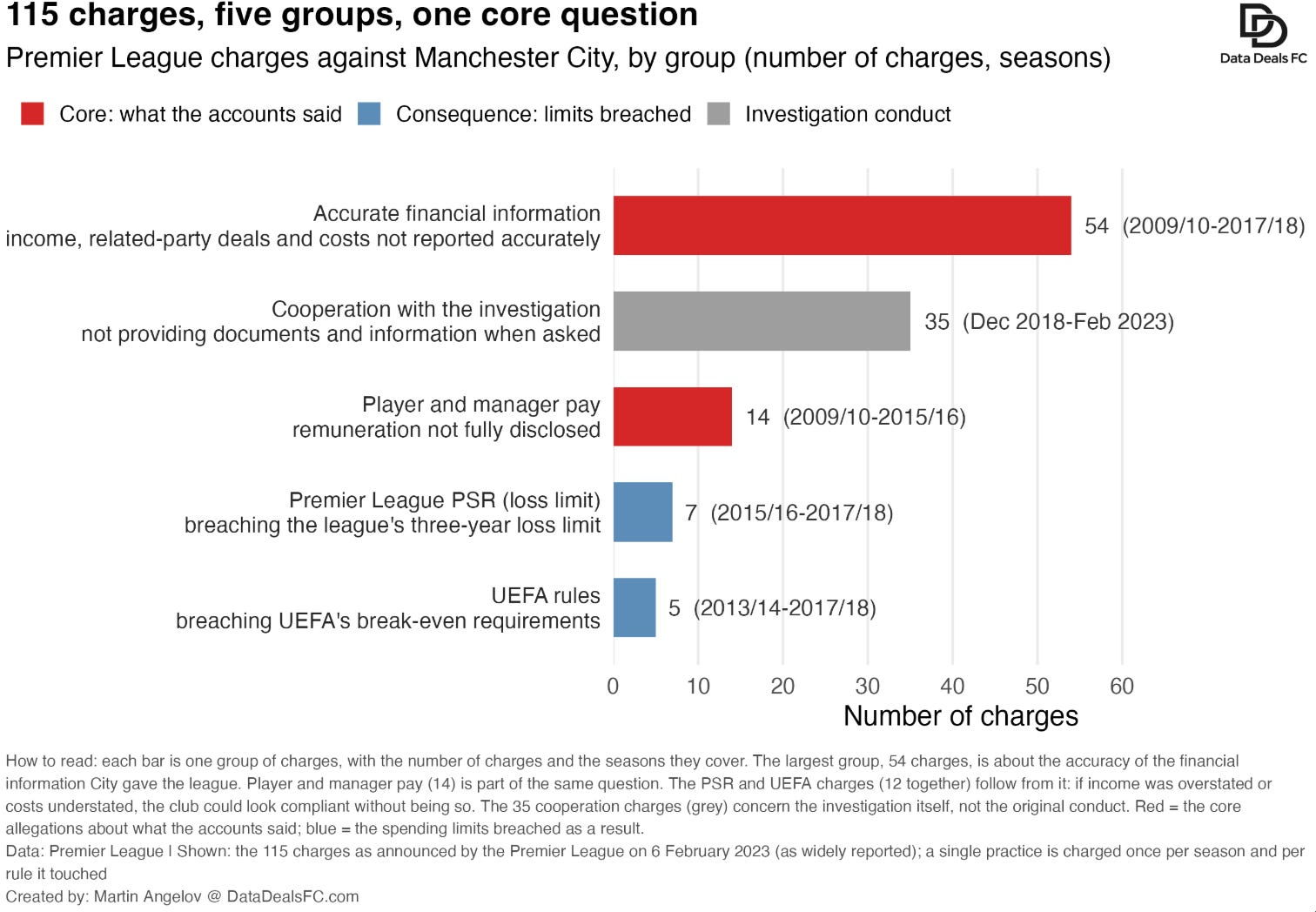
The structure matters more than the total.
The 54 charges about financial information and the 14 about pay are the core: they say City’s accounts did not show where the money came from or what the club really spent.
The 12 PSR and UEFA charges largely follow from them. If income was overstated and costs understated, a club can appear to comply with a loss limit it actually breached.
The 35 cooperation charges concern the investigation itself.
That is also why the number is so large. A single practice is charged once for every season it affected and once for every rule it touched. As The Athletic put it this week,
The charges boil down to a handful of issues, multiplied by the years involved.
4. The core allegation: owner money presented as sponsorship
City’s principal sponsor is Etihad, the Abu Dhabi airline. City’s owner is Sheikh Mansour, through ADUG. Both are rooted in Abu Dhabi, which is exactly why the related-party question arises.
According to the leaked emails, much of the money City recorded as Etihad sponsorship did not come from Etihad. The clearest example is 2015/16.
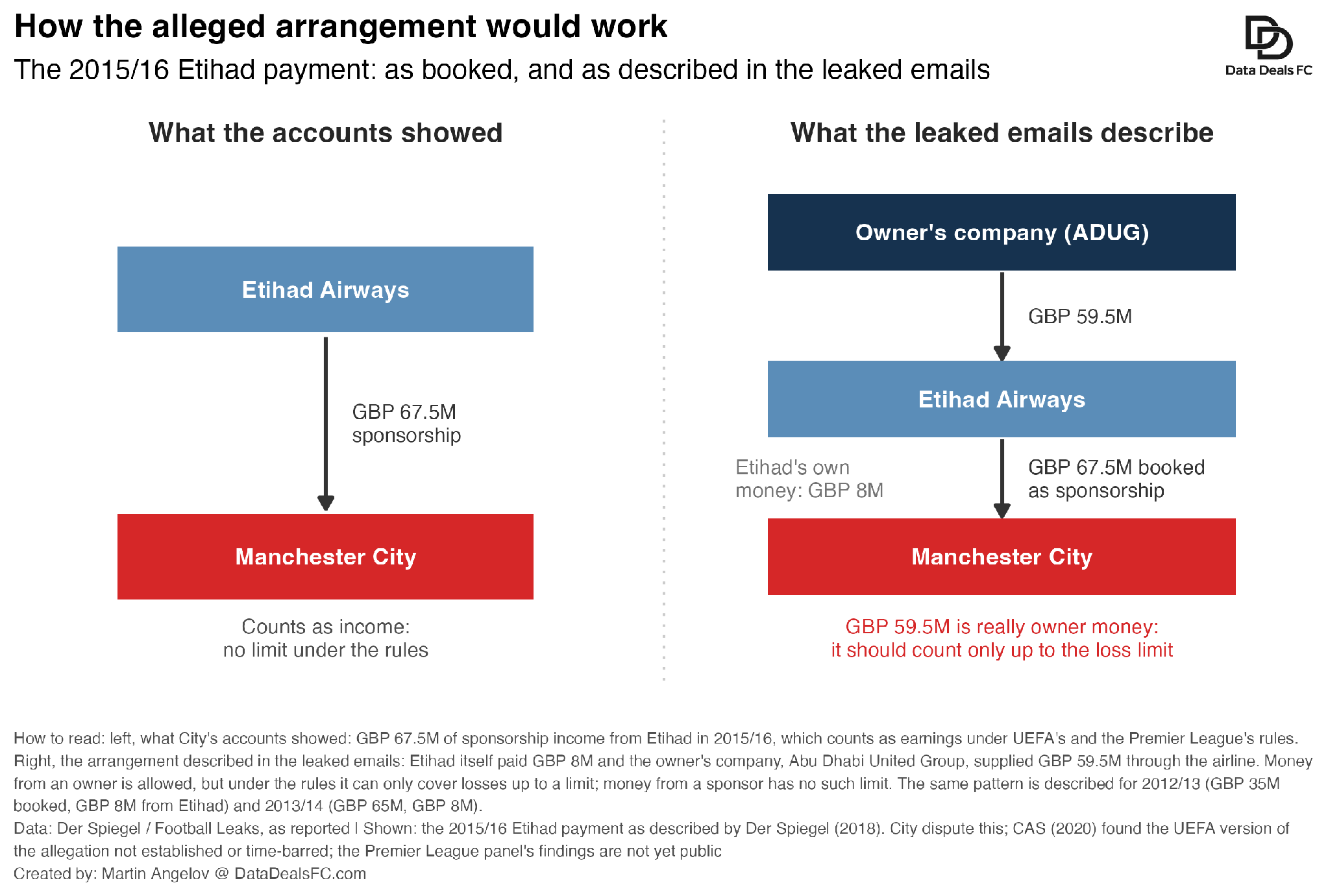
City booked £67.5M of Etihad sponsorship that season. An email from City’s then chief financial officer, Jorge Chumillas, reportedly set out that
Only £8M of it was to come from the airline and the remaining £59.5M from ADUG.
It was not the only year. Here is everything I could trace to published reporting of the leaks and the UEFA case.
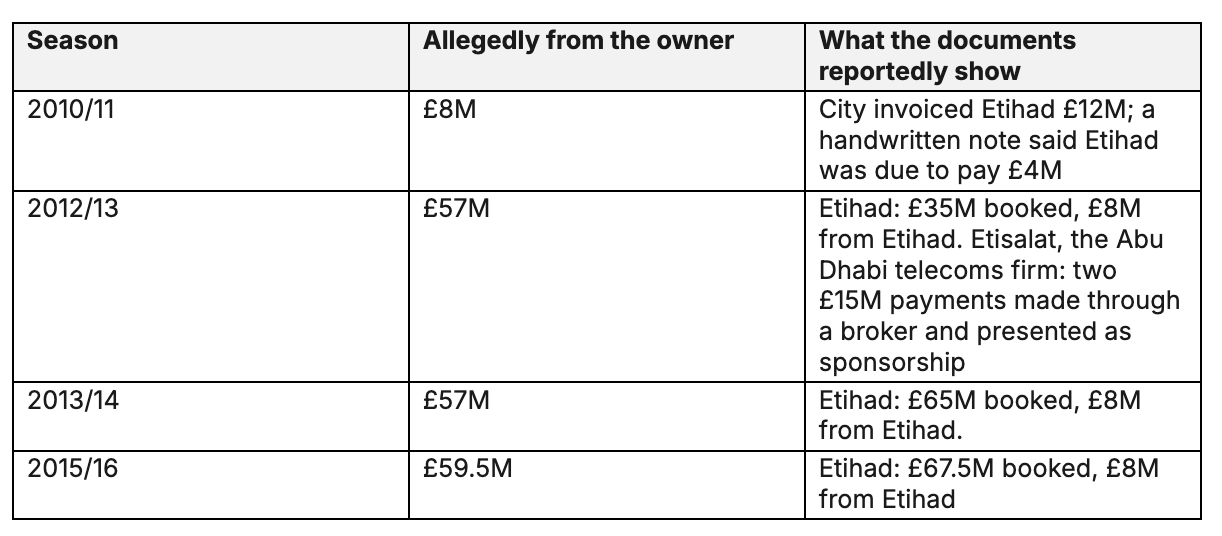
A second email points the same way. In December 2013, City board member Simon Pearce reportedly wrote to Etihad that, of the £99M the airline owed City for 2012/13 and 2013/14 combined (£31.5M and £67.5M), Etihad itself would provide just £8M. That puts the owner's share across those two seasons at about £91M, close to the £84M in the table.
Now go back to the £59.5M during 2015/16 recorded by City as sponsorship. Why would anyone route money this way?
If the £59.5M is recorded as sponsorship, it counts as money the club earned. The club's income goes up by £59.5M, so it can spend £59.5M more on wages and transfers and still appear to break even.
If the same £59.5M is recorded honestly, as money from the owner, it does not count as income at all. The club’s income stays where it was, and that extra spending shows up as a loss, and the owner can only cover that loss up to a limit: £105M over three seasons under the Premier League's rules, and far less under UEFA's, just €30M (about £22M) over three seasons by 2015/16. The £59.5M allegedly routed through Etihad that year was, on its own, roughly double UEFA's entire three-year allowance.
Same money, same bank account, same players signed. The only difference is the label, and the label decides whether the club looks like it is following the rules.
Here is where that money sat in City’s accounts.
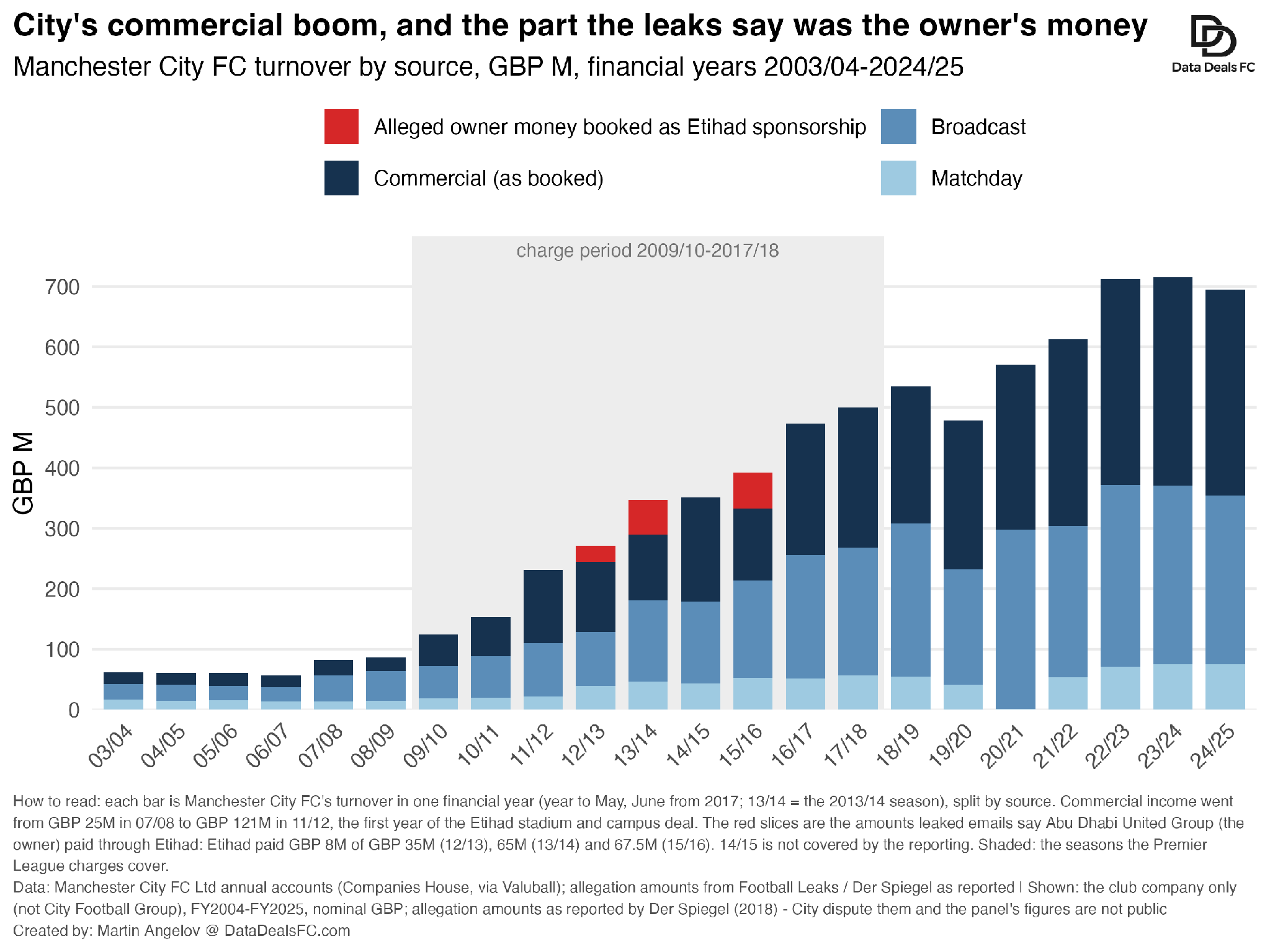
City’s income comes from three sources:
matchday (tickets and hospitality),
broadcasting (television and prize money) and
commercial (sponsors and merchandise).
Commercial is the one that changed fastest after the takeover. It was £25M in 2007/08 and £121M by 2011/12, the first year of the Etihad stadium and campus agreement. The red slices are the Etihad amounts the emails describe as owner money.
They are never most of City’s income. But they sit exactly in the category the rules use to decide how much a club may spend.
What happened when UEFA looked at this
In 2020, UEFA concluded that City had overstated their sponsorship income between 2012 and 2016. According to The Athletic, UEFA’s case put the total at around £200M: money City had recorded as sponsorship but which was, in UEFA’s view, really the owner’s, passed through sponsors. That is close to the roughly £180M in the table above.
That is not the end of the matter. UEFA’s case could only reach back five years, so much of it was thrown out as too old. The Premier League’s rules have no such limit, and its charges go back to 2009/10. Some of the evidence also came too late for CAS: an email from City board member Simon Pearce only became public two days after CAS published its full judgment. And according to The Athletic, the Premier League uncovered new lines of enquiry during the case. What the panel concluded about which amounts is not yet known.
Inside one season: 2012/13
The allegations become clearer when you look at a single year, both through the leaked emails and through City’s own accounts.
In the summer of 2013, as City’s finance team compiled the 2012/13 accounts, sacking manager Roberto Mancini had created a problem. According to Der Spiegel, Chumillas wrote internally that the cost meant City would be £9.9M short of complying with UEFA’s rules that season. The chief executive, Ferran Soriano, reportedly suggested the gap could be closed with a bonus sponsors had agreed to pay for winning the FA Cup.
Except, City had lost the FA Cup final to Wigan.
The emails then describe a workaround: payments from three Abu Dhabi entities (Etihad, the investment fund Aabar and the Abu Dhabi tourism authority) would be adjusted to cover the shortfall. When Chumillas asked whether they could change the dates of the sponsorship payments, Pearce reportedly replied:
“Of course. We can do what we want.”
For many people that line has become the whole case in six words. City have never disputed the contents of the emails, only the context in which they were presented.
City’s accounts for that year add something the emails do not. Look at the club’s “other operating income”, a line that is normally close to zero.
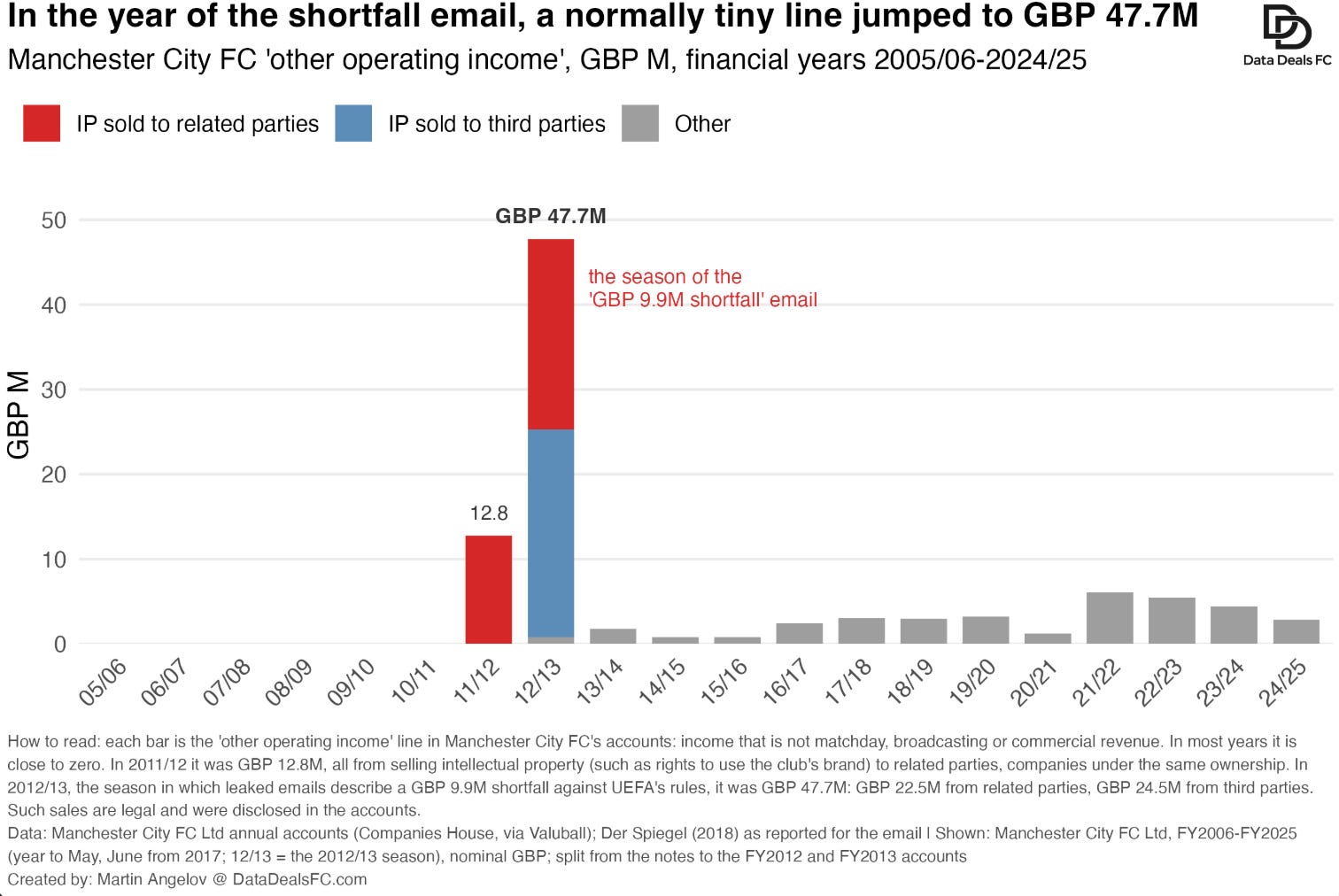
In 2011/12 it was £12.8M, from selling intellectual property to related parties.
In 2012/13 it was £47.7M: £22.5M from selling intellectual property to related parties, £24.5M to third parties and £0.8M of other income.
Selling intellectual property, such as the rights to use the club’s brand, to sister companies within the same ownership group is legal, and the accounts disclosed it. But it is a reminder of how much of City’s route to break-even in those years ran through companies connected to its owner. In the season the emails describe a £9.9M gap, the accounts show £22.5M of income from related parties that was not sponsorship at all.
The same accounts also show how the owner's funding was made permanent. After the takeover, City's losses were funded with loans from its parent company. By the end of 2011/12 the club owed its parent £822.9M, and its debts exceeded its assets by £468.8M. During 2012/13 it borrowed more, and then the whole balance, about £1.01bn, was converted into new shares. The owner stopped being a lender and became, in effect, a larger shareholder: the debt disappeared and the balance sheet swung from £469M in the red to £435M in the black.
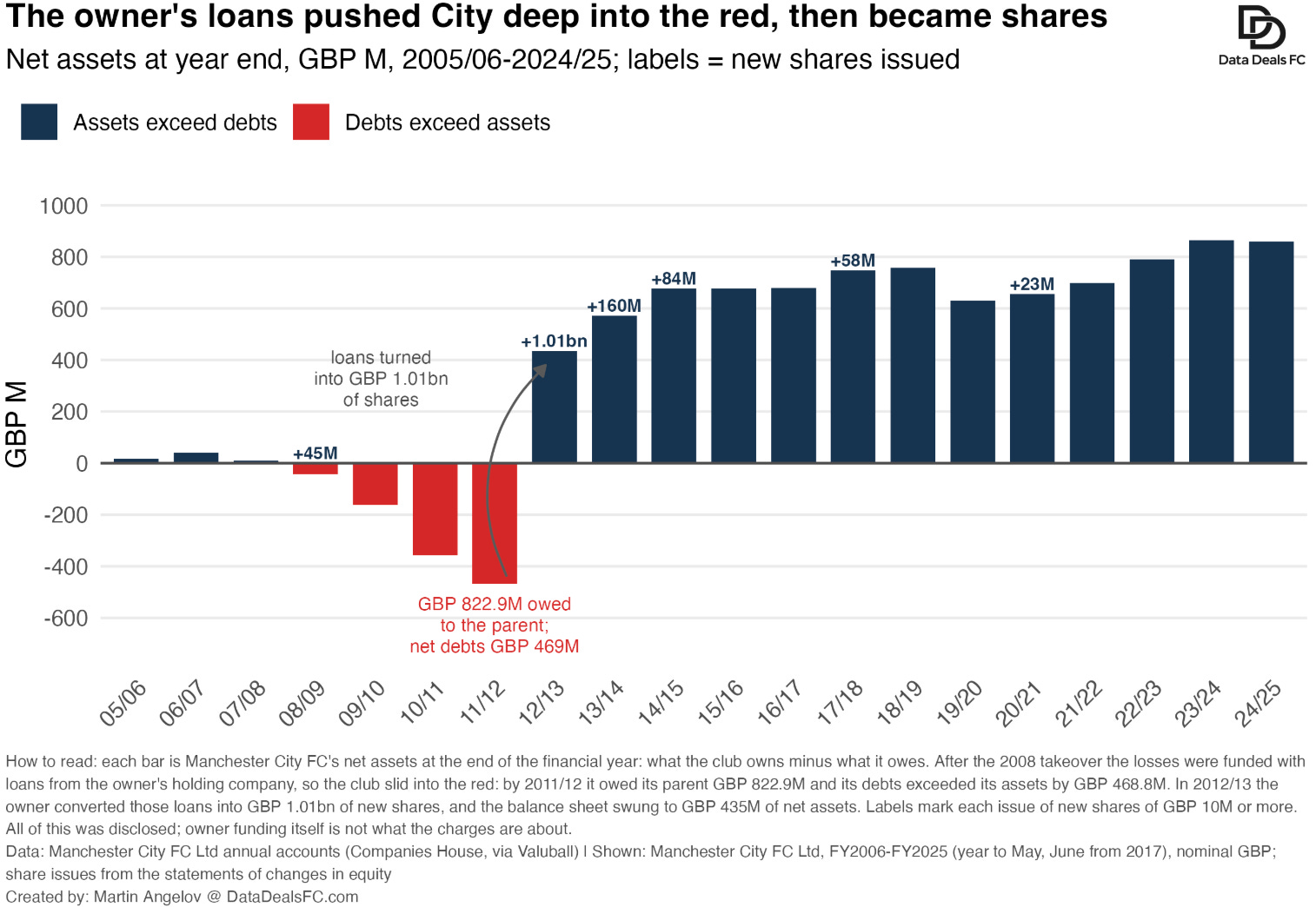
Or in less technical terms:
Before 2012/13: City owed its owner about £1bn and looked deep in the red.
After 2012/13: City owed nothing, looked solidly in the black, and the owner simply owned more of the club.
This was legal, and it was disclosed. It just shows how much the owner put in, about £1bn by then and £1.39bn in total. But the charges aren’t about this money. They’re about the other money, allegedly passed through sponsors so it looked like income.
5. Allegation two: the manager’s second contract
The logic that works on income also works on costs.
If someone else pays part of a club’s expenses, the club looks cheaper to run than it is, and it can spend more elsewhere without breaching the limits.
Mancini managed City from 2009 to 2013 and won the club’s first league title in 44 years. His official City salary was reported at about £1.45M a year.
According to documents published by Der Spiegel, he also had a consultancy agreement with Al Jazira, a club in Abu Dhabi also owned by Sheikh Mansour, worth about £1.75M a year and requiring only a few days’ work. The reporting described a payment trail leading back to ADUG. If that is correct,
More than half of what City’s manager earned was paid outside City’s accounts.
In money terms it is the smallest allegation, about £7M over four years. In principle it is also the clearest, because a manager’s pay is a basic cost of running a football club, and the charges on player and manager pay say City did not disclose all of it.
6. Allegation three: image rights paid outside the club
The third allegation concerns image rights, which need a short explanation.
A footballer’s image rights are the right to use his name and face commercially: in advertising, on merchandise, in video games. Top players often hold these rights in a separate company, and their club pays that company to use them. Those payments are a legitimate part of what a player costs, and they belong in the club’s accounts alongside his salary.
The reporting on the charges describes a company called Fordham Sports paying part of certain City players’ image-rights fees between 2010/11 and 2015/16, around £11M a year, in an arrangement reportedly known internally as Project Longbow. If that is right,
Part of the real cost of City’s squad sat outside City’s books for six seasons: about £66M in total.
7. Putting it together: what the accounts would have shown
Each allegation pushes the numbers in the same direction.
The sponsorship one makes income look larger.
The pay ones make costs look smaller.
Together they make the club look more profitable, and therefore more compliant, than it was.
The first place this shows up is the wage-to-revenue ratio, the share of income a club spends on staff. It is the most widely watched warning sign in football finance.
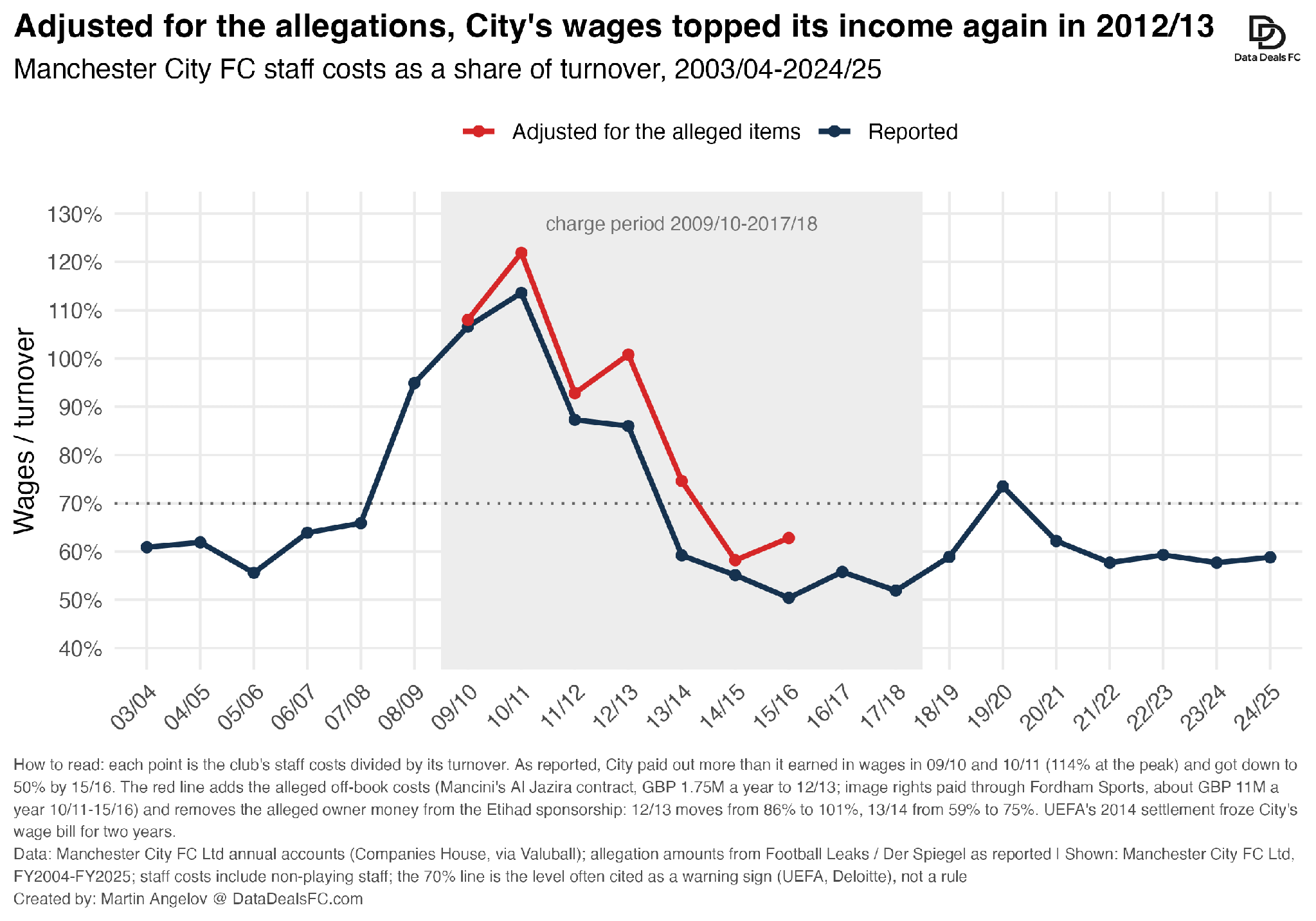
The dark line is City as reported. In 2010/11 the club spent 114% of its turnover on wages: it paid out more in salaries than it earned in total. By 2015/16 the ratio was down to 50%, which on paper is
One of the fastest financial turnarounds any Premier League club has ever managed.
The red line applies the allegations: it removes the alleged owner money from income and adds the alleged off-book payments to wages. In most years the difference is modest. In 2012/13 the ratio moves from 86% to 101%, and in 2013/14 from 59% to 75%.
Those are also exactly the years UEFA was assessing. In May 2014 it fined City €60M (about £49M), with €40M suspended, limited their Champions League squad to 21 players and froze their wage bill for two years. The cost shows up in City’s 2013/14 accounts as a £16.3M settlement with UEFA.
The second place the pattern shows up is the bottom line.
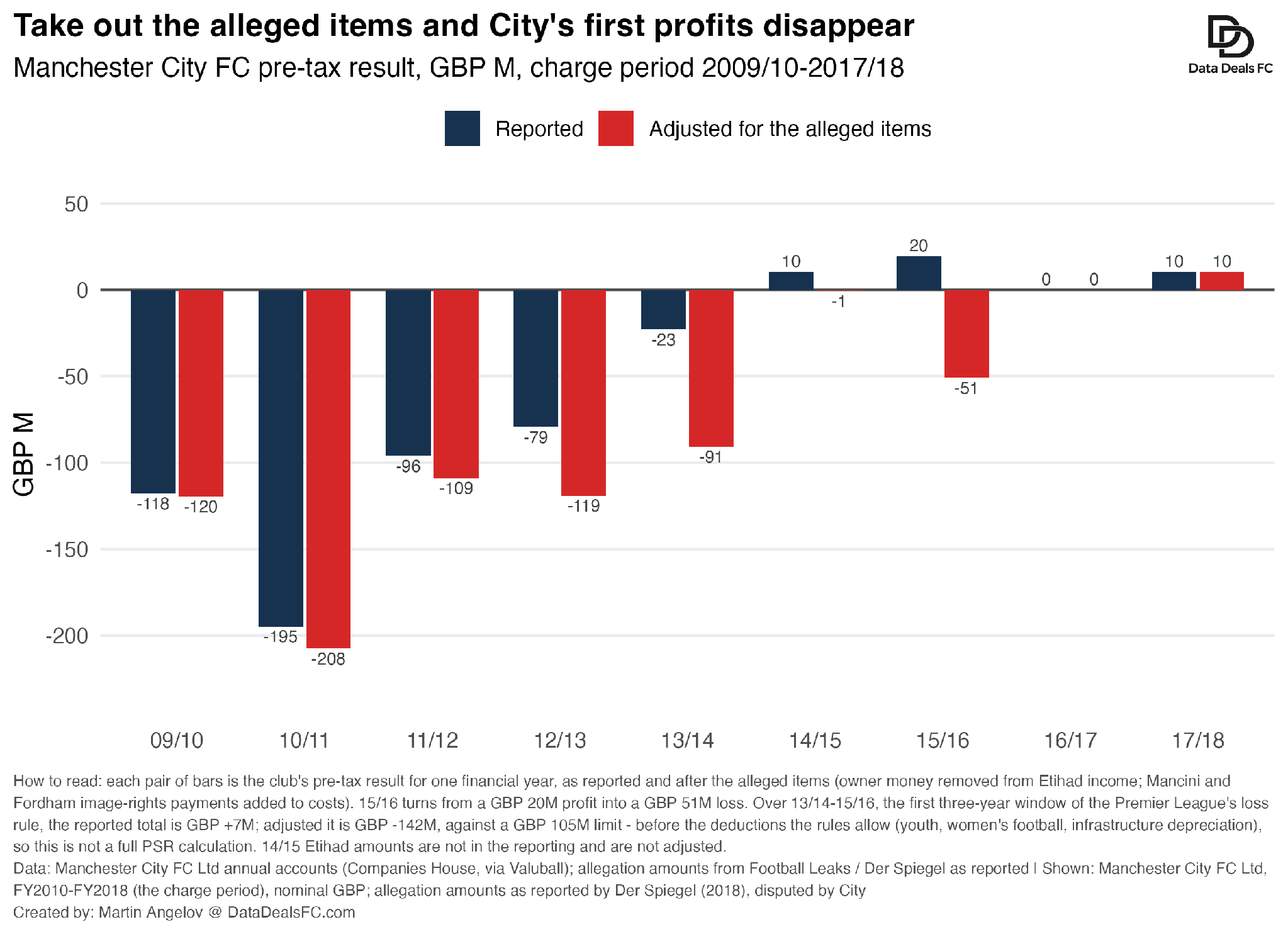
The early years (09/10 to 11/12) barely change. City lost between £100M and £200M a year after the takeover, openly, and that was never the allegation. The years that change are the ones that looked like the turnaround. In 2015/16, a reported pre-tax profit of £20M becomes a loss of £51M.
The most telling comparison is over three seasons, because the Premier League’s rule is a three-year test. Over 2013/14 to 2015/16, the first window PSR assessed,
City reported a combined profit of £7M.
With the alleged items applied, the same three years show a loss of about £142M, against a permitted loss of £105M.
That comparison needs careful reading. The rules let clubs exclude certain spending before testing the limit, including youth development, women’s football and the depreciation of stadiums and training facilities. Those figures are not in the published accounts, so I have not applied them, and with them City’s adjusted loss could come back under £105M. This is not a PSR calculation and should not be quoted as one.
What it does show is how the charges connect. The PSR and UEFA charges are not separate accusations of overspending. They follow from the accounting ones:
A small reported profit becomes a large loss once the alleged items are put back where they belong.
8. Why the owner’s money is not the offence
Much of the commentary treats Sheikh Mansour’s investment as the scandal. Under the rules, it is not. An owner is allowed to put money into a club. The rules only limit how much of it can be used to cover losses.
City’s accounts show exactly how much the owner put in.
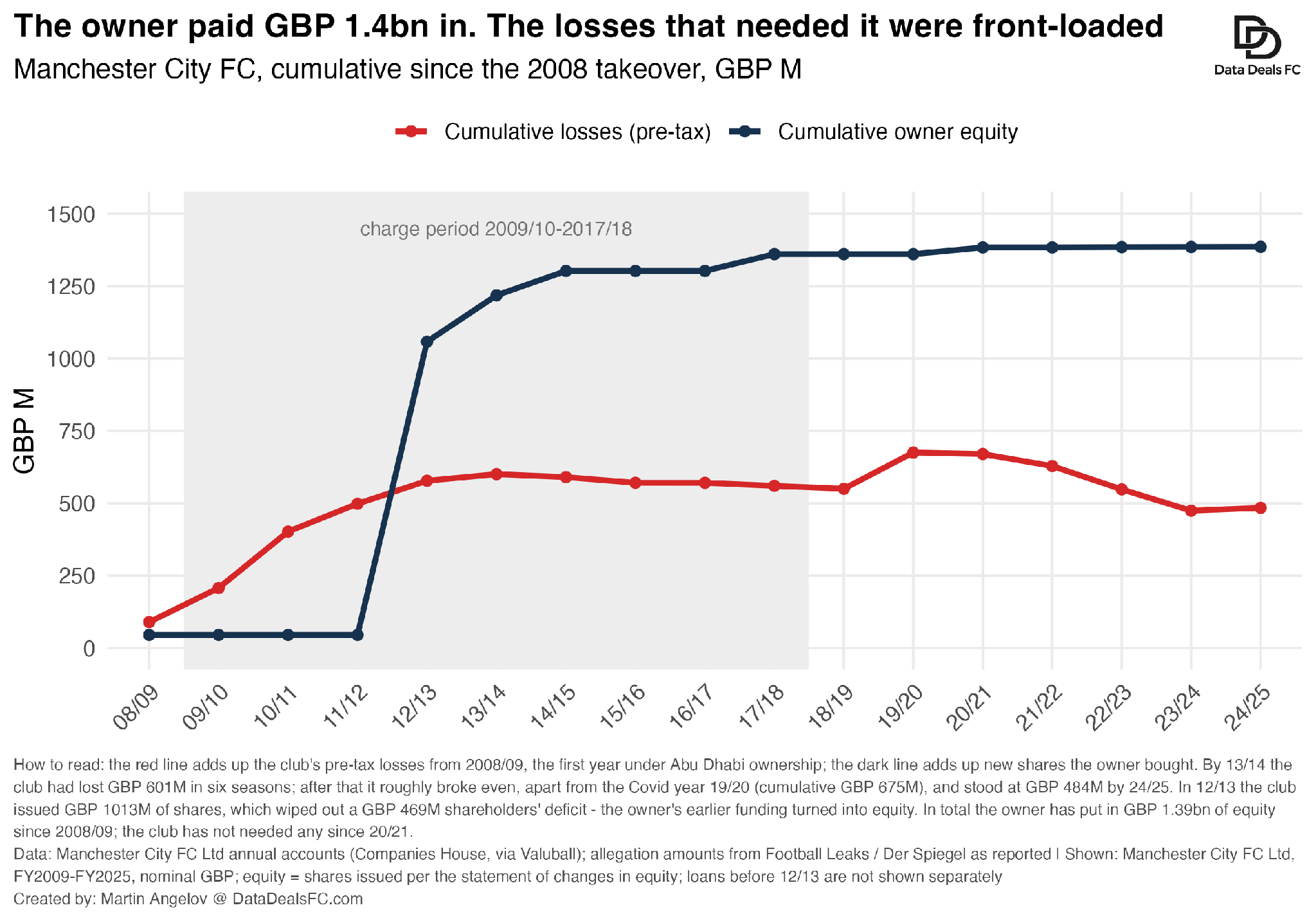
In the six seasons after the takeover, City lost £601M before tax. The owner covered it, first with loans and then, in 2012/13 and 2013/14, by converting £1.17bn of those loans into shares (the blue line that sky-rockets on the figure). In total the owner has put £1.39bn of equity into the club since 2008.
After 2014 the losses stop growing (the red line in the figure above). Apart from the Covid season, the club has roughly broken even for a decade and has not needed new equity since 2020/21.
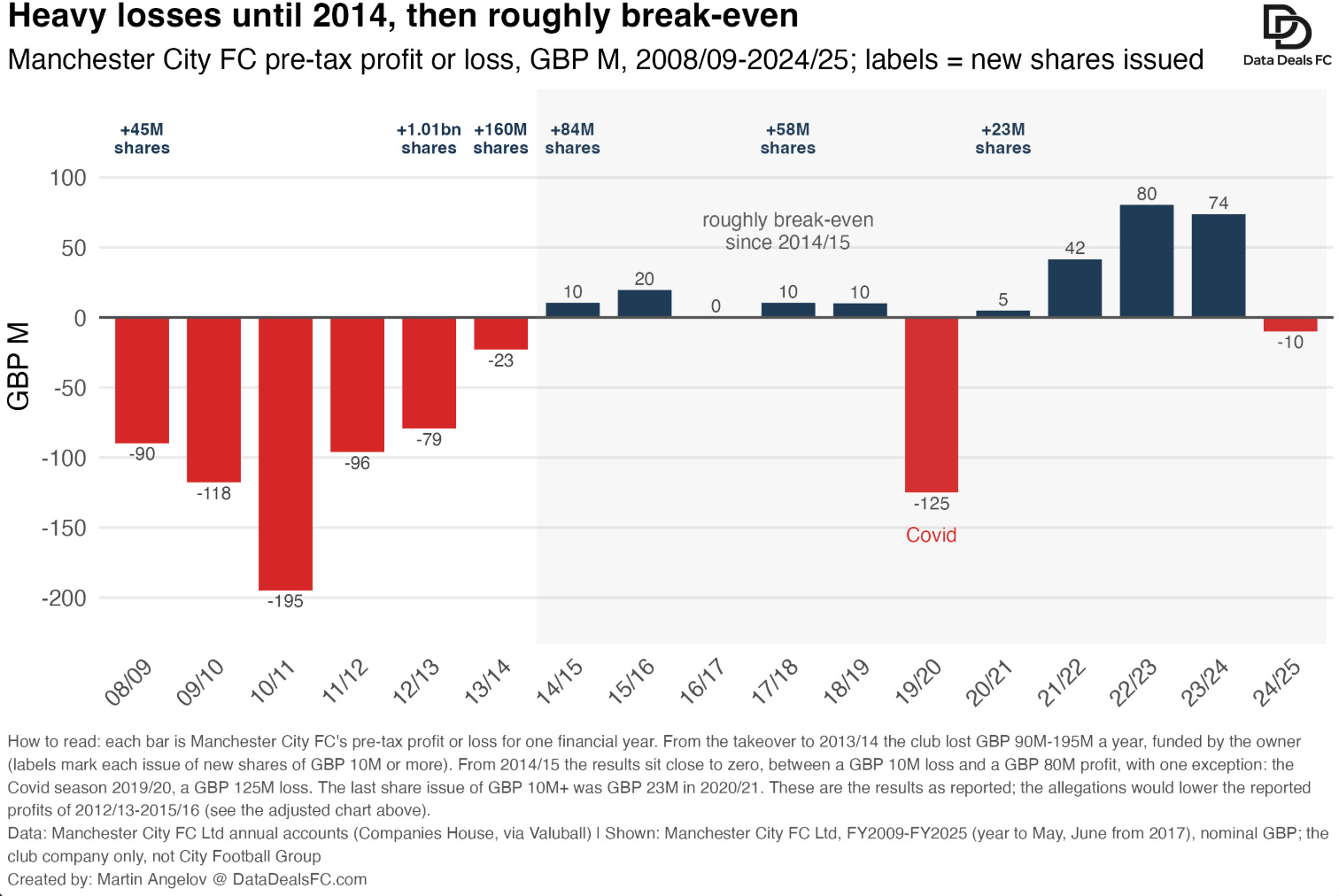
All of that was disclosed, and none of it is charged. The allegation is narrower, and in a sense more serious, that
On top of the declared investment, more owner money arrived labelled as something else.
9. The cooperation charges
The last group, 35 charges, has nothing to do with money. It concerns how City responded to the investigation between December 2018 and February 2023.
The Premier League’s rules oblige clubs to cooperate with its inquiries: to provide documents, answer questions and act in good faith. The charges allege City did not.
There is a precedent. In 2020 CAS upheld the €10M fine against City for obstructing UEFA’s investigation, and was scathing about the club’s conduct even as it lifted the ban. And one of the leaked emails, from City’s head of legal in 2014, reportedly said
The chairman (Khaldoon Al Mubarak) would rather spend £30M on the 50 best lawyers in the world, suing for 10 years, than accept a sanction.
12 years later, the case is still ongoing.
These charges matter for two reasons.
They carry their own sanctions, independent of the financial findings.
And they help explain why the process took so long.
10. What happens next
Quite a lot, and slowly.
The sanction. The panel has found City guilty but has not yet decided the punishment. Under the Premier League’s rule W.51 it can impose anything from a reprimand or a fine to a points deduction or expulsion, and it can combine them. Most lawyers expect any points deduction to be applied going forward rather than by stripping past titles.
The appeal. City are expected to appeal, as they did successfully against UEFA in 2020.
The decision itself. The panel’s reasons have to be published, but both sides can argue over what is released and what is redacted. Until then, nobody outside the case knows which amounts the panel accepted, whether it found the same pattern in years the leaks did not cover, or which single charge failed.
The timetable. People close to the case have told The Athletic they would be surprised if all of this took less than another year.
And then the claims. Several Premier League clubs have reportedly instructed lawyers to assess whether they can claim compensation for places, prize money and Champions League income they lost to City. That is not a fantasy.
In June, a Premier League commission ordered Everton to pay Burnley £35M because Everton’s rule-breaking had kept them up at Burnley’s expense.
How that case was won, step by step, is the subject of Part 2 of the City files coming up shortly.
How other clubs such as Arsenal, Liverpool, Man United and Tottenham can claim their damages will be covered in Parts 3-6 of the series, including detailed break-downs of the likely amounts to be claimed.
To conclude
Three ideas make the whole case easier to understand.
The money is not the issue; the label is. The same £60M counts as income if a sponsor pays it and as owner funding if the owner does. Football’s financial rules depend entirely on that distinction, which is why the charges focus on whether City’s accounts described their money accurately.
The alleged items are small relative to City and large relative to the rules. A few tens of millions a year would not change how big the club was. On City’s own figures, it could change whether a reported profit was really a nine-figure loss.
“115” is a count of rules and seasons, not of schemes. Underneath it are a small number of alleged practices, one accounting consequence and one long dispute about cooperation. Once you see that structure, the rest of the case follows.
For an even more beginner-friendly review and a selection of the most interesting leaked documents follow the magic hat 🎩

Boom — that was my resume of Man City’s 115 Charges, explained in plain English.
In Part 2, we’ll move from what City did to what their rivals can do about it. We will take apart the 2026 Burnley v Everton case, the precedent that could prove most dangerous (money-wise) for City: the exact methods and reasoning a Premier League tribunal used to make one club pay another for breaking the financial rules, and that City's competitors can now use to seek follow-on damages of their own.
Thank you for reading until the end ❤️
I hope you enjoyed reading this article as much as I enjoyed putting it together.
Talk soon,
Martin
PS. If you enjoyed this piece, you might also enjoy how Kevin De Bruyne used data scientists to negotiate his City contract and how City used a data science technique to find De Bruyne’s replacement.
P.P.S. If a tailor-made report (such as the one I did on Kai Havertz’s contract negotiation) is what interests you, drop me a line.
This post was AI-assisted. The AI was paid entirely by me, and I can confirm none of it came from a related party.
Sources: Manchester City FC Ltd annual accounts (via Valuball.co), FY2004-FY2025 (Companies House, company 40946 via Valuball), including the notes on other operating income (FY2012 and FY2013), share issues (FY2013 and FY2014) and the UEFA settlement (FY2014). Allegation amounts: Der Spiegel / Football Leaks (2018), as reported by The Athletic, Sports Illustrated, the Irish Times and others, and UEFA’s 2020 findings as reported by Sky Sports; all disputed by City. CAS 2020/A/6785 (July 2020). Charges: Premier League statement of 6 February 2023, as widely reported. Verdict, timeline and next steps: The Athletic (David Ornstein; Philip Buckingham; Jacob Whitehead; Oliver Kay), 25-26 September 2026. UEFA settlement: ITV News, 16 May 2014. The adjusted figures apply the reported allegation amounts to City’s published accounts; they illustrate the allegations and are not a PSR or UEFA calculation.